Short answer
A practical sleepwear elastic and trim specification checklist for sourcing managers preparing RFQs for pajama sets, camisoles, nightgowns, robes, lounge sets, and private-label sleepwear. Covers waistband elastic, lace, binding, drawcords, labels, packaging trims, component MOQ, measurable tolerances, sample gates, QC checks, compliance documents, and supplier wording that reduces quotation gaps.
Key takeaways
What buyers should remember
- Use a sleepwear elastic and trim specification checklist before sampling, not after the first fit round. Waistband elastic, lace, binding, drawcords, buttons, labels, hangtags, stickers, polybags, and carton labels can each carry separate MOQ, lead time, artwork approval, and substitution risk.
- Quote trim by component, not as one garment allowance. A private-label pajama set with stock encased elastic is not directly comparable with one using custom jacquard elastic, dyed lace, branded heat-transfer labels, and retailer barcode packaging.
- A sleepwear trim spec needs measurable fields: material, width, length per garment, placement, sewing method, relaxed measurement, extended measurement if used, tolerance, shade standard, sample approval status, and substitution rule.
- Do not release bulk cutting from a fit sample that used substitute elastic, substitute lace, temporary labels, or placeholder packaging. Approve the fit direction only and keep trim approval open.
- Most sleepwear trim failures are comfort or wash issues: rolling waistbands, tight elastic, scratchy lace, peeling heat-transfer labels, twisting drawcords, loose cord tips, uneven binding tension, and creased exposed elastic after packing.
- Ask suppliers to return RFQ tables with trim MOQ, unit price, wastage allowance, sample lead time, bulk lead time, document availability, carton dimensions, gross weight, net weight, CBM, and critical-path notes.
Buyer comparison table
Evidence Basis and Scope
Byline: Vincent Xi, Editorial Author. Author profile: https://velora-intimates.com/authors/vincent-xi/. The approved author basis identifies the named author and role; it does not add claims about factory visits, testing history, client work, certifications, awards, or production capacity.
This sleepwear elastic and trim specification checklist is for buyers preparing an RFQ for pajama sets, camisole-and-short sets, nightgowns, robes, lounge sets, and sleep separates. It covers elastic, lace, binding, drawcords, buttons, snaps, sliders, rings, labels, thread, hangtags, polybags, stickers, carton labels, tolerances, sample gates, QC checkpoints, and document requests.
Methodology: the checklist was built from common apparel RFQ fields, tech-pack measurement practice, final-inspection checkpoints, and public source contexts. Source context 1: ISO 3758:2023, the 2023 edition of the International Organization for Standardization care-labelling symbol standard. Source context 2: U.S. Federal Trade Commission textile labelling rules at 16 CFR Part 303, used as a 2026 regulatory reference for covered U.S.-bound textile products.
Limitations: this article is a sourcing checklist, not a legal opinion, retailer manual, certificate review, or laboratory test report. Before bulk approval, verify current destination-market rules, the retailer's routing guide, fabric and trim data sheets, test reports, restricted-substance documents, fiber-content reports, color fastness reports, barcode files, carton strength needs, and any certificate scope claimed by the supplier.
- Data point: ISO 3758:2023 is the 2023 edition of ISO's care-labelling symbol standard; use it only where the destination market and retailer accept ISO care symbols.
- Data point: U.S. FTC textile labelling rules are codified at 16 CFR Part 303; for covered U.S.-bound textile products, verify fiber content, country of origin, and manufacturer or dealer identity labelling before shipment.
- Example calculation to verify in the supplier quote: if 1 adult pajama set uses 0.72 meter of 25 millimeter waistband elastic and the order is 1,200 sets, base elastic consumption is 864 meters; with an assumed 5 percent cutting and handling wastage, planning consumption becomes 907.2 meters.
- Example carton calculation to verify by packing trial: a carton measuring 60 centimeters by 40 centimeters by 35 centimeters has a gross outside volume of 0.084 cubic meter before carton-wall thickness, void space, compression limits, and weight limits are considered.
Start With the Buying Risk
If the buyer's main risk is cost comparison, require each supplier to quote the same trim construction. A sleep short priced with stock 20 millimeter elastic cannot be compared fairly with one priced with custom 30 millimeter jacquard elastic.
If the buyer's main risk is launch timing, ask which trim controls the calendar before the first sample is made. Custom jacquard elastic, dyed lace, heat-transfer labels, metal cord tips, branded hangtags, and retailer barcode stickers can all sit outside the garment sewing lead time.
If the buyer's main risk is returns, focus the sleepwear elastic specification on comfort and laundering. Rolling elastic, scratchy lace, peeling labels, twisting drawcords, and hard cord tips cause more sleepwear complaints than small decorative differences.
If the buyer's main risk is low MOQ sleepwear sourcing, separate stock trim options from custom trim options early. Low garment MOQ is only useful when elastic, lace, labels, hangtags, polybags, and carton labels can also be sourced at workable component minimums.
- Request component-level price, MOQ, and lead time in the RFQ.
- State whether trims must be stock, custom dyed, custom branded, or open to approved alternatives.
- Require written approval for any elastic, lace, drawcord, label, thread, hardware, hangtag, sticker, polybag, or carton-label substitution.
- Keep a trim-card version number on the quotation, sample comments, purchase order, and inspection file.
Component Map Before Sampling
Map trims by placement before requesting a price. List waistband, neckline, armhole, hem, placket, cuff, pocket edge, side seam, shoulder strap, bow, drawcord channel, button, snap, ring, slider, belt loop, internal tie, hanger loop, brand label, care label, hangtag, polybag sticker, and carton label.
For sets, map the top and bottom separately. A camisole may need fold-over elastic, strap sliders, and lace at the neckline, while the matching short may need encased waistband elastic, drawcords, and a different label placement.
Tie each trim to a buyer decision. Retail programs need barcode accuracy and routing-guide compliance. Hospitality programs need laundering performance. Boutique brands may spend more on lace handfeel. Distributors usually need repeatable trims, clear carton marks, and low substitution risk.
For better supplier comparison, treat this as a pajama trim specification, not only a design worksheet. Each component should have a cost field, approval gate, inspection method, and reorder rule.
- Waistband: elastic type, width in millimeters, relaxed length by size, extension rule, recovery check, waistband height, topstitch method, and rolling limit.
- Neckline and armhole: binding type, visible width, tension requirement, seam allowance, waviness limit, and shade standard.
- Lace: composition, width in millimeters, edge profile, stretch direction, motif repeat, placement from garment edge, handfeel review, and wash requirement.
- Drawcord: material, diameter or width, finished length, tip type, channel opening, exit position, bartack location, and pull check.
- Labels: label type, dimensions in millimeters, placement, legal content, language, fiber content, care symbols, country of origin, and barcode if required.
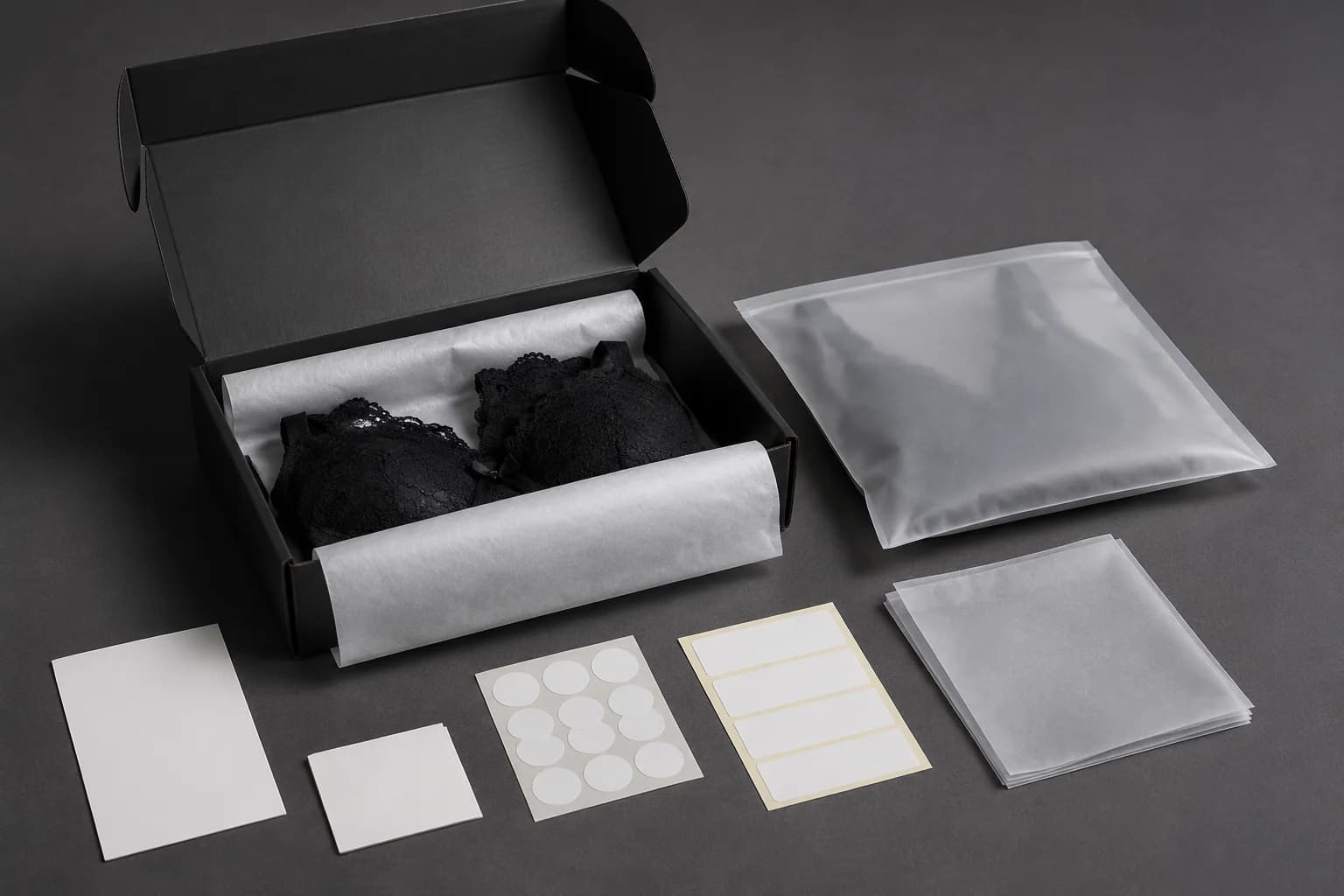
- Packaging trims: hangtag, tissue if used, polybag, warning statement where required, size sticker, barcode sticker, carton mark, and retailer routing label.
RFQ Clauses to Copy
Use the RFQ to make assumptions visible. Ask the supplier to price the garment only after listing every trim component, its MOQ, its lead time, and whether it is stock or custom.
When design is not final, ask for two options. Price one version with low-risk stock trims and one version with branded or custom trims. This shows the cost and calendar effect before the buyer approves the look.
Do not leave packaging until the purchase order stage. Carton size, polybag dimensions, barcode labels, folding method, and routing labels can change both freight cost and retail compliance risk.
Use exact wording for sleepwear trim MOQ questions. Ask whether the MOQ is counted by style, color, width, artwork, yarn color, lace pattern, supplier item code, or purchase order.
- Quote FOB unit price for Option A using stock encased elastic and stock lace, and Option B using custom jacquard elastic and custom-dyed lace. Show garment MOQ, trim MOQ, lead time, and price difference for each option.
- List each trim component with material, width, color, length per garment, MOQ, wastage allowance, sample lead time, bulk lead time, and stock or custom status.
- State all quotation assumptions, including substitute trims, testing fees, sample charges, courier fees, hangtag printing, barcode stickers, carton marks, and special packing.
- No trim substitution is permitted without buyer written approval. If an approved trim becomes unavailable, provide photos, a physical swatch where needed, cost impact, lead-time impact, and risk note before use.
- Provide estimated carton dimensions in centimeters, units per carton, gross weight in kilograms, net weight in kilograms, and CBM. Confirm final carton count by packing trial using approved trims.
- Mark any critical-path item, including custom elastic strike-off, lace lab dip, heat-transfer label testing, metal tip sourcing, compliance testing, or retailer label approval.
MOQ Questions That Change the Order
Ask for MOQ at garment level and trim level. A factory may accept the sewing order while the elastic, lace, label, hangtag, or carton supplier still requires a higher component minimum.
Separate stock trims from custom trims in the quotation. Stock white, black, nude, grey, or navy elastic may support smaller runs when width and handfeel are already available. Dyed-to-match elastic or lace needs lab dip approval and may create leftover trim liability.
Use planning numbers only as assumptions until the supplier confirms. Example to verify in the supplier quote: an adult private-label sleepwear launch at 300 to 600 sets per color may be feasible when fabric, elastic, lace, labels, and packaging are all available from stock or low-MOQ sources. Custom jacquard elastic or custom-dyed lace may move practical planning toward 1,000 to 3,000 sets per color because component MOQ can exceed garment MOQ.
Split sample lead time from bulk trim lead time. Example to verify in the supplier quote: fit sample sewing may take 7 to 10 calendar days after materials arrive, custom elastic strike-off may take 10 to 14 calendar days after artwork approval, and bulk dyed trim may take 15 to 25 calendar days after lab dip approval. The longest approved trim path should be shown on the production calendar.
For a low MOQ pajama set order, ask whether the supplier can use common elastic widths, existing lace patterns, shared thread colors, standard woven labels, and unbranded carton labels. Those choices often matter more than the stated garment MOQ.
- Ask for garment MOQ by style, color, and size ratio.
- Ask for elastic MOQ by width, color, composition, construction, and logo pattern.
- Ask for lace MOQ by design, width, color, and dye method.
- Ask for label MOQ by woven label, printed label, heat-transfer label, hangtag, and barcode sticker.
- Ask whether MOQ is counted by style, color, artwork, width, trim supplier item code, or purchase order.
- Ask who owns leftover custom trims after production and how they will be stored, invoiced, or disposed of.
Elastic Fields That Prevent Fit Disputes
Specify elastic for the body and the wearer, not only for the trim drawer. State elastic type, construction, width, relaxed elastic length by size, finished waist measurement, extended measurement if used, recovery expectation, channel height, stitch type, and whether the elastic is tacked, topstitched, coverstitched, or floating inside the channel.
Check elastic behavior before approving the fit. Two 25 millimeter elastics can feel different if one is firm braided elastic and the other is soft knitted elastic. Ask for relaxed and stretched swatches plus the sample garment.
For exposed elastic, control the visible details. Include face yarn color, back yarn color, edge softness, logo repeat, pattern direction, join position, and shade approval. For encased elastic, inspect twisting, rolling, tunnelling, seam bulk, and recovery after wash.
Use the approved sample to set tolerances. Example values to verify: for an adult women's size M sleep short, relaxed waistband measurement may be 36.0 centimeters with a tolerance of plus or minus 1.0 centimeter; finished elastic width may be 25 millimeters with a tolerance of plus or minus 1 millimeter; finished drawcord length may be 120 centimeters with a tolerance of plus or minus 2 centimeters. Final values should match the approved fit sample and grade rule.
Check the full size range. A waistband that works on size M can be loose on XS or tight on XL if the elastic length is graded mechanically. Size-set review matters for plus sizes, maternity sleepwear, teen sleepwear, relaxed unisex fits, and wholesale assortments.
Use the phrase elastic waistband tolerance for sleepwear in the internal tech pack if that is the buyer's inspection concern. It helps pattern, sample, QC, and purchasing teams discuss the same measurable field.
- Record relaxed waistband measurement by size in centimeters.
- Record extended waistband measurement only if the buyer will inspect it consistently.
- Record elastic width in millimeters and finished waistband height in centimeters.
- State the measurement condition: relaxed flat, extended flat, folded, or worn on form.
- Check rolling, twisting, tunnelling, seam bulk, scratchiness, edge bite, and recovery after wash.
- State whether the elastic may be substituted by construction, width, color, or supplier item code.
Lace, Binding, Drawcords, Hardware, Labels
Approve lace by skin contact first. Ask for composition, width, stretch direction, edge profile, motif repeat, thickness, shade standard, placement, seam allowance, and wash requirement. A trim that looks acceptable on a table may fail once it sits against bare skin for a full night.
Approve binding by tension. Fold-over elastic can clean up camisole necklines and armholes, but high or low tension creates waviness. Self-fabric binding may feel softer, but it can grow after wash if fabric recovery is weak. Picot elastic needs an edge-irritation check and a channel-fit decision.
Approve drawcords by function and safety review. Specify material, diameter or width, end finish, finished length, channel width, exit position, and bartack method. Metal tips can add perceived value but may create tumble-dryer noise, compression marks, cost increases, and extra retailer review.
Approve buttons, snaps, rings, and sliders by attachment strength and skin contact. Robes, nursing sleepwear, camisoles, and pajama shirts need material, diameter, finish, color, corrosion risk, pull-strength requirement, spare-button policy, and placement checked before bulk.
Approve labels as comfort components and legal components. Woven neck labels can scratch. Side-seam care labels can twist. Heat-transfer labels can peel if the chemistry and fabric finish are mismatched. For covered U.S.-bound textile products, FTC rules at 16 CFR Part 303 are a relevant source context for textile labelling; other markets need current local rules and retailer manuals.
For private-label sleepwear trims, keep artwork approvals separate from material approvals. A correct logo file does not approve the handfeel of a woven label, the adhesion of a heat-transfer label, or the shade of a dyed lace.
- For lace: approve handfeel, stretch, shade, width, edge softness, motif direction, seam behavior, and wash appearance.
- For binding: check visible width, tension, waviness, puckering, recovery, and shade match.
- For drawcords: inspect finished length, exit alignment, tip security, channel movement, and bartack position.
- For buttons and snaps: check diameter, color, attachment strength, corrosion risk, spare trim policy, and skin-contact comfort.
- For labels: verify legal content, language, dimensions, placement, print durability, comfort, barcode match, and country-of-origin wording.
Sample Gates for Trim Approval
The first gate is the trim card. It should hold actual elastic, lace, binding, drawcord, button, snap, ring, slider, label, thread, hangtag, sticker, polybag, and carton-label swatches where relevant. Photos are useful for tracking, but physical swatches are needed for handfeel, stretch, thickness, color, and edge softness.
The second gate is the fit sample. If the fit sample uses substitute elastic or temporary lace, approve only the pattern direction. Do not approve comfort, rolling behavior, final appearance, shade, or bulk cutting from that sample.
The third gate is the size set. Measure relaxed waistband, extended waistband if used, strap length, binding width, lace placement, drawcord length, label placement, button spacing, and set pairing across sizes.
The fourth gate is the pre-production sample. It should use bulk-intended fabric, bulk-intended trims, approved sewing method, final label content, final folding, polybag, and carton plan. If any trim is still pending, mark the sample conditional and record the cost and calendar risk.
The final gate is the sealed reference sample. Keep it available for factory QC, buyer review, and final inspection so the approved trims are not judged from memory or old photos.
- Trim card approval: component identity, shade, handfeel, width, source type, and version date.
- Fit sample approval: garment balance only when correct elastic and trims are used.
- Size-set approval: grade, elastic comfort, extension behavior, and trim placement across sizes.
- Pre-production sample approval: final fabric, trims, sewing, labels, folding, polybag, and carton plan.
- Sealed reference sample: comparison point for production and inspection.
Tolerance Table Fields
Write tolerances so an inspector can measure them without interpreting the design. Useful fields include component width, component length, placement from seam or edge, shade standard, seam allowance, stitch type, stitch density where relevant, and acceptable appearance after washing.
For waistbands, list relaxed waist, extended waist if used, elastic width, waistband height, topstitch distance, channel height, drawcord opening position, and drawcord length. For camisoles, list strap elastic width, strap finished length, slider placement, armhole binding visible width, neckline binding visible width, and lace depth.
For pajama shirts and robes, add trim points that often get missed. Pajama shirts need button diameter, button spacing, placket width, piping width, pocket placement, and collar label placement. Robes need belt width, belt length, loop position, internal tie length, and hanger loop strength.
Example tolerance set to verify against the approved sample: lace placement may be 2.0 centimeters from the hem edge with a tolerance of plus or minus 0.3 centimeter; neckline fold-over elastic visible width may be 8 millimeters with a tolerance of plus or minus 1 millimeter; woven label placement may be centered at back neck with a tolerance of plus or minus 0.5 centimeter. Adjust these values to the style, size range, and retailer manual.
Define the measurement method once. If relaxed waist is measured flat on a table, every inspector should use that method. If lace placement is measured from the scallop edge, stitching line, or folded hem edge, state the reference point in the tech pack.
For long-tail inspection searches such as pajama waistband elastic rolling or sleepwear lace placement tolerance, the useful answer is not a slogan. The answer is a measured field, a reference point, an accepted tolerance, and a sample that matches bulk trim.
- Use centimeters for garment measurements and millimeters for narrow trim widths where practical.
- Define reference points: seam edge, fold edge, stitching line, center back, side seam, or hem edge.
- Record the shade rule: exact match, approved contrast, or tonal match.
- State whether tolerance applies before wash, after wash, or both.
- Call out intentional asymmetry so QC does not reject the approved design.
QC Defects Specific to Sleepwear Trim
In-line QC should watch the sewing process. Check whether elastic is stretched evenly, binding tension is stable, lace edges curl, drawcord exits align, and bartacks are placed correctly before the same defect repeats across the lot.
End-line QC should touch the garment, not only measure it. Run a hand along lace and label edges, pull the waistband gently to check recovery, move the drawcord through the channel, open and close buttons or snaps, and inspect heat-transfer labels for cracking, poor adhesion, or off-center placement.
Bulk inspection should include packing effects. Exposed elastic can crease when folded sharply. Lace can snag on hangtags. Cord tips can press into lightweight jersey. Heat-transfer labels can mark or stick if packed before cooling.
Agree defect severity before inspection. A missing care label or wrong fiber-content label can block sale. A twisted internal elastic is usually a major comfort defect. A lace placement variation inside the agreed tolerance may be minor.
Treat standards as references, not proof of performance. If ISO 3758:2023 symbols appear on the care label, that means the label uses a care-symbol system; it does not prove that the garment passed a wash test. Verify that each test report matches the production style, fiber content, color, and trim set.
- Critical risks: missing legal label, wrong fiber content, unsafe drawcord, unapproved trim substitution, failed restricted-substance requirement.
- Major risks: rolling waistband, weak elastic recovery, scratchy lace, peeling heat transfer, broken drawcord tip, severe shade mismatch, skipped bartack.
- Minor risks: trim placement variation inside tolerance, removable loose thread, slight packaging wrinkle, minor shade variation accepted against the approved standard.
- Process risks: uneven sewing tension, mixed trim lots, wrong stitch type, incorrect heat-transfer temperature, unapproved label artwork, missing spare button.
- Retail risks: barcode mismatch, wrong size sticker, carton marking error, incorrect size ratio, poor folding, crushed trim during packing.
Documents to Request Without Overclaiming
Request documents by destination market, age group, fiber content, product classification, and retailer manual. Avoid broad words such as certified unless the supplier provides a current certificate with the correct product, material, factory, issuing body, issue date, validity date, and scope.
For adult sleepwear, common requests include fiber-content test reports, color fastness reports, dimensional stability or wash reports, restricted-substance declarations or test reports, care-label artwork approval, country-of-origin confirmation, and packaging compliance documents.
For U.S.-bound covered textile products, FTC rules at 16 CFR Part 303 are a relevant source context for fiber and identity labelling. For other markets, confirm current local textile labelling rules before printing labels or booking shipment.
For children's sleepwear, do not reuse the adult checklist. Flammability, drawstring, small-part, and age-grade requirements can be materially different. State the age range, selling country, product type, and classification before requesting test reports.
Name a standard only when it applies to the buyer's actual requirement. ISO 3758:2023 may support care-symbol communication where accepted. It does not certify the supplier, the fabric, the trim, or the finished garment.
- Request current documents, not verbal assurances.
- Check document scope before treating it as order evidence.
- Separate legal compliance from retailer-specific performance requirements.
- Ask who pays for new tests, failed retests, courier samples, and document amendments.
- Do not imply certification unless a current certificate has been reviewed and its scope matches the order.
Packing and Freight Decisions
Choose folding after the trim is approved. Wide exposed elastic can crease if folded too tightly. Lace can snag. Metal cord tips can mark jersey. Heat-transfer labels can stick or mark if garments are packed too soon after application.
Set the packaging specification before the purchase order. Define folding method, garment orientation, tissue if used, polybag dimensions, warning text where legally required, barcode sticker position, size sticker, carton assortment, carton dimensions, gross weight target, and master-carton rule.
Use packing trials for carton count. Example to verify: if 1 folded pajama set in a polybag measures 28 centimeters by 22 centimeters by 2.5 centimeters, and the planned carton measures 60 centimeters by 40 centimeters by 35 centimeters, a simple gross-volume estimate suggests up to 84 sets before compression limits, void space, carton-wall allowance, practical stacking, and weight limits. The final units per carton must come from a packing trial using approved trims.
Compare suppliers using the same logistics format. A lower unit price can disappear if carton utilization is poor or if retailer chargebacks arise from wrong carton marks, barcode labels, size ratios, or routing labels.
For sleepwear label and packaging specification, include the same approval discipline used for garment trims. A correct garment sample can still ship late if barcode labels, polybag size, warning text, carton marks, or retailer routing labels are incomplete.
- Run the packing trial after final elastic, lace, drawcords, labels, folding, and polybag are approved.
- Avoid sharp folds across exposed elastic, lace motifs, padded trims, heat transfers, and cord tips.
- Confirm polybag size from final folded measurement, not the first prototype.
- Ask for carton dimensions in centimeters, gross weight in kilograms, net weight in kilograms, CBM, and units per carton.
- Check retailer routing guides before printing carton marks, barcode labels, or purchase order labels.
Buyer Scenarios
Small private-label launch: use stock trims unless the supplier confirms custom trim MOQ and timing in writing. A 300 to 600 sets per color planning assumption only holds when fabric, elastic, lace, labels, and packaging are available from stock or low-MOQ sources.
Retail capsule: standardize where the customer will not notice the difference. Use the same elastic width and construction across styles where fit allows, limit lace widths, and keep label placement consistent. This reduces approval work and mixed-trim risk.
Distributor or wholesaler: prioritize durability and reorder clarity. Encased elastic, simple drawcords, durable labels, approved substitution rules, clear carton marks, and stable size assortments usually matter more than delicate trim detail.
Hospitality program: treat laundering performance as the design limit. Decorative lace and fragile heat transfers may be poor choices unless wash reports, label durability, seam strength, trim recovery, yellowing risk, and color-transfer review support the use case.
Premium boutique sleepwear: convert comfort claims into inspection criteria. Soft lace, brushed elastic, covered seams, and heat-transfer labels still need edge-softness review, adhesion checks, shade control, recovery checks, and repeat-order availability.
- Small launch: stock trims, low ambiguity, and fast sample correction.
- Retail capsule: standardized elastic, label placement, lace families, and packaging method.
- Wholesale program: durability, carton clarity, reorder consistency, and approved substitutions.
- Hospitality use: laundering performance, neutral trims, and low-maintenance labels.
- Premium boutique: handfeel, edge softness, shade control, and trim-card discipline.
Purchase Order Check
Before issuing the purchase order, compare the latest quotation, tech pack, trim card, sample comments, test requirements, and packing instructions line by line. Disputes often start when one document changes and another stays old.
Confirm that the quoted price includes the approved trims, not the earlier substitutes used for sampling. Check MOQ, wastage, overage, sample fees, courier fees, testing fees, packaging costs, hangtags, barcode stickers, carton labels, and routing requirements.
Lock approval gates in writing. Bulk cutting should wait until the required lab dips, trim cards, fit or pre-production samples, and documents reach the agreed approval stage. If the buyer chooses parallel production for timing reasons, record the accepted risk and the cost rule if a trim fails approval.
A good trim specification does not automatically make sleepwear more expensive. It makes quotations comparable, sample comments clearer, inspections more objective, and shipment risk easier to control.
- Match PO details against the approved sample, trim card, and latest quotation.
- Confirm all trim substitutions are closed, rejected, or formally accepted.
- Verify current compliance documents before shipment booking.
- Confirm carton plan through packing trial, not estimate only.
- Keep sealed samples available for factory QC and final inspection.
Visual Brief for Article Image
Create a realistic B2B procurement and QC desk scene for a sleepwear elastic and trim specification article. Show a flat lay of an adult women's pajama short and camisole sample in soft modal-cotton jersey, with exposed 25 millimeter waistband elastic, fold-over neckline elastic, narrow lace hem trim, drawcord with plain tips, woven label sample, heat-transfer care label swatch, thread cone, measuring tape, small caliper, trim card, polybag sample, and plain shipping carton mock-up.
Show procurement-relevant detail: elastic width being measured in millimeters, lace placement near the hem, relaxed waistband measurement across the garment, drawcord tips beside the channel opening, label placement swatches, and a folded polybag sample beside the carton. The scene should feel like a sourcing manager's working table, not a fashion campaign.
Use neutral daylight, a clean industrial table surface, accurate textile scale, realistic jersey drape, and clear material texture. Avoid visible brand logos, readable text, certificates, awards, people, watermarks, showroom styling, decorative clutter, and unrealistic machinery.
- Primary objects: pajama short, camisole, waistband elastic, fold-over elastic, lace trim, drawcord, labels, trim card, measuring tools, polybag, carton.
- QC focus: width measurement, placement tolerance, handfeel swatches, label placement, and packing trial.
- Avoid: logos, readable text, fake documents, people, certificates, awards, and impossible factory equipment.
Procurement checklist
Before you send the inquiry
Target quantity and replenishment plan
Tech pack, reference sample, or construction notes
Fabric, lace, elastic, and hardware preferences
Size range, grading rules, and fit tolerance
Private-label packaging and barcode needs
Destination market and compliance requirements
FAQ
What should a sleepwear elastic and trim specification checklist include for an RFQ?
It should list every elastic and trim component by placement, material, width, length per garment, color, sewing method, tolerance, MOQ, lead time, sample approval stage, test requirement, packaging effect, and approved substitution rule. Common items include waistband elastic, neckline or armhole binding, lace, drawcords, labels, buttons or snaps, thread, hangtags, polybags, stickers, and carton labels.
What MOQ should buyers expect for custom sleepwear elastic?
There is no universal MOQ. As an example planning assumption to verify in a supplier quote, stock trims may support adult sleepwear programs around 300 to 600 sets per color when other materials are available, while custom jacquard elastic or custom-dyed lace may push planning toward 1,000 to 3,000 sets per color. Ask for MOQ by elastic width, color, yarn, construction, logo pattern, and trim supplier.
How should elastic waistband tolerance for sleepwear be written in a tech pack?
Write elastic tolerance as measurable inspection fields: relaxed waistband length by size in centimeters, elastic width in millimeters, finished waistband height, topstitch distance, channel height, drawcord length, and placement from seams. State the measurement method, such as relaxed flat measurement or extended flat measurement.
Can a buyer approve bulk production if the fit sample used substitute elastic?
The buyer can approve pattern direction conditionally, but should not approve final comfort, recovery, shade, rolling behavior, or bulk cutting from a sample that used substitute elastic. The sample comment sheet should state that trim approval remains open and that a pre-production sample with bulk-intended trims is required.
Which samples should be approved before bulk sleepwear production?
Approve the trim card, fit sample, size-set sample, pre-production sample, and sealed bulk reference. The pre-production sample should use bulk-intended fabric, elastic, lace, labels, sewing method, folding, polybag, and carton plan. If any trim is still a substitute, mark the approval as conditional.
What compliance documents should be requested for sleepwear trims?
Request documents based on destination market, age group, fiber content, and retailer requirements. Common requests include fiber-content reports, color fastness reports, wash or dimensional stability reports, restricted-substance documents, care-label artwork approval, country-of-origin confirmation, and packaging compliance files. For U.S.-bound covered textile products, FTC rules under 16 CFR Part 303 are a relevant source context for textile labelling.
Related sourcing guides
P1 · b2b manufacturing guide
Best Lingerie Manufacturing Model for Startup Brands in 2026
Compare lingerie manufacturing models for startup brands in 2026. Learn how to evaluate MOQ, lead time, materials, QC, packaging, compl...
P1 · lingerie manufacturing
Best Lingerie Manufacturing Model for Startup Brands: How to Choose Without Overbuying
Compare wholesale, private label, ODM, OEM, and hybrid lingerie manufacturing models for startup brands. Includes MOQ checklist, lead t...
P1 · b2b manufacturing guide
Best Lingerie Manufacturing Model for Startup Brands: OEM vs Private Label vs Hybrid Guide
Compare OEM vs private label lingerie manufacturing for startup brands. Learn how to evaluate MOQ, lead time, cost, QC, packaging, comp...
P1 · b2b lingerie sourcing
Best Low MOQ Lingerie Products for Ecommerce Sellers in 2026: Top 5 Picks, Comparison Guide, Costs, MOQ, and RFQ Checklist
Compare Top 5 low MOQ lingerie products for ecommerce sellers in 2026. Review MOQ, cost drivers, lead time, packaging, QC, compliance d...