Short answer
A buyer-side guide to plus-size lingerie grading rules for ecommerce private label programs, covering fit bases, component-level POM grades, powernet and stretch-lace recovery, size-set sampling, MOQ, quality control, and SKU packing.
Key takeaways
What buyers should remember
- Fix the commercial size range, body chart, fit base, and pattern source before comparing private label lingerie quotations.
- Write grading rules by point of measure and component. Cup, underband, wing, strap, torso, gusset, waist, hip, and leg opening should not inherit one uniform increment.
- Put relaxed, extended, and recovery requirements in the tech pack wherever powernet, stretch lace, microfiber, elastic, or bonded fabric controls fit.
- Use risk-based size-set sample approval as a bulk-cutting gate for underwire, molded, longline, shaping, low-stretch lace, and torso-dependent lingerie.
- Separate garment MOQ, minimum color quantity, material minimums, sample timing, and bulk lead time from technical grading approval.
- Match the sewn-in size label, barcode, inner-bag label, carton mark, packing list, and ecommerce size chart before shipment release.
Buyer comparison table
Set the fit base for plus-size lingerie grading
Plus-size lingerie grading rules should be fixed before an ecommerce private label buyer compares supplier prices. A quotation developed from an existing straight-size block is not equivalent to one developed around a relevant plus-size fit sample, even when the sketch, color, and fabric description are identical.
For a hypothetical ecommerce range using size labels 1X through 5X, a buyer could nominate size label 2X as the fit base. This is an example size-run assumption for one private label program as of 2026-07-21, not a universal grading rule. Verify it in the supplier quotation against the brand body chart, intended customer, fit-model criteria, product category, and supplier pattern system before approval.
Ask the supplier to identify the pattern source. It may propose adapting an existing block, digitizing an approved reference sample, or developing a new base pattern. The answer affects development cost, confidence in adjacent sizes, ownership of pattern files, and the number of correction rounds likely to be needed.
The quotation should also state whether grading is included and which deliverables will be supplied. Useful deliverables can include a grade-rule table, point-of-measure chart, nested graded pattern, size-set measurement report, and final production tech pack. Do not assume these files are included merely because the quotation refers to sample development.
- Commercial size labels and planned quantity by size, color, and SKU
- Fit base size and documented reason for selecting it
- Brand body chart and garment measurement chart
- Pattern source, file format, ownership, and revision status
- Point-of-measure codes and grade increments between adjacent size labels
- Sizes where cups, wires, elastics, closures, linings, gussets, or panels change
- Required grading files and written approval gate before bulk cutting
Write separate grading rules for bras, briefs, and bodysuits
A plus-size lingerie tech pack should not express the grade only as added bust, waist, or hip circumference. Lingerie fit depends on where tension and support are carried. The grade-rule table must show how pressure-sensitive and load-bearing components change, not only how the overall garment becomes wider.
For a plus-size bra grading specification, request underband relaxed length, underband extended length, wing height, cup height, cup width, neckline length, strap placement, strap adjustment range, closure dimensions, and gore or cradle measurements where applicable. The supplier should identify any transition in cup construction, wire, lining, elastic strength, strap width, hook-and-eye depth, or reinforcement.
For bralettes, alpha size labels can conceal important cup-and-band assumptions. Ask whether each label uses one cup volume, a flexible cup range, or separate internal pattern combinations. Confirm how neckline coverage, sling position, side support, and underband tension change across the proposed size curve.
For plus-size bodysuit grading, horizontal increments are only part of the decision. Include shoulder-to-gusset length, front and back rise, torso length, strap range, gusset width, snap position, and leg-opening extension. A wider pattern with an unchanged vertical grade can still pull at the shoulder, neckline, crotch, or gusset.
Briefs need separate controls for waist, high hip, full hip, front rise, back rise, gusset width, and leg opening. Applying the hip increment to every point can leave the waistband loose or the leg opening tight. Ask the supplier to explain the relationship between these POMs and support it with size-set samples.
- Band and wing: relaxed length, extended length, wing height, elastic specification, closure row, and closure position
- Cup and neckline: height, width, coverage line, lining, sling, wire channel, and available mold or wire range
- Strap: width, total length, usable adjustment range, attachment position, slider, ring, and reinforcement
- Torso: shoulder-to-gusset, body length, front rise, back rise, gusset width, and snap placement
- Lower body: waist, high hip, full hip, rise, gusset, and leg opening in the required measurement states
- Pattern review: nested grade, seam lines, notches, grain direction, stretch direction, and size-dependent pieces
Control powernet, stretch lace, and elastic by test state
A customer-facing size chart cannot replace production garment measurements. The manufacturing POM table should state the base value, adjacent-size grade, tolerance, measurement path, setup condition, and whether the garment is measured relaxed, extended, or after recovery.
For a hypothetical high-waist stretch-mesh brief, assume a total relaxed hip grade of 5.0 centimeters between adjacent size labels. This 5.0-centimeter value is an example buyer-side calculation for that garment and POM as of 2026-07-21, not an industry requirement. Verify whether the supplier records total-circumference or laid-flat measurements in its quotation, graded pattern, physical size set, and final tech pack.
Tolerance should follow function and measurement repeatability. For one hypothetical plus-size bra tech-pack draft, a buyer might begin with a +/- 1.0-centimeter tolerance for total relaxed underband length. For one hypothetical brief draft, the buyer might begin with +/- 1.5 centimeters at total relaxed hip. These are example assumptions for the named garment areas as of 2026-07-21 and must be verified against the supplier's measurement method, approved samples, material behavior, quotation, and inspection plan.
Fiber content alone does not predict fit. Nylon-elastane powernet, stretch lace, microfiber jersey, plush-back elastic, and bonded fabric can differ in extension force, directional stretch, recovery, thickness, shrinkage, edge curl, and seam behavior even when their descriptions appear similar.
For recovery testing, define the procedure before production. State the starting measurement, extension point, hold period, rest period, remeasurement point, setup condition, and permitted residual growth. A request for good recovery without a written method allows sampling, production, and inspection teams to apply different criteria.
- POM code and plain-language description
- Diagram showing the exact measurement path
- Base-size garment measurement and adjacent-size grade
- Total or half-garment measurement convention
- Relaxed, extended, and post-recovery values where relevant
- Tolerance by garment area and measurement state
- Recovery method and buyer-defined acceptance limit
- Closure row, strap position, snap status, or other setup condition
Approve risk-based lingerie size-set samples
A soft stretch brief does not need the same sample sequence as an underwire bra, molded bralette, longline bustier, or shaping bodysuit. Set lingerie size-set sample approval according to material rigidity, support load, cup construction, torso dependency, closure complexity, and the width of the commercial size range.
Typical control points include a development sample, an approved fit-base sample, any required correction sample, risk-sensitive size-set samples, and a pre-production sample made with confirmed bulk materials. Select the smallest, base, largest, or other transition sizes according to the style rather than requesting samples without a stated decision purpose.
Request extra evidence around component transitions. A new wire, mold, hook-and-eye depth, strap width, gusset shape, lining panel, or elastic specification can make a middle size more technically significant than an endpoint. Mark each transition clearly in the grade-rule table and sample request.
Connect every approval to a controlled document. The measurement report should identify the sample version, size label, material status, measured values, deviations, fitting comments, and unresolved actions. Product photographs can support the approval record but cannot replace measurements, construction review, or fit assessment.
Keep appearance approval separate from technical production approval. A buyer can approve color, scallop placement, and trim position while rejecting underband tension or torso length. Bulk cutting should begin only after the purchase order's named technical gate has been cleared in writing.
- Development sample: silhouette, construction sequence, and material direction
- Fit-base sample: measurements, balance, pressure points, coverage, and adjustability
- Correction sample: closure of named fit, measurement, or construction issues
- Size-set samples: physical evidence that the proposed grade works away from the base
- Transition-size sample: confirmation of any new wire, mold, closure, panel, elastic, or reinforcement
- Pre-production sample: bulk materials, final labels, barcode placement, folding, and workmanship standard
Separate plus-size lingerie MOQ from fit approval
A plus-size lingerie MOQ can affect the available size curve, but it cannot validate the grade. Fabric, lace, dyed elastic, hook-and-eye tape, straps, hardware, labels, and packaging may each have a separate minimum. Ask for garment MOQ, minimum color quantity, and material or trim minimums as separate quotation fields.
A low advertised MOQ is not meaningful until the supplier confirms how it applies. It may refer to the style total, one color, one fabric booking, one size curve, or one packaging version. The quotation should also show whether upper sizes carry different material consumption, marker efficiency, component, labor, or packing costs.
For one hypothetical early-stage ecommerce program, a buyer could request quotations at 300 to 600 pieces per color per style. This unit range is an example RFQ assumption for one style, one color, and one proposed size curve as of 2026-07-21. It is not a Velora Intimates commitment and must be verified in the supplier quotation against fabric, dyeing, lace, elastic, trim, label, packaging, and production minimums.
A development calendar should be divided by approval stage. For one hypothetical private label style, an initial development sample may be budgeted at 7 to 14 calendar days, selected size-set samples at a further 10 to 20 calendar days after consolidated fit comments, and bulk production at 35 to 60 calendar days after technical approval and material readiness. These ranges are buyer-side planning assumptions for that program as of 2026-07-21 and must be replaced by written dates in the supplier quotation and purchase order.
Use separate signoffs for commercial terms and technical readiness. Commercial approval covers price, quantity, payment, Incoterm, packaging cost, and delivery window. Technical approval covers pattern, grade, materials, measurements, construction, labels, sample status, and permission to cut bulk material.
- Garment MOQ by style, color, size curve, and packaging version
- Minimum color quantity for custom-dyed fabric, lace, elastic, or trim
- Material and trim minimums that exceed the garment order
- Size-dependent fabric consumption, marker, component, labor, and packaging surcharges
- Sample charges, courier charges, included correction rounds, and pattern fees
- Development, size-set, pre-production, bulk, inspection, and ex-factory timing
- Material-readiness and approval conditions that start the production calendar
Lock bulk materials and sewing construction before grading approval
A grade approved in substitute mesh is not automatically valid in bulk stretch lace, powernet, microfiber, satin, or bonded fabric. Stretch direction, extension force, recovery, thickness, shrinkage, surface friction, and seam behavior can change fit even when the fiber description appears similar. Record whether every sample uses substitute, production-intent, or confirmed bulk material.
Elastic and closure specifications require separate approval. Wider or firmer elastic may improve stability in upper sizes but can also change pressure, appearance, seam feeding, and garment measurements. The supplier should state whether the complete size range uses the same waistband, underband, strap elastic, hook-and-eye tape, closure row, and elastic application tension.
Sewing construction can alter the effective grade. Seam allowance, overlock bite, coverstitch width, zigzag setting, differential feed, elastic tension, binding tension, bar tacks, and reinforcement layers should match the approved sample. A correct paper pattern can still produce a different garment when these production settings change.
Molded cups, underwires, and preformed components can create hard range limits. Confirm the available mold, cup, and wire combinations before publishing an ecommerce size chart or accepting orders. If an upper size requires a different cup, wire, lining, closure, or cradle, approve the transition as a design decision rather than leaving it as an undocumented production adjustment.
Lace placement affects cost and ecommerce presentation. Larger pattern pieces can change scallop position, motif balance, cup-edge coverage, and material yield. Decide whether controlled placement is required for product photography and matching sets or whether bulk variation within a buyer-approved limit is acceptable.
- Powernet and mesh: stretch direction, extension force, recovery, transparency under tension, and shrinkage method
- Stretch lace and embroidery: usable width, rigidity, scallop position, motif placement, and seam allowance
- Microfiber and jersey: weight reference, directional stretch, recovery, edge curl, and surface appearance
- Shaping panels: compression target, panel direction, edge finish, lining, and seam reinforcement
- Elastic: width, construction, application tension, joining method, extension, and recovery
- Hardware and closures: dimensions, finish, placement, strength expectation, and size-dependent changes
- Sewing process: seam type, stitch setting, feed, reinforcement, and measurement condition after sewing
Use QC checkpoints before fit defects are locked into production
Incoming material inspection should confirm that fabric and trims match the approved references. A visually similar elastic, lace, lining, or powernet can produce a different fit. Check color, usable width, stretch direction, recovery, surface defects, lace edges, closures, hardware, labels, barcode stock, inner bags, and cartons before cutting.
At the pre-production meeting, translate the approved sample and plus-size lingerie tech pack into factory instructions. Review the measurement table, nested grade, seam allowance, stitch construction, elastic application, reinforcement, label position, folding method, barcode location, carton marks, and unresolved approval conditions with production and quality personnel.
Inline inspection should concentrate on defects that become expensive to correct after assembly: mismatched cups, uneven elastic tension, twisted straps, inaccurate closures, weak strap attachments, displaced gussets, seam slippage, wrong size labels, distorted underwires, and inconsistent panel alignment.
Final inspection can verify selected garment measurements, workmanship, SKU accuracy, barcode scans, packing ratios, quantities, and carton records. It cannot economically repair an incorrect graded pattern, incompatible bulk fabric, wrong cup component, or widespread elastic-tension problem after production is complete.
ISO 2859-1, published by the International Organization for Standardization, is a relevant source context for acceptance-sampling plans as of 2026-07-21. It does not set lingerie grading increments, fit tolerances, defect classifications, cup coverage, compression targets, or elastic-recovery limits. Those remain buyer-defined criteria that must be written into the inspection plan.
- Incoming: fabrics, lace, elastics, closures, hardware, labels, and packaging materials
- Pre-production: approved sample, graded pattern, measurement method, sewing details, and packing method
- First output: critical POMs, elastic tension, cup pairing, gusset position, straps, and closures
- Inline: measurement drift, component matching, reinforcement, seam quality, and size-label accuracy
- Final: selected-size measurements, workmanship, SKU accuracy, barcode scans, packing ratio, and carton marks
- Shipment release: inspection result, packing list, carton data, and purchase-order match
Make the graded size survive ecommerce fulfillment
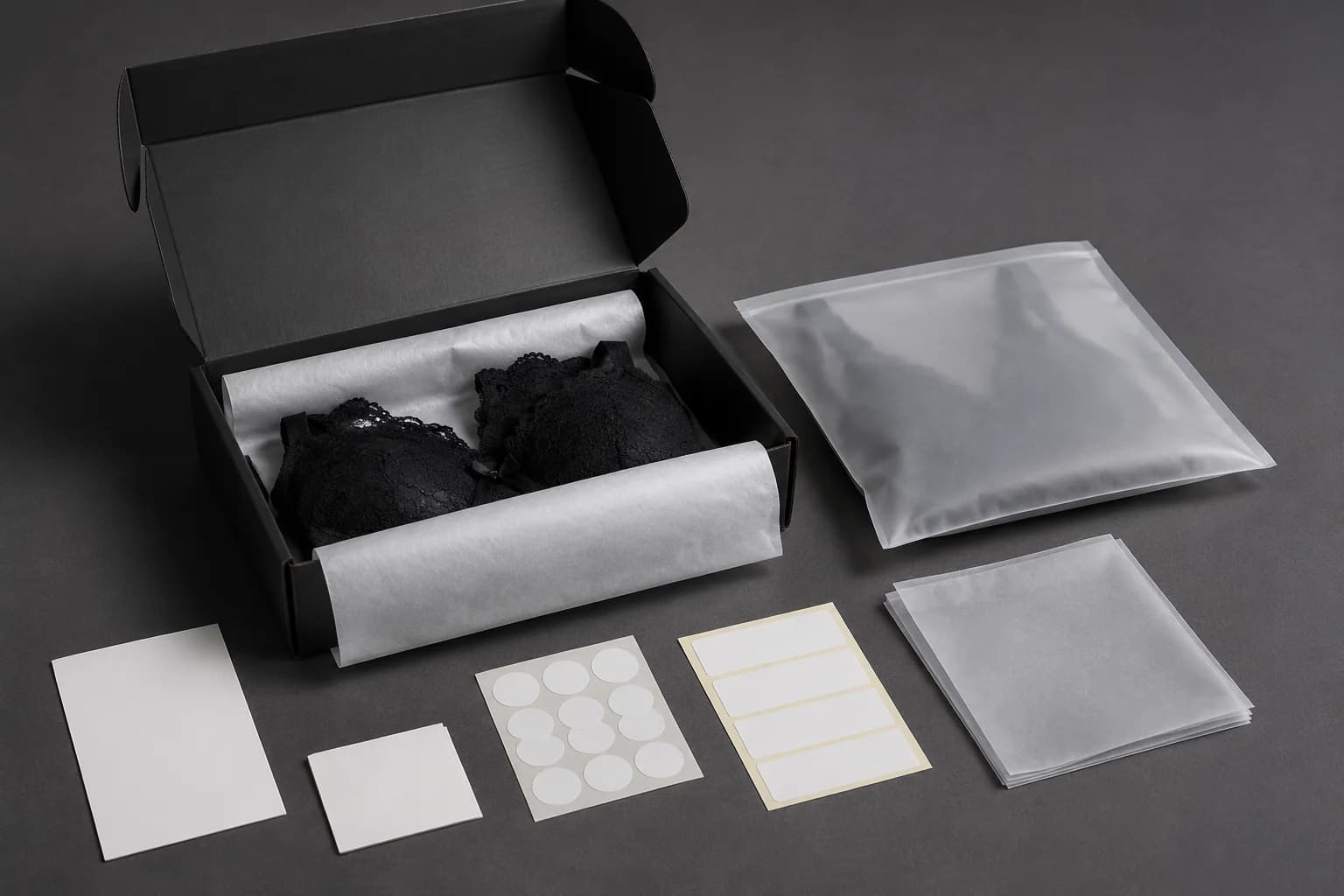
The ecommerce SKU must remain consistent from the sewn garment to the warehouse record. Compare the main size label, care label, hangtag if used, barcode, inner-bag sticker, carton mark, packing list, and product-page size name. A correctly graded garment placed in the wrong bag is still a fulfillment defect.
Use an actual folding and packing trial for padded bras, bustiers, longline styles, bodysuits, and multi-piece sets. The trial should reveal whether cups are crushed, hooks snag lace, sliders mark mesh, gusset snaps press into fabric, or upper sizes exceed the planned inner bag and carton configuration.
For a hypothetical packing calculation dated 2026-07-21, assume one carton holds 48 individually bagged plus-size mesh bodysuits, measures 60 centimeters by 40 centimeters by 40 centimeters, and has a target gross weight of 12.0 kilograms. The calculated carton volume is 0.096 cubic meter, derived from 0.60 meter multiplied by 0.40 meter multiplied by 0.40 meter. This is an example procurement calculation for that packout, not a freight standard, and must be verified through the supplier packing trial, carton quotation, final size mix, inspection record, and freight quotation.
Choose solid-size, solid-color, or controlled mixed cartons according to the receiving operation. Mixed cartons can suit an ecommerce launch only when every inner bag is scannable and the packing list identifies the exact SKU quantity in each carton.
- Approve the folded sample and inner-bag size before ordering packaging
- Lock SKU names, color names, size names, barcode format, label dimensions, and placement
- Protect hooks, sliders, snaps, lace, elastics, and molded cups during folding
- Confirm carton configuration, net weight, gross weight, dimensions, marks, and packing ratio
- Run a barcode-readability check using the receiving channel's required equipment or method
- Reconcile garment labels, inner bags, cartons, packing list, and ecommerce catalog data
Request compliance evidence by market and product scope
Ask for compliance documents tied to the destination market and the actual material or finished product. A general compliance statement does not identify which fabric, trim, dye lot, print, label version, or lingerie style was assessed.
For the United States, relevant public source contexts include the Federal Trade Commission's textile fiber labeling guidance and Care Labeling Rule guidance, considered here as of 2026-07-21. Depending on the product and importer structure, buyers may need to address fiber content, country of origin, responsible company identification, and care instructions. Confirm current obligations with qualified compliance advice before approving label artwork.
For the European Union, relevant public contexts include European Commission guidance on textile labeling and general product safety, together with European Chemicals Agency guidance on REACH chemical restrictions, considered here as of 2026-07-21. REACH is a regulatory framework, not a product-quality certification. Any test report should be current and traceable to the supplied material, trim, dye lot, print, or finished product.
ISO 8559-1:2017, published by the International Organization for Standardization, is used here as a source context for body-measurement terminology as of 2026-07-21. It does not prescribe the grading increment for a private label bra, brief, bralette, or bodysuit. Likewise, ISO 2859-1 can structure acceptance sampling but does not define buyer-specific fit, measurement, workmanship, or packaging limits.
Do not describe a product, material, supplier, or production site as certified unless a current document supports the exact claim and scope. A management-system certificate, unrelated material report, expired document, or report for a different production site does not establish compliance for the ordered lingerie style.
- Fiber-content evidence and final care-label artwork
- Country-of-origin and importer or responsible-party details where required
- Chemical test reports linked to the relevant material, trim, dye lot, print, or finished product
- Product-safety and traceability records required by the destination market
- Packaging marks, warnings, and material declarations where applicable
- Document issue date, report scope, tested item, issuing body, and current validity
- Written confirmation of which ordered SKU or material each document covers
Private label plus-size lingerie RFQ fields
A private label lingerie RFQ should force the supplier to describe what is included, what changes by size, and what remains unresolved. Send the product sketch or reference, destination market, commercial size range, size-color quantity split, material direction, packaging requirement, inspection expectation, and requested delivery window with the questions below.
Ask the supplier to return its proposed grade rather than responding only with a price. The reply should make the pattern source, POM convention, material status, size-dependent components, sample sequence, MOQ basis, and bulk-cutting gate visible before development begins.
- State the recommended plus-size fit base, pattern source, and reason for the base-size choice.
- Provide a graded POM table showing base values, adjacent-size increments, tolerances, measurement paths, and setup conditions.
- Confirm whether each circumference is recorded as a total or laid-flat measurement.
- Separate relaxed, extended, and recovery requirements for underband, waist, hip, leg opening, and other stretch-controlled areas.
- List every size-dependent change in cup, mold, wire, lining, elastic, strap, closure, gusset, reinforcement, or panel construction.
- Identify the production-intent fabric, stretch lace, powernet, elastic, lining, and hardware used for each sample.
- Quote MOQ by style, color, size curve, material, trim, label version, and packaging method.
- State which samples are included, correction-round terms, pattern or grading fees, and the written gate required before bulk cutting.
Method, source context, and limits
Methodology: the recommendations were derived by mapping each grading decision to the document that controls it: RFQ, body chart, garment POM table, grade-rule table, nested pattern, sample report, approval record, material file, production instruction, inspection plan, compliance file, packing plan, and shipment record. A field was included when leaving it unstated could cause suppliers to quote, grade, sample, measure, sew, inspect, or pack the same style differently.
The public source contexts used to frame the article are the U.S. Federal Trade Commission's textile fiber and care-labeling guidance, European Commission product-labeling and product-safety guidance, European Chemicals Agency REACH guidance, ISO 8559-1:2017 for body-measurement terminology, and ISO 2859-1 for acceptance-sampling structure. These sources address labeling, regulatory context, terminology, or inspection methods. They do not establish Velora Intimates specifications, production practices, certification, or product claims.
The numerical procurement data are scenario inputs, not market benchmarks. The size-run assumption, grade increment, tolerances, MOQ range, sample and production calendar, carton configuration, weight, dimensions, and volume calculation are each labeled with their unit, scope, date, and derivation. Replace them with values confirmed by the supplier quotation, approved size-set samples, final tech pack, inspection plan, packing trial, purchase order, and freight quotation.
Limitations: this article does not confirm current Velora Intimates MOQ, production capacity, available materials, lead time, certificates, test reports, production-site address, client results, or available size range. It does not replace live fitting, graded-pattern review, laboratory testing, legal advice, product-safety assessment, freight planning, or a signed purchase order.
Author basis: Velora Intimates lists Vincent Xi as an Editorial Author at https://velora-intimates.com/authors/vincent-xi/. That public profile is the only author basis used here. No personal factory-visit, client-result, testing, certification, award, ranking, or length-of-experience claim is made.
Procurement checklist
Before you send the inquiry
Target quantity and replenishment plan
Tech pack, reference sample, or construction notes
Fabric, lace, elastic, and hardware preferences
Size range, grading rules, and fit tolerance
Private-label packaging and barcode needs
Destination market and compliance requirements
FAQ
What should plus-size lingerie grading rules include in a supplier tech pack?
They should identify the commercial size range, fit base, body chart, pattern source, garment POMs, adjacent-size grades, relaxed and extended measurements, tolerances, recovery method, size-dependent components, sample sequence, and written bulk-cutting gate. The ecommerce size chart is an output of this work, not a substitute for a production measurement table.
How should a buyer specify plus-size bra band and cup grading?
Separate the underband, wing, cup, neckline, strap, closure, gore, cradle, wire, and lining rules. Ask the supplier to identify where cup volume, wire shape, hook-and-eye depth, strap width, elastic strength, or reinforcement changes within the size range. Approve those transition sizes physically rather than relying only on a nested pattern.
Should the lingerie fit base sit inside the plus-size range?
The most useful base generally represents the intended customer and exposes the style's main support and pressure points. The final choice depends on the brand body chart, product type, pattern system, fit-model criteria, and commercial range. Require the supplier to explain its recommendation instead of accepting an undocumented straight-size carryover.
Which plus-size lingerie size-set samples need approval before bulk cutting?
Choose samples according to product risk. The fit base and selected endpoint or transition sizes can provide a starting structure, while molded cups, underwire, rigid lace, shaping panels, longline bands, new closures, or torso-dependent styles may justify additional samples. Record the selected sizes, materials, decision purpose, and approval gate in the purchase order.
How do powernet and stretch lace affect plus-size lingerie grading?
They affect extension force, recovery, compression, transparency under tension, edge behavior, seam performance, and the effective garment measurement after sewing. Approve the grade in production-intent material and document stretch direction, relaxed and extended POMs, recovery method, elastic application, and seam construction.
How should buyers compare a plus-size lingerie MOQ?
Ask whether the MOQ applies by style, color, size curve, fabric booking, trim option, label version, or packaging method. Also request minimum color quantities, material minimums, size-dependent consumption, sample charges, and upper-size component surcharges. A low total MOQ can still be commercially unsuitable when separate fabric, dye, lace, elastic, or packaging minimums apply.
Related sourcing guides
P1 · b2b manufacturing guide
Best Lingerie Manufacturing Model for Startup Brands in 2026
Compare lingerie manufacturing models for startup brands in 2026. Learn how to evaluate MOQ, lead time, materials, QC, packaging, compl...
P1 · lingerie manufacturing
Best Lingerie Manufacturing Model for Startup Brands: How to Choose Without Overbuying
Compare wholesale, private label, ODM, OEM, and hybrid lingerie manufacturing models for startup brands. Includes MOQ checklist, lead t...
P1 · b2b manufacturing guide
Best Lingerie Manufacturing Model for Startup Brands: OEM vs Private Label vs Hybrid Guide
Compare OEM vs private label lingerie manufacturing for startup brands. Learn how to evaluate MOQ, lead time, cost, QC, packaging, comp...
P1 · b2b lingerie sourcing
Best Low MOQ Lingerie Products for Ecommerce Sellers in 2026: Top 5 Picks, Comparison Guide, Costs, MOQ, and RFQ Checklist
Compare Top 5 low MOQ lingerie products for ecommerce sellers in 2026. Review MOQ, cost drivers, lead time, packaging, QC, compliance d...