Short answer
A practical OEKO-TEX lingerie fabric sourcing checklist for private label buyers comparing certificate scope, component BOM lines, knitted fabric specs, lace and elastic MOQ drivers, sample approvals, QC checkpoints, packing data, carton estimates, and claim wording before bulk production.
Key takeaways
What buyers should remember
- Check the OEKO-TEX certificate against the exact lingerie component. Main fabric evidence does not automatically cover lace, power mesh, strap elastic, foam cups, labels, prints, bonding film, metal trims, hangtags, polybags, or the finished garment.
- Quote from a component-level lingerie BOM. The MOQ driver is often a custom-dyed trim, molded cup, branded care label, heat-transfer label, hook-and-eye tape, or packaging item rather than the body fabric.
- Lock measurable fabric and trim fields before pre-production approval: composition, GSM, width, stretch, recovery, shrinkage, shade standard, lace usable width, elastic tension, foam thickness, process route, and document scope.
- Keep MOQ, lead time, carton capacity, gross weight, and freight volume marked as quote-specific until the supplier confirms them for the exact style, color, size range, material route, and packing method.
- Use OEKO-TEX documents as evidence to review, not ready-made public claim wording. Destination-market rules, retailer restricted substance lists, fiber labeling, care labeling, packaging rules, and hangtag text still need separate approval.
Buyer comparison table
Evidence Base and Use Case
Use this OEKO-TEX lingerie fabric sourcing checklist when a private label bra, brief, bodysuit, bralette, camisole, or set is being quoted with OEKO-TEX relevant materials. The buyer decision is narrow: can the supplier prove the component scope, repeat the approved material, and quote the commercial risk before bulk cutting starts?
Byline: Vincent Xi, Editorial Author, Velora Intimates, https://velora-intimates.com/authors/vincent-xi/. The approved author basis is the Velora Intimates author profile identifying Vincent Xi as Editorial Author. This article does not claim factory certification, client outcomes, private testing, buyer rankings, factory visits, awards, or first-person production experience.
Methodology: the checklist was built from two source contexts. Source context one is publicly available OEKO-TEX STANDARD 100 guidance on certificate scope, product class, and certificate validity checks, reviewed as of 2025; buyers should verify current details directly against the live certificate. Source context two is standard private label intimate-apparel procurement structure: BOM review, swatch approval, lab dip or strike-off approval, pre-production sample approval, incoming material inspection, inline inspection, final inspection, packing audit, and PO document control.
Planning data used in this article is either source-context based or labeled as an example assumption to verify in the supplier quote. Example assumption as of 2026: 300 kilograms per color may be used for early comparison of a custom-dyed knitted lingerie fabric MOQ, but the mill quote controls the real minimum. Example assumption as of 2026: 10 to 14 calendar days may be used for lab dip planning after the supplier receives the buyer's color standard, but the dye house queue controls the real timing. Example calculation as of 2026: a 60 centimeter by 40 centimeter by 40 centimeter master carton equals 0.096 cubic meter, calculated by length times width times height; the packing trial controls the final freight volume.
- Best time to use it: before proto sampling, before pre-production sample approval, before cutting approval, and before issuing the purchase order.
- Best format: one BOM line per fabric, lining, lace, mesh, elastic, foam, hook tape, label, package item, and claim-relevant process.
- Best supplier response: confirmed, not applicable, assumption to verify, or requires buyer testing.
- Best internal owner: the buyer or importer responsible for claims, labeling, PO terms, restricted substances, and destination-market compliance.
Check the Certificate Against the Exact Component
The first step in OEKO-TEX lingerie fabric sourcing is checking whether the document covers what the buyer wants to buy. A certificate for a knitted fabric range does not automatically cover scalloped lace, strap elastic, foam, hook-and-eye tape, heat-transfer labels, foil prints, adhesive films, silicone grippers, hangtags, polybags, or a finished garment claim.
A bra usually combines direct and near-direct skin-contact inputs. Map body fabric, wing mesh, cup lining, lace overlay, underband elastic, shoulder strap elastic, foam, wire casing, hook tape, rings, sliders, care label, and decoration separately. A brief needs the same discipline for body fabric, gusset lining, lace insert, waistband, leg elastic, transfer label, size sticker, and packaging.
Ask for the certificate number, issuing institute, holder name, valid-until date, product class, covered article description, color or finish limits, and the supplier's relationship to the holder. If the garment factory is forwarding a mill document, require traceability from the mill or trim shipment to the material lot used for cutting.
OEKO-TEX STANDARD 100 uses product classes based on article use. Product Class II is commonly relevant to articles with direct skin contact in OEKO-TEX public standard context as of 2025, but buyers must confirm the live certificate and intended claim. A Product Class II component certificate is not the same as certification of the finished bra, brief, bodysuit, or sleepwear set.
- Ask: Which BOM line does this certificate support?
- Ask: Are printing, bonding, coating, brushing, garment washing, silicone, heat transfer, foil, flocking, or adhesive lamination included in scope?
- Ask: Is the garment factory the certificate holder, an authorized buyer of the certified material, or only forwarding a supplier document?
- Hold back public wording until scope and claim permission are verified for the exact article.
- Treat new fluorescent shades, metallic effects, pigment prints, flocking, seasonal finishes, and post-dye treatments as separate scope checks.
Build the BOM Before Discussing MOQ
The MOQ decision should come after the lingerie BOM is visible. A finished-garment minimum can hide the real blocker: custom-dyed lace, strap elastic, hook tape, molded cups, printed labels, retail boxes, or a shade-matched gusset lining.
A workable BOM separates main fabric, contrast fabric, gusset lining, lace, mesh, underband elastic, strap elastic, foldover elastic, wire casing, foam, cup lining, wires, hooks, eyes, rings, sliders, bows, care labels, brand labels, heat-transfer labels, hangtags, size stickers, polybags, retail boxes, inserts, and master cartons. Each line should show supplier, article code, composition, color reference, finished width, weight or thickness, MOQ, lead time, certificate status, stock or custom status, substitution rule, and document owner.
Example calculation to verify in the supplier quote as of 2026: if a brief uses 0.09 meter of 160 centimeter-wide main fabric per piece after marker-efficiency assumptions, a 5,000 piece order requires 450 meters before wastage. If the mill quotes 300 kilograms per color for custom dyeing and the fabric is 180 grams per square meter, the purchased quantity may exceed the order requirement. The buyer then needs a plan for excess material, a matching set, a reorder, or a stock-color alternative.
Bras can create a different MOQ problem. A soft bra may need lace, cup lining, wing mesh, underband elastic, strap elastic, hook tape, rings, sliders, and labels in the same shade family. A molded bra adds foam thickness, cup shape, lamination, cup-size availability, and carton protection. Stock black, white, or nude inputs may keep the launch smaller; seasonal colors often raise the minimum through dyed-to-match trims.
The best MOQ question is direct: quote the lowest practical MOQ by style, color, and size range, then name the component setting that minimum. This lets the buyer compare a stock-material launch against a custom-color program without guessing.
- Quote main fabric, gusset lining, lace, mesh, elastic, foam, hook tape, labels, hangtags, polybags, retail boxes, and cartons separately.
- Mark the MOQ-limiting item for every style and color.
- Ask for one quote using stock supported materials and one quote using custom-dyed materials.
- Avoid custom color dependencies for trial orders unless excess-material cost is already accepted.
- Cost matching sets as one connected BOM because the bra and brief may share only some limiting trims.
Specify Materials in Measurable Terms
The material decision is not whether a fabric sounds premium. It is whether the supplier can repeat the approved handfeel, stretch, recovery, shade, width, shrinkage, seam behavior, elastic tension, lace placement, label comfort, and document scope in bulk.
For knitted lingerie fabric, request fiber composition by percentage, construction, finished width in centimeters, GSM in grams per square meter, stretch percentage in length and width, recovery percentage after extension, shrinkage after washing, colorfastness target, pilling grade where relevant, handfeel standard, and finish process. The supplier should state whether the material is yarn-dyed, piece-dyed, printed, brushed, bonded, coated, washed, or treated after knitting.
For lace sourcing, decide whether the design depends on scallop placement, motif repeat, or cutting yield. Request total width in centimeters, usable cutting width in centimeters, repeat size in centimeters, edge type, scallop direction, stretch direction, elastane content where applicable, motif placement limit, color-matching method, and whether the lace is rigid, mechanical stretch, or elastane stretch.
For lingerie elastic, the buyer is deciding comfort and size stability. Request width in millimeters, elongation, recovery, tension target, edge type, brushed side, picot or foldover construction, dye method, latex status where relevant to the target market, and skin-contact position in the garment.
Example tolerance assumptions to verify in the supplier quote as of 2026: main fabric GSM at plus or minus 5 percent for the approved quality, finished roll width at plus or minus 2 centimeters, and small placement points such as strap position or gusset width at plus or minus 0.5 centimeter on the finished garment. These are buyer-side example assumptions, not universal factory standards.
For padded bras, foam deserves its own BOM line. Request thickness in millimeters, density where available, cup shape, lamination method, color, odor requirement, yellowing risk, compression recovery, and separate documentation for foam or laminate where relevant. Adhesives, bonding films, printed logos, and transfer labels can change both performance and compliance review.
- Main fabric: composition, construction, GSM, finished width, stretch, recovery, shrinkage, finish, handfeel, colorfastness, certificate scope.
- Lace: total width, usable width, repeat, scallop direction, stretch direction, motif placement, shade tolerance, certificate status.
- Elastic: width, elongation, recovery, tension, edge type, brushed side, dye method, latex status where relevant, garment position.
- Foam: thickness, density where available, color, lamination, odor, yellowing risk, compression behavior, documentation.
- Substitution rule: no equivalent is approved until the buyer receives specs, swatch, shade record, document scope, price impact, MOQ impact, and lead-time impact.
Approve Samples Without Losing Material Control
The sample decision is not only fit. A bra can fit correctly with development elastic and fail in bulk when the approved color uses a different underband. A brief can look right at proto stage and feel tight after leg elastic is substituted.
Start material confirmation before proto sampling or at the same time. Request fabric swatches, lace cuts, elastic cards, foam pieces, trims, label samples, packaging samples, and component documents for every proposed BOM line. For custom colors, request lab dips or strike-offs before sales samples. For prints, bonding, heat transfer, silicone gripper, flocking, brushed elastic, and molded cups, request process samples before the full set is approved.
Example timing assumptions to verify in the supplier quote as of 2026: 7 calendar days for available swatch dispatch after supplier confirmation, 10 to 14 calendar days for lab dips after receipt of the buyer's color standard, 14 to 21 calendar days for proto samples after BOM confirmation, and 45 calendar days for bulk production after all approvals and deposit. Actual timing depends on material stock, dye house queue, trim sourcing, cup molding, order size, approval speed, and holiday calendar.
Use approval stages with different decisions attached. Proto confirms construction direction. Fit sample confirms pattern and comfort changes. Size set checks grading. Pre-production sample confirms bulk-intended materials, trims, labels, packaging, workmanship, and measurement standard. Cutting should wait until exceptions are written and accepted.
Importers and distributors selling to more than one retailer should keep approvals by customer, market, and delivery window. A label, warning statement, polybag format, carton mark, or barcode rule accepted by one customer may fail another customer's receiving requirements.
- Ask whether proto samples use bulk-intended materials or development substitutes.
- Require a substitute-component list for every sample, including article code, color, width, and reason.
- Tie cutting approval to the PP sample, BOM, color standard, and packing specification.
- Do not treat fit approval as approval for lace, elastic, foam, hook tape, label material, or claim wording.
- Review color as a set because fabric, lace, elastic, hook tape, and thread can react differently in the same shade family.
Read Documents by BOM Line
The compliance decision is whether each material record supports the buyer's intended use and claim. OEKO-TEX documentation can support restricted-substance screening for covered articles, but it does not replace destination-market rules, retailer restricted substance lists, fiber labeling, care labeling, packaging rules, or product-page wording review.
For every fabric and trim supplier, request the current certificate where applicable, covered article description, product class, validity date, holder name, and confirmation that the supplied lot sits within scope. If a component has no OEKO-TEX document, decide whether a test report, material declaration, or buyer-required lab test is needed before purchase order release.
A document can be valid and still insufficient for the style. A certificate may cover dyed knit fabric but not a foil print added later. It may cover a lace quality but not a new fluorescent shade. It may cover foam but not adhesive lamination. It may be held by a mill that is not clearly connected to the garment factory's purchase record.
Request care label content, fiber composition confirmation, country-of-origin marking approach, packaging material specification, polybag warning text where required by the sales channel, and retailer-specific declarations. If the product ships to the European Union, United Kingdom, United States, Canada, Australia, or another regulated market, the responsible importer, brand, or seller of record should review current labeling and chemical requirements.
Control file naming before the order scales. A useful document name includes style number, component, supplier, certificate or report number, issue date, valid-until date, color, and version. For a reorder, ask whether the same material lot, certificate, processing route, and component suppliers still apply.
- Attach documents by BOM line instead of sending one mixed compliance folder.
- State whether each document supports a component, a process, packaging, or a finished-garment claim.
- Link certificate or report evidence to supplied lot numbers before cutting.
- Do not turn an internal supplier declaration into a public certification claim.
- Keep retailer restricted substance lists and market labeling rules as separate buyer responsibilities.
Inspect Materials Before Cutting
The QC decision starts at receiving, not final inspection. Twisted strap elastic, harsh edges, mismatched lace scallops, off-shade gussets, loose hook tape, cup dents, and rough labels can cause returns even when the packed cartons look tidy.
Incoming inspection should check roll labels, lot numbers, width, shade, GSM where measurable, visible defects, odor, handfeel, stretch direction, recovery, lace repeat, elastic width, elastic recovery, foam thickness, trim count, label artwork, and packaging quantities. Compare each item with the approved swatch, lab dip, signed standard, or PP sample. If shade varies by lot, keep lots separated by size, set, or shipment where practical.
The pre-production meeting decides how the approved sample will be repeated. Review the BOM, measurement chart, sewing sequence, seam allowance, needle type, thread, bar tack positions, elastic tension, cup handling, lace placement, label placement, metal trim safety, packing method, carton mark, and inspection standard.
Bra checks should include cup symmetry, wire channel length, cup shape, wing tension, hook-and-eye alignment, strap adjustment range, and center-front stability. Brief checks should include gusset coverage, leg-opening tension, waist elastic join, side-seam twisting, and lace edge comfort.
Inline inspection protects the buyer while corrections are still possible. Elastic tension errors change fit. Lace placement errors hurt set appearance. Foam wrinkles and cup dents can become permanent. Hook tape misalignment can irritate skin or damage fabric.
Final inspection should cover measurements, workmanship, shade, size ratio, SKU, barcode, packing quantity, carton dimensions, gross weight, sharp-edge risk where relevant, and document completion. If the buyer uses AQL sampling, the inspection level should be written in the PO or booking. This article does not prescribe a universal AQL because channel, price point, order risk, retailer requirement, and buyer policy vary.
- Incoming: roll number, lot number, width, shade, GSM, defect grade, handfeel, odor, stretch, recovery, lace repeat, elastic width, foam thickness.
- Pre-production: approved PP sample, BOM, measurement chart, sewing method, trim placement, label position, packing method, carton mark.
- Inline: elastic tension, lace symmetry, cup dents, seam strength, gusset placement, hook tape alignment, strap twisting.
- Final: measurements, appearance, size ratio, SKU, barcode, packing quantity, carton dimensions, gross weight, document package.
- Quote question: which inspection checkpoints are included, and which require third-party booking by the buyer?
Plan Packaging During RFQ
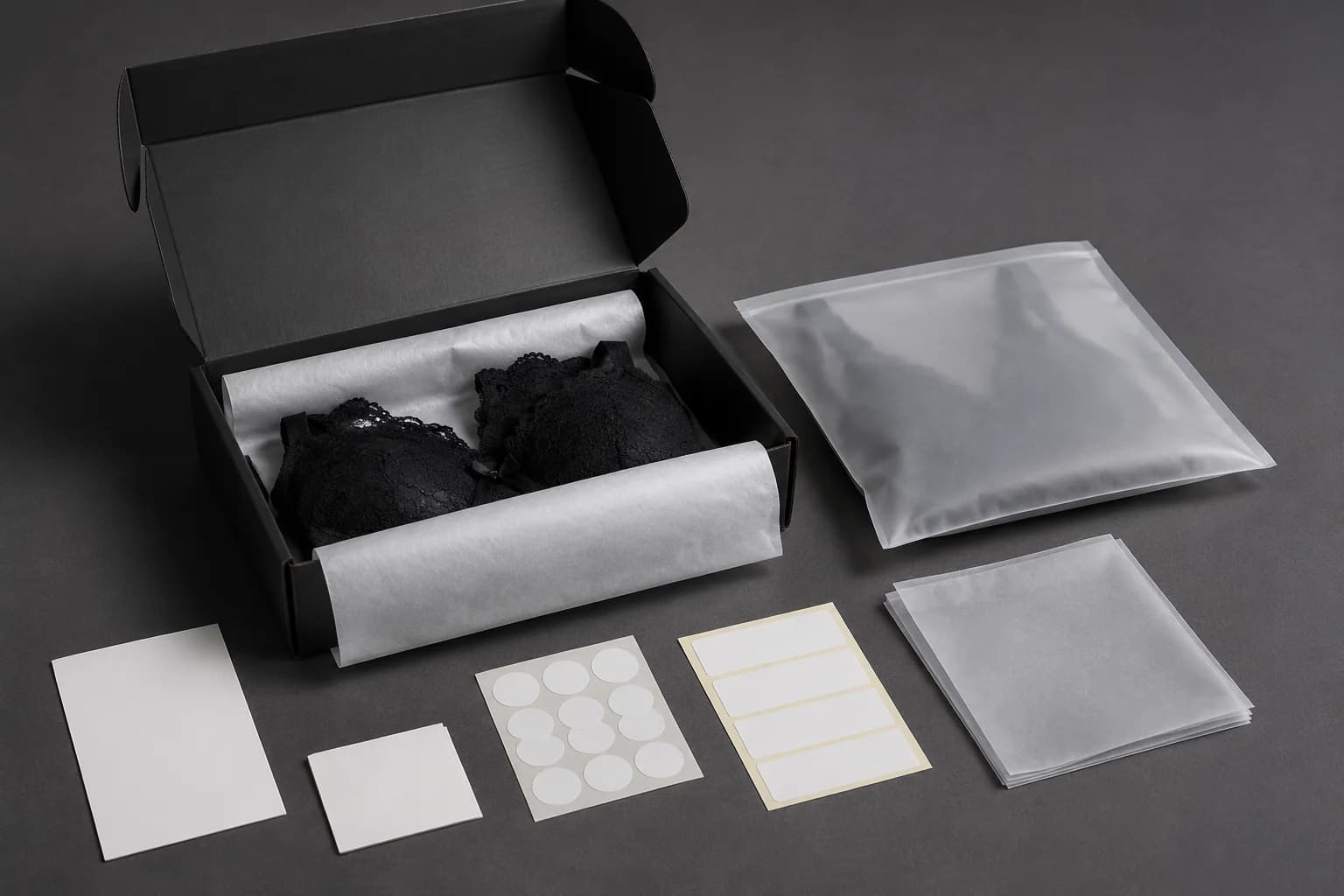
The packaging decision affects landed cost, warehouse handling, retailer compliance, and product presentation. Decide early whether the product ships flat-packed, hanger-packed, individually polybagged, boxed, tissue-wrapped, size-stickered, or prepared for a retailer-specific receiving process.
Ask for individual packing method, polybag material and thickness if specified by the buyer, warning text if required by the sales channel, hanger type, hangtag placement, size sticker placement, carton dimensions, units per inner pack, units per master carton, gross weight, net weight, carton marking, and sealing method. If the buyer sells to retail, share barcode, SKU, carton label, and assortment rules before packaging approval.
Example freight calculation to verify after packing trial as of 2026: a master carton measuring 60 centimeters by 40 centimeters by 40 centimeters has a volume of 0.096 cubic meter. If an example carton holds 80 lightweight briefs, the buyer can estimate carton count and cubic volume for early freight planning. If an example carton holds 24 molded bras because cups cannot be compressed, chargeable volume per unit changes materially. The supplier must confirm actual carton size, packing quantity, net weight, and gross weight.
E-commerce brands and wholesale distributors often need different packing choices. A direct-to-consumer brand may need unit-level SKU labels and presentation packaging. A distributor may need retailer carton marks, size-color assortment packing, and warehouse receiving labels. Ask for unit-level and carton-level photos at PP approval and during final packing.
Packaging also affects claims. Printed care labels, hangtags, stickers, inserts, and product listings should not contain unsupported certification wording. If a hangtag mentions OEKO-TEX, verify whether the statement refers to a fabric, component, or finished article and whether the current certificate supports that wording.
- Quote flat-pack and hanger-pack options separately where applicable.
- Request carton dimensions in centimeters, units per carton, net weight in kilograms, gross weight in kilograms, and carton mark layout.
- Confirm how molded cups are protected from compression during packing and transit.
- Approve retailer packing before bulk packing starts.
- Remove unsupported certification wording from hangtags, inserts, carton labels, and product listings.
RFQ Fields That Make Quotes Comparable
The RFQ decision is whether suppliers are pricing the same product. Without controlled fields, one quote may use stock black fabric, another may assume custom-dyed lace, and another may exclude packaging or compliance documents.
Start with commercial fields: style type, reference image or technical sketch, size range, estimated order quantity by style, quantity by color, target market, requested incoterm, delivery window, packaging channel, and whether the order is a trial, launch, replenishment, or retailer program. If there is a target price, state whether it is ex-works, FOB, landed-cost based, or retail-margin based.
Add material fields that remove guesswork: composition, construction, GSM, finished width, stretch, recovery, lace width, lace repeat, elastic width, elastic tension, foam thickness, color standard, stock or custom color status, certificate status, document owner, MOQ by component, and substitution approval rule. Require suppliers to mark unknown values as assumptions to confirm.
Development fields should cover swatch availability, lab dip lead time, strike-off lead time, proto sample cost, proto lead time, included revisions, fit sample requirement, size set requirement, PP sample requirement, measurement standard, and approval deadline. For bras, clarify cup and band matrix early because sampling and grading can expand quickly.
Production fields should cover material lead time, bulk lead time after approval, cutting start condition, inline inspection availability, final inspection standard, tolerance table, defect classification, packing method, carton details, payment terms, incoterm, port, shipment document package, and who pays for additional testing if the buyer or retailer requires it.
Close the RFQ with one supplier-facing risk question: which component is most likely to affect MOQ, price, document availability, or lead time? For lingerie, the answer is often lace, elastic, molded cups, custom color, hook tape, or packaging.
- Commercial: style, sketch, size range, order quantity, color quantity, target market, incoterm, delivery window, packing channel.
- Material: composition, GSM, width, stretch, recovery, lace, elastic, foam, color, certificate status, MOQ, document owner.
- Development: swatch, lab dip, strike-off, proto, fit sample, size set, PP sample, revision cost, approval deadline.
- Production: lead time, cutting condition, QC checkpoints, tolerances, defect classes, packing, cartons, payment terms, document package.
- Risk: ask the supplier to name the component most likely to delay the order or change the quote.
What to Verify Before PO
This checklist has limits. It cannot replace live certificate verification, destination-market legal review, retailer compliance review, buyer-required lab testing, or the importer's restricted substance program. OEKO-TEX documentation is useful evidence, not a universal approval for every claim, market, process, or component.
Before issuing the PO, verify certificate validity date, covered article scope, supplier relationship to the certificate holder, product class relevance, color or finish coverage, and whether the supplied material lot is covered. Confirm whether printing, bonding, garment washing, silicone application, heat transfer, adhesive lamination, or packaging decoration changes the compliance position.
Verify the commercial assumptions separately. MOQ, price, sample timing, bulk lead time, carton dimensions, units per carton, gross weight, and freight estimate can change after final material selection. A stock black lace quote is not comparable with a seasonal color quote requiring dyed-to-match lace, elastic, hook tape, thread, and printed packaging.
The final PO should attach or reference the approved BOM, measurement chart, color standards, sample approval record, packaging specification, QC standard, tolerance table, compliance document list, shipment terms, and approved claim wording where applicable. Any component, color, packaging, process, or claim wording change after PO confirmation should require written buyer approval.
- Verify certificate validity and scope before PO and before reorder.
- Confirm every skin-contact or claim-supporting component.
- Check destination-market labeling, chemical, packaging, and retailer requirements separately.
- Treat MOQ, lead time, carton volume, and freight cost as quote-specific, not universal.
- Require written approval for material substitution, color change, packaging change, process change, or claim wording change.
Procurement checklist
Before you send the inquiry
Target quantity and replenishment plan
Tech pack, reference sample, or construction notes
Fabric, lace, elastic, and hardware preferences
Size range, grading rules, and fit tolerance
Private-label packaging and barcode needs
Destination market and compliance requirements
FAQ
How do I use an OEKO-TEX lingerie fabric sourcing checklist before sending an RFQ?
Use the checklist to turn the style into BOM lines before asking for price. Ask the supplier to confirm each fabric, lace, mesh, elastic, foam, hook tape, label, and packaging item with article code, material spec, MOQ, lead time, certificate status, and substitution rule. Then compare quotes by the same BOM instead of comparing one vague finished-garment price against another.
Does an OEKO-TEX certificate for the main fabric cover the whole lingerie garment?
Not automatically. A bra, brief, bodysuit, or lingerie set may include lace, power mesh, elastic, foam, hook tape, rings, sliders, labels, prints, adhesives, hangtags, and packaging. The buyer must check each relevant component and process. A certificate for one fabric should not be extended to unsupported trims, later processes, or finished-garment claims.
What MOQ should buyers expect for OEKO-TEX relevant lingerie materials?
MOQ depends on the mill, trim supplier, color, finish, stock status, document scope, and order timing. As an example RFQ assumption to verify as of 2026, 300 kilograms per color can be used for early planning of a custom-dyed knitted lingerie fabric. Stock lace or elastic may be available at lower quantities, while custom-dyed trim can set its own minimum. Always ask which component controls the finished garment MOQ.
When should OEKO-TEX and material compliance documents be requested?
Request documents before proto sampling where possible, reconfirm them before PP sample approval, and verify them again before bulk cutting or reorder. The file should include certificate number, holder name, scope, product class, validity date, covered article description, and the link between the document and the supplied material lot.
Which fabric specification fields matter most for private label lingerie sourcing?
The most useful fields are composition, construction, GSM, finished width, stretch, recovery, shrinkage, colorfastness target, handfeel standard, lace usable width and repeat, elastic width and tension, foam thickness, shade tolerance, finish type, and certificate scope. For bras, add cup shape, foam behavior, wire casing, strap adjustment range, and underband tension.
What should an RFQ say instead of just asking for OEKO-TEX fabric?
Ask suppliers to quote each BOM line with material article code, composition, width, GSM or thickness, stretch or tension data, color status, MOQ, lead time, certificate number, certificate holder, valid-until date, covered article description, and whether later processing is included. Also ask which component is most likely to affect MOQ, price, document availability, or lead time.
Related sourcing guides
P1 · b2b manufacturing guide
Best Lingerie Manufacturing Model for Startup Brands in 2026
Compare lingerie manufacturing models for startup brands in 2026. Learn how to evaluate MOQ, lead time, materials, QC, packaging, compl...
P1 · lingerie manufacturing
Best Lingerie Manufacturing Model for Startup Brands: How to Choose Without Overbuying
Compare wholesale, private label, ODM, OEM, and hybrid lingerie manufacturing models for startup brands. Includes MOQ checklist, lead t...
P1 · b2b manufacturing guide
Best Lingerie Manufacturing Model for Startup Brands: OEM vs Private Label vs Hybrid Guide
Compare OEM vs private label lingerie manufacturing for startup brands. Learn how to evaluate MOQ, lead time, cost, QC, packaging, comp...
P1 · b2b lingerie sourcing
Best Low MOQ Lingerie Products for Ecommerce Sellers in 2026: Top 5 Picks, Comparison Guide, Costs, MOQ, and RFQ Checklist
Compare Top 5 low MOQ lingerie products for ecommerce sellers in 2026. Review MOQ, cost drivers, lead time, packaging, QC, compliance d...