Short answer
A practical buyer guide to the ODM lingerie development timeline from tech pack to bulk production. It explains when the supplier calendar really starts, which sample approvals block bulk cutting, how component MOQ for lace, mesh, elastic, cups, labels, and packaging can change the order plan, and what to confirm before QC, carton booking, documents, and shipment handover.
Key takeaways
What buyers should remember
- Start the ODM lingerie development timeline from a costable tech pack, not from the first design conversation. A costable file should define measurements, BOM, artwork, packaging, size ratio, target market, delivery term, and compliance expectations.
- For a wireless bra and brief set using supplier-stock mesh, stock lace, stock elastic, standard hook-and-eye tape, and printed brand labels, the 2026 planning assumption used in this article is 8 to 13 calendar weeks from complete tech pack to ex-factory readiness, derived from sample, approval, and bulk production workflow estimates and subject to supplier quote confirmation.
- For underwire bras, molded-cup bras, bodysuits, shapewear, custom-dyed lace, custom elastic, retailer packaging, or size-set approval, the 2026 planning assumption used here is 10 to 18 calendar weeks from complete tech pack to ex-factory readiness, based on added material, fit, trim, testing, and packaging approval steps.
- MOQ must be checked by component. A 2026 example calculation in this article shows that 600 sets across 3 colors and 5 sizes equals 40 sets per color-size combination, which may be below the efficient minimum for custom lace, jacquard elastic, molded cups, labels, barcode stickers, hangers, or printed polybags.
- Bulk cutting should wait until the approved pre-production sample, final BOM, color standards, size ratio, measurement tolerance table, packaging files, barcode data, carton assortment, inspection plan, and payment trigger are confirmed in writing.
- The RFQ should separate sample lead time, buyer approval days, bulk production lead time, component MOQ, packaging lead time, inspection terms, carton dimensions, gross weight, and document readiness so the buyer can compare ODM lingerie suppliers on the same basis.
Buyer comparison table
Scope, Evidence, And Limits
Use this article after the product has moved past concept selection and the buyer needs a practical ODM lingerie development timeline from tech pack to bulk production. It is written for importers, distributors, retail buyers, brand founders, procurement managers, and sourcing teams comparing supplier quotes for private-label lingerie, wholesale lingerie, or retailer programs.
Authorship is attributed to Vincent Xi, Editorial Author, using the Velora Intimates author profile at https://velora-intimates.com/authors/vincent-xi/ as the first-party author source. This article does not claim factory visits, client outcomes, certifications, exact rankings, awards, or first-person production experience.
The timing ranges are procurement planning baselines, not supplier commitments. They are derived from common apparel workflow steps: file review, sample costing, fit comments, material approval, PP sample release, bulk cutting, sewing, packing, inspection, carton planning, and freight handover. Each dated estimate should be checked against a supplier quote, signed PO, retailer manual, forwarder quote, test report, or compliance adviser review.
- Source context: Velora Intimates author profile for Vincent Xi, used only for authorship attribution as of the article date, 2026-07-19.
- Source context: ISO 2859-1 is a sampling-procedure standard identifier referenced in inspection programs as of the article date, 2026-07-19. Buyers must still define inspection level, AQL values, defect classes, measurement sample count, and reinspection rules in the purchase contract.
- Source context: ANSI/ASQ Z1.4 is a sampling-procedure standard identifier referenced in inspection programs as of the article date, 2026-07-19. It is not a product certification and does not replace buyer-defined quality terms.
- Source context: Regulation (EU) 2023/988, the General Product Safety Regulation, applies from 13 December 2024 in the European Union. The scope is EU consumer product safety context; buyers should verify current obligations with a qualified compliance adviser.
- Limitation: this article is not legal, customs, tax, certification, laboratory, or freight advice. Treat every lead time, MOQ, tolerance, AQL value, carton calculation, and document item as an RFQ input until confirmed in signed order documents.
Start The Clock When The Tech Pack Can Be Costed
The buyer decision here is simple: decide whether the supplier can quote the intended product or only a rough direction. A costable lingerie tech pack should include front and back sketches or CADs, sample size, full size range, graded measurements, point-of-measure diagram, BOM, stitch and construction notes, color references, logo artwork, care label content, label placement, packaging method, carton requirements, target order quantity, destination market, and delivery term.
If the file only says soft lace, breathable mesh, strong elastic, or standard packing, the supplier must choose the meaning. That choice affects price, MOQ, sample accuracy, inspection criteria, and repeat-order consistency. Ask the supplier to write every assumption into the quote, including material substitutes, construction assumptions, and packaging defaults.
Measurement tolerances should be set by point of measure. For the 2026 tolerance example used in this article, a soft bralette underband relaxed width may be quoted with plus or minus 1.0 centimeter for the approved sample size, while hook-and-eye placement, center-front height, strap attachment position, or gore width may be quoted with plus or minus 0.5 centimeter. These are example buyer tolerance assumptions based on lingerie fit-risk logic and must be verified with the supplier and technical fit reviewer before PO release.
- For bras, define band size logic, cup size logic, cup height, cup width, cradle width, gore height, underband relaxed width, underband extended width, strap length, strap adjustment range, hook-and-eye position, wire length if used, and cup symmetry points.
- For briefs, define waist relaxed width, waist extended width, front rise, back rise, leg opening, gusset width, gusset length, side seam height, and back coverage.
- For bodysuits, define torso length, neckline drop, snap position, gusset opening, strap setting, leg opening tension, and recovery after stretch.
- For lace, state width in centimeters or millimeters, composition, stretch direction, repeat scale, scallop usage, color reference, and placement.
- For elastic, state width in millimeters, face finish, skin-contact side, placement, stretch recovery expectation, stitching method, and color.
Choose The Right Timeline Before You Push The Supplier
For a wireless bra and brief set using supplier-stock mesh, stock lace, stock elastic, standard hook-and-eye tape, and printed brand labels, the 2026 planning assumption in this article is 8 to 13 calendar weeks from complete tech pack to ex-factory readiness. The source basis is the sum of typical workflow blocks: first sample preparation, buyer comments, revised or PP sample, material booking, bulk cutting, sewing, finishing, packing, and final inspection readiness. The range assumes no custom dyeing, no major fit rejection, no retailer testing delay, and buyer responses inside the agreed review window.
For underwire bras, molded-cup bras, bodysuits, shapewear, corset-inspired pieces, custom-dyed lace, custom jacquard elastic, extended cup sizes, retailer packaging, or size-set approval, use the 2026 planning assumption of 10 to 18 calendar weeks from complete tech pack to ex-factory readiness. The added time comes from cup shape approval, wire channel positioning, shade approval, elastic tension adjustment, grading review, packaging proofing, possible testing, and tighter PP approval control.
The supplier may give a production lead time that starts after approvals, deposit, and materials are ready. The buyer calendar is wider. It includes tech pack completion, sample courier time, fitting, comment consolidation, artwork release, lab dip approval, payment timing, inspection booking, freight booking, and compliance review.
- Before costing: missing-field list, feasibility comments, material assumptions, construction risks, and development risks.
- Before first sample: sample material status, substitute list, sample size, sample color, and sample fee.
- Before PP approval: final BOM, color standard, trim approvals, measurement tolerance table, and packaging files.
- Before bulk cutting: purchase order, payment trigger, size ratio, carton assortment, barcode data, and inspection plan.
- Before shipment: final inspection report if used, packing list, carton marks, commercial invoice data, gross weight, net weight, and freight handover details.
Quote MOQ By Constraint, Not By Wish
The buyer decision is whether to launch with the desired color and size spread or reduce the range to fit real component minimums. A supplier may accept a small sewing order, but lace, elastic, cups, wires, hook-and-eye tape, rings, sliders, labels, hangtags, barcode stickers, polybags, hangers, insert cards, and cartons can each carry a separate minimum.
The 2026 example calculation in this article uses 600 sets across 3 colors and 5 sizes. The scope is a launch-order MOQ review. The calculation is 600 sets divided by 15 color-size combinations, giving an average of 40 sets per color-size combination. That average may be below the efficient minimum for custom-dyed lace, custom elastic, molded cups, printed labels, or printed packaging, so the buyer should ask for stock alternatives, surcharge options, or a reduced color range.
Size logic can change MOQ and cost. An underwire range may require different wire sizes, cup pads, hook-and-eye widths, strap widths, and underband elastics. A full-bust or plus-size range may need stronger mesh, wider elastic, reinforced seams, extra lining, or grading checks that were not obvious from the sample size.
- Ask for MOQ by garment style, color, and size range.
- Ask for MOQ by lace, mesh, microfiber, cotton gusset, elastic, cup pad, wire, hook-and-eye tape, ring, slider, label, hangtag, barcode sticker, printed polybag, insert card, hanger, and carton.
- Ask whether each minimum is based on current stock, mill production, dye lot, tooling, print run, mold use, or packaging vendor policy.
- Ask how leftover custom material will be stored, invoiced, reserved for repeat orders, or disposed of.
- Ask whether repeat orders can use the same material code, dye lot standard, pattern, mold, cup shape, and packaging file.
Decide What Each Sample Approves
A first ODM sample can approve direction, not necessarily production. Decide whether the sample is a concept sample, fit sample, revised fit sample, size-set sample, photo sample, sales sample, shipment sample, or pre-production sample. Not every order needs every sample type, but the PO should name which sample controls bulk production.
For bralettes, briefs, camisoles, or simple stretch mesh sets, one fit sample and one PP sample may be enough when the tech pack is complete and stock materials are accepted. For underwire bras, balconettes, longline bras, molded-cup bras, shapewear bodysuits, bonded seams, embroidery, engineered lace placement, or high-tension elastic, expect more review points because small changes affect fit and shelf appearance.
Sample comments should make the next decision obvious. Instead of too tight, state whether to change relaxed underband width, extended underband width, elastic quality, hook position, seam allowance, or grading. Instead of lace looks cheap, state whether the problem is pattern scale, opacity, shine, handfeel, scallop edge, color, repeat placement, or lining.
- Mark each sample as review only, fit approval, color approval, material approval, packaging approval, photo approval, sales approval, or bulk production approval.
- Record sample version, date received, point of measure, requested change, supplier response, cost impact, timing impact, and approval status.
- Check relaxed and extended measurements for underband, waist, leg opening, neckline, and straps.
- Check symmetry on cups, lace panels, straps, leg openings, center seams, hook-and-eye placement, and side seams.
- Keep approved physical samples sealed, dated, and labeled for production and inspection reference.
- Require the supplier to label any sample component that differs from the intended bulk BOM.
Materials, Colors, And Claims Need Separate Sign-Off
Material approval should answer whether the fabric works in the garment, not only whether the swatch looks acceptable. Mesh may roll after sewing. Lace may distort when mirrored across cups. Elastic may recover in a hand pull but feel harsh in wear. Approve appearance, stretch direction, recovery expectation, skin-contact position, edge behavior, and sewing behavior for the product type.
Color approval should answer whether all components can sit together under retail lighting. Black lace, black mesh, black elastic, black hook-and-eye tape, and black labels can come from different suppliers and still look mismatched. For fashion colors, decide whether approval is by physical swatch, lab dip, fabric card, or production lot standard, and state the light source or review condition in the approval record.
Certification language should be treated as a document-control issue. If a buyer wants to use OEKO-TEX STANDARD 100, GRS, recycled-content, organic, restricted-substance, or similar claims, request current documents covering the relevant material, facility, process, product category, and date. A supplier statement is not the same as a valid certificate for the order, and this article does not claim that Velora Intimates holds any certification.
- Approve lace width, scallop usage, repeat direction, color standard, placement, lining method, and allowable shade band.
- Approve mesh composition, stretch direction, opacity, handfeel, edge behavior, and color match.
- Approve elastic width in millimeters, placement, skin-contact side, tension, recovery, stitch method, and shade.
- Approve cup pad shape, thickness, size mapping, color, lining compatibility, and crushing risk during shipment.
- Approve hardware color, coating, dimensions, ring and slider inner width in millimeters, hook-and-eye rows, and destination-market compliance expectations.
- Approve labels, hangtags, barcode stickers, printed polybags, carton marks, retailer routing data, and document files before bulk packing.
Define QC Failure Before The Inspector Arrives
Bulk production should start only after the PO terms, payment trigger, final BOM, approved PP sample, material bookings, packaging files, and inspection plan are aligned. Before sewing, the supplier still has to receive and inspect materials, relax fabric where needed, make markers, cut panels, bundle components, prepare lines, set machines, choose needles and thread, and confirm label placement.
Incoming QC should check shade, width, defects, elasticity, lace damage, mesh holes, elastic recovery, label accuracy, barcode accuracy, hardware finish, and trim count. Cutting QC should check panel direction, lace placement, notch accuracy, size bundling, fabric relaxation, and mirror symmetry. Inline QC should check seam allowance, skipped stitches, thread tension, cup symmetry, wire channel position, strap attachment, elastic tension, bartack placement, label position, and measurement drift.
If the PO uses final random inspection, the buyer should define the sampling approach. In the 2026 inspection example used in this article, AQL 2.5 for major defects and AQL 4.0 for minor defects are buyer-defined acceptance criteria for a dated shipment when written into a PO or quality agreement. The source context is common acceptance sampling practice associated with ISO 2859-1 or ANSI/ASQ Z1.4; it is not a certification, product guarantee, or supplier default.
- Critical examples to classify: wrong barcode, unsafe sharp component, missing legally required label, wrong product, wrong size label, or wrong carton assortment for a retailer shipment.
- Major examples to classify: cup asymmetry, open seam, severe shade mismatch, broken hook, distorted wire channel, stain, incorrect label placement, wrong gusset position, or measurement outside critical tolerance.
- Minor examples to classify: loose thread, light pressing mark, small non-functional appearance issue, or carton mark scuff that does not affect receiving.
- Inspection inputs: inspection level, AQL values if used, defect list, measurement sample count, barcode scan rule, carton opening rule, photo requirement, and reinspection cost rule.
Packaging And Cartons Can Move The Ship Date
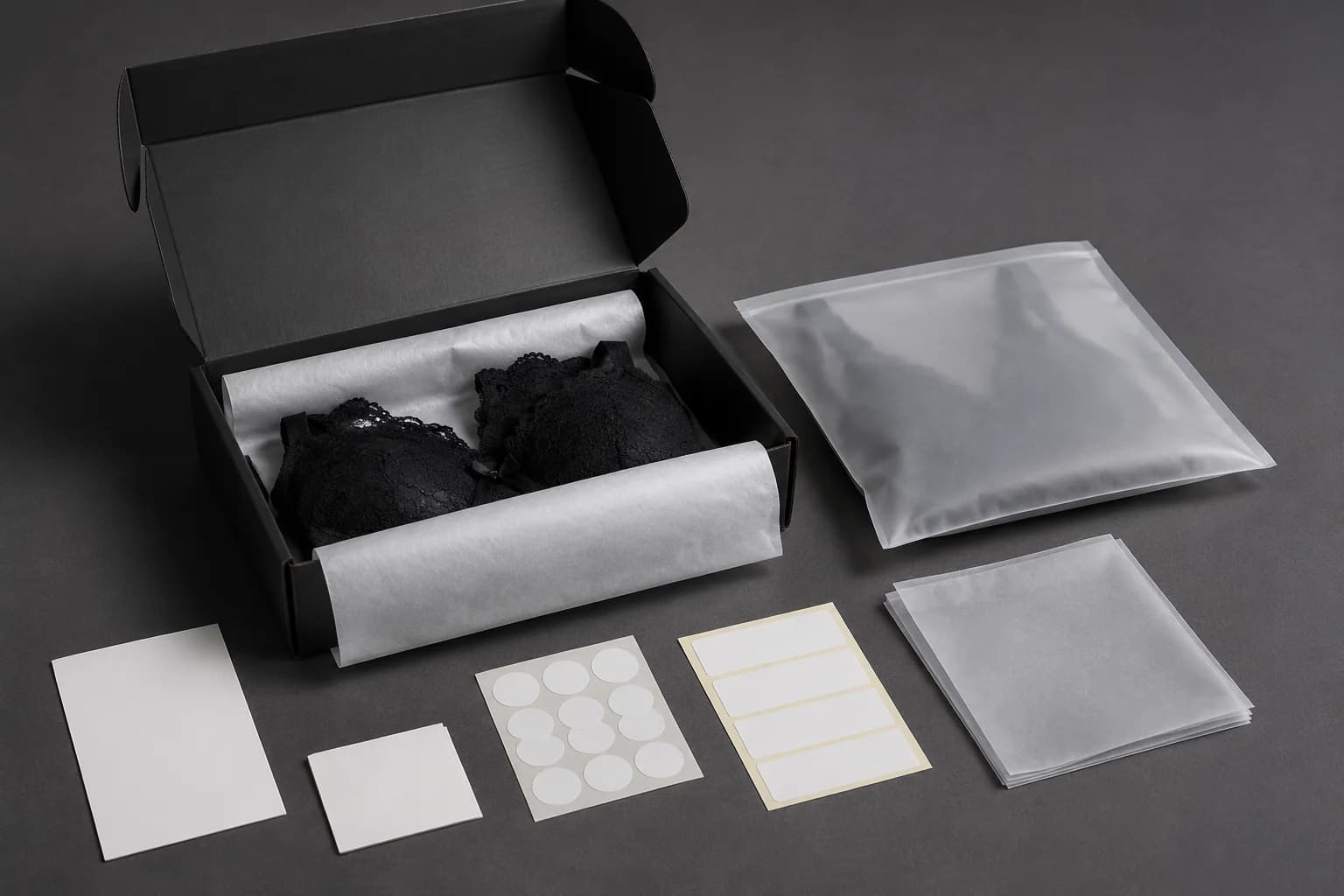
Packaging is a production decision, not a finishing detail. A lingerie set may be packed flat, folded, protected with tissue, placed in a printed polybag, hung on a hanger, inserted in a drawer box, packed by ratio, packed by store allocation, or prepared for e-commerce single-unit shipment. Each choice changes labor, MOQ, carton cube, barcode placement, and damage risk.
For retail orders, confirm folding method, cup protection, hanger type, size sticker position, barcode type and placement, hangtag attachment point, polybag warning text where required, carton assortment, carton mark layout, inner pack quantity, master carton quantity, and retailer routing-guide data. For distributor and private-label orders, decide whether cartons are packed by size, by color, by set, by ratio pack, or by warehouse receiving rule.
The 2026 carton example in this article uses a master carton measuring 60 centimeters by 40 centimeters by 35 centimeters. The scope is freight planning before shipment booking. The calculation is 60 cm x 40 cm x 35 cm = 84,000 cubic centimeters, or 0.084 cubic meters. For 120 cartons of that same size, the gross carton volume is 10.08 cubic meters before palletization, carton bulge, or carrier adjustments. The source basis is the carton volume formula; the buyer must verify packed dimensions, gross weight, and chargeable-weight rules with the forwarder.
- Request carton dimensions in centimeters and gross weight in kilograms before freight booking.
- Check whether molded cups, padded bras, wires, or boning need protection against crushing during sea, air, courier, or warehouse handling.
- Confirm whether the order ships as loose cartons, pallets, courier cartons, store-allocation cartons, or consolidated cargo.
- Verify importer, consignee, notify party, delivery term, commercial invoice data, packing list fields, country-of-origin statement if needed, and document deadlines before production finishes.
RFQ Wording That Prevents Re-Quoting
A good RFQ makes the supplier price the order the buyer actually plans to place. State the first-order quantity, color split, size ratio, target market, target channel, delivery term, packaging route, inspection plan, and document needs. If the buyer expects replenishment, separate forecast from the first PO so the supplier does not treat forecast units as committed quantity.
Ask the supplier to label assumptions. Useful wording includes stock lace assumed, custom color excluded, standard polybag included, third-party testing excluded, buyer inspection excluded, barcode stickers included, carton marks included, and freight not included. This makes competing quotes easier to compare and reduces price changes after sampling.
Ask for two schedules: fastest feasible timeline and controlled first-order timeline. The fastest path may suit repeat orders or stock-material styles. The controlled path is usually better for first orders, new fits, custom materials, wider size ranges, retailer packaging, or compliance-heavy programs.
- Timeline: Please provide separate lead times for tech pack review, first sample, revised sample, PP sample, material booking, bulk cutting, sewing, packing, final inspection readiness, and ex-factory date. State calendar days or business days for each stage.
- MOQ: Please break MOQ down by style, color, size range, lace, mesh, elastic, cup, wire, hook-and-eye tape, ring, slider, label, hangtag, barcode sticker, printed polybag, hanger, insert card, and carton.
- Materials: Please state which materials are supplier stock, which require dyeing or production, which may be substituted, and which require buyer approval before bulk booking.
- Samples: Please mark whether each sample uses exact bulk fabric and trims. If substitutes are used, list the difference and confirm whether fit, cost, color, or bulk performance may change.
- Packaging: Please quote unit packing, inner pack, master carton, barcode label, hangtag, polybag, carton mark, and any retailer routing requirement separately if not included in the garment unit price.
- QC: Please confirm inline QC availability, final inspection readiness date, inspection standard, AQL values if used, defect classification, measurement sample count, barcode scan requirement, and reinspection cost rule.
- Documents: Please list documents available before shipment, including commercial invoice, packing list, fiber composition, care label file, test reports if required, supplier declarations if available, and certificate scope documents if any claim is requested.
PO Release Checklist
Before issuing the PO, convert development discussion into written commercial and technical terms. Reference the final tech pack version, approved sample version, final BOM, color standards, packaging specification, MOQ, price, currency, payment terms, delivery term, inspection standard, shipment date, and required documents.
Check what the unit price includes. Sampling fees, courier fees, custom trim development, packaging artwork setup, testing, inspection, export cartons, hangtags, barcode labels, polybags, hangers, insert cards, and freight coordination should be listed as included, excluded, or quoted separately.
For repeat orders, verify material continuity before assuming the previous order can be copied. Lace pattern, elastic handfeel, hook-and-eye shade, cup pad shape, and packaging stock can change if the original material is gone. A repeat PO should reference retained samples, material codes, color standards, accepted deviations, and updated compliance documents.
- Final tech pack version and approved sample version.
- Final BOM with supplier codes, material descriptions, color references, and approved substitutions if any.
- Confirmed MOQ, price, currency, payment terms, and delivery term.
- Approved size ratio, color split, measurement tolerance table, and critical point-of-measure list.
- Packaging specification, barcode data, carton mark, carton assortment, and retailer routing requirements.
- Inspection plan, AQL values if used, critical defect list, measurement sample count, barcode scan rule, photo requirement, and reinspection rule.
- Compliance documents, test reports, certificate scope if any claim is requested, commercial invoice data, packing list fields, and shipping document requirements.
Procurement checklist
Before you send the inquiry
Target quantity and replenishment plan
Tech pack, reference sample, or construction notes
Fabric, lace, elastic, and hardware preferences
Size range, grading rules, and fit tolerance
Private-label packaging and barcode needs
Destination market and compliance requirements
FAQ
What is the ODM lingerie development timeline from tech pack to bulk production?
For a new style using mostly stock materials, the 2026 planning assumption in this article is 8 to 13 calendar weeks from complete tech pack to ex-factory bulk readiness, derived from sample, approval, production, packing, and inspection workflow estimates. For underwire, molded-cup, bodysuit, shapewear, custom-dyed lace, custom elastic, retailer-packaging, or size-set projects, the 2026 planning assumption is 10 to 18 calendar weeks. Both ranges must be verified in the supplier quote because material availability, approval speed, holiday calendars, testing, and factory capacity can change the schedule.
When can bulk cutting start for an ODM lingerie order?
Bulk cutting should start only after the final tech pack, BOM, color and trim approvals, size ratio, packaging specification, purchase order, payment terms, and pre-production sample are approved. The buyer should also lock barcode data, carton assortment, inspection standard, measurement tolerance table, and critical defect list before cutting release.
What MOQ should a buyer expect for ODM lingerie?
MOQ should be requested by style, color, size range, and component. A supplier may quote one garment MOQ, but lace, elastic, molded cups, wires, hook-and-eye tape, labels, hangtags, printed polybags, hangers, barcode stickers, and cartons can each have separate minimums. The 2026 launch-order example in this article shows that 600 sets across 3 colors and 5 sizes averages 40 sets per color-size combination, which may be too low for some custom components.
How should I ask a supplier for ODM lingerie sample lead time?
Ask for separate lead times for tech pack review, first sample, revised sample, PP sample, material booking, bulk cutting, sewing, packing, and inspection readiness. Also ask whether each sample uses bulk lace, mesh, elastic, cups, hardware, labels, and packaging, because substitute materials can make the first sample faster but less reliable for production approval.
Which sample should be treated as the production standard?
The pre-production sample is usually the safest production standard because it should reflect final materials, construction, measurements, trims, labels, and packaging. Earlier concept or fit samples may be useful for review, but they may not include the final bulk material or approved construction. The PO should name the approved sample version and tech pack version clearly.
What defects are most important to check in lingerie QC?
Important lingerie QC checks include cup symmetry, wire channel placement, elastic tension, skipped stitches, seam strength, lace alignment, shade matching, strap attachment, hook-and-eye position, gusset placement, label comfort, stains, oil marks, loose threads, barcode accuracy, carton marks, and carton assortment. Buyers should classify critical, major, and minor defects before inspection.
Related sourcing guides
P1 · b2b manufacturing guide
Best Lingerie Manufacturing Model for Startup Brands in 2026
Compare lingerie manufacturing models for startup brands in 2026. Learn how to evaluate MOQ, lead time, materials, QC, packaging, compl...
P1 · lingerie manufacturing
Best Lingerie Manufacturing Model for Startup Brands: How to Choose Without Overbuying
Compare wholesale, private label, ODM, OEM, and hybrid lingerie manufacturing models for startup brands. Includes MOQ checklist, lead t...
P1 · b2b manufacturing guide
Best Lingerie Manufacturing Model for Startup Brands: OEM vs Private Label vs Hybrid Guide
Compare OEM vs private label lingerie manufacturing for startup brands. Learn how to evaluate MOQ, lead time, cost, QC, packaging, comp...
P1 · b2b lingerie sourcing
Best Low MOQ Lingerie Products for Ecommerce Sellers in 2026: Top 5 Picks, Comparison Guide, Costs, MOQ, and RFQ Checklist
Compare Top 5 low MOQ lingerie products for ecommerce sellers in 2026. Review MOQ, cost drivers, lead time, packaging, QC, compliance d...