Short answer
A practical sourcing guide for startup lingerie brands comparing a low MOQ seamless lingerie manufacturer for startup brand orders, covering MOQ split rules, nylon-spandex seamless yarn, circular knitting risks, sample gates, QC checks, compliance documents, carton planning, and RFQ wording.
Key takeaways
What buyers should remember
- A low MOQ seamless lingerie manufacturer for startup brand orders should state the MOQ counting basis: per style, color, size, yarn lot, pad type, label, polybag, hangtag, barcode sticker, and carton mark.
- Pilot planning range: example assumption to verify in the supplier quote, 300 to 800 pieces per style for simple seamless briefs, thongs, light-control shorts, or bralettes when available yarns, standard trims, and simple export packing are used.
- Sampling calendar: example assumption to verify in the supplier quote, 7 to 12 business days for an initial sample, 5 to 10 business days for a correction sample after written comments, and 7 to 10 business days for a pre-production sample using bulk-intended materials.
- Measurement tolerance examples to verify in the supplier quote: garment body length plus or minus 1.0 cm per size, underband or waistband width plus or minus 0.5 cm per size, strap length plus or minus 0.5 cm per size, and front or back rise plus or minus 1.0 cm per size.
- Seamless lingerie inspection should name defects before production: shade bands, barre lines, needle lines, twisted panels, uneven waistband recovery, gusset placement drift, pad pocket distortion, loose yarn ends, and private-label packing errors.
- Named standards must be checked by document scope. A supplier practice, internal declaration, or buyer inspection rule is not the same as a current third-party certificate covering the relevant article, material, component, or packaging scope.
Buyer comparison table
What the first RFQ should decide
A startup buying from a low MOQ seamless lingerie manufacturer for startup brand testing needs a quote that answers one question first: what exactly is being tested? A useful pilot usually tests one or two base bodies, such as a seamless bralette with removable pads, a mid-rise brief, a thong, or a light-control short. When the first order adds too many colors, strap constructions, pad types, label formats, and carton rules, the buyer cannot tell whether sales results came from fit, price, color, channel, or merchandising.
The supplier choice should follow the pilot purpose. Fit validation needs size-set discipline and clear measurement tolerances. Online sales testing needs SKU depth, correct barcodes, and reliable packing. Retail buyer presentation needs better sample finish, label accuracy, and carton data. Replenishment forecasting needs a repeatable body and a documented production path.
Byline: Vincent Xi, Editorial Author, https://velora-intimates.com/authors/vincent-xi/. For Article or BlogPosting structured data, the author is a Person named Vincent Xi with jobTitle Editorial Author and the same author URL. Editorial attribution is limited to that author profile; this article does not claim factory visits, client outcomes, certifications, awards, lab testing, or unverified first-person experience.
- Use this guide when comparing a lingerie manufacturer, OEM lingerie manufacturing partner, private-label lingerie supplier, or lingerie wholesale supplier for a small seamless underwear pilot.
- State the buying brief in this order: garment type, target wearer, size range, color count, nylon-spandex or other yarn direction, fabric handfeel, support level, packaging plan, delivery term, and sales channel.
- Treat a low-MOQ offer as conditional until development, sampling, material availability, testing, packing, document support, and freight data are included in writing.
- Do not approve bulk production from photos when fit, compression, fabric handle, gusset position, pad movement, waistband recovery, or packaging is new.
When low MOQ is realistic
Low MOQ is most workable when the buyer stays close to the supplier's existing seamless base body, available yarn, standard stitch program, trim library, and export packing method. Pilot planning range: example assumption to verify in the supplier quote, 300 to 800 pieces per style can be workable for simple seamless briefs, thongs, light-control shorts, or bralettes when the color count is controlled and no exclusive yarn is required.
The same quantity becomes harder when the buyer requests custom dyed yarn, multiple seasonal shades, molded pads, special elastic, printed polybags, retailer hangers, and complex carton sorting. Those items may carry their own minimums even if the garment body MOQ looks low. The commercial decision is whether the pilot should validate demand or launch the final retail presentation; trying to do both can make the first order too expensive and too slow.
Ask for the MOQ ladder, not just the lowest number. Bulk comparison point: example assumption to verify in the supplier quote, 1,200 pieces per style may allow better setup absorption and material allocation after the body, yarn, color, and packaging are approved. That figure is a reference for quote comparison, not a universal supplier rule.
- RFQ wording: please quote MOQ per style, color, size, yarn lot, pad type, label, hangtag, barcode sticker, polybag, and carton mark.
- Inventory control: keep the first order to a tight size curve and 1 to 2 colors, an example assumption to verify against the buyer's sales plan, when sell-through is unknown.
- Hidden cost check: confirm whether leftover custom trims must be paid for, stored for repeat orders, shipped with the goods, or discarded by written instruction.
- Decision rule: compare landed cost per sellable unit, not only ex-factory unit price, because defects, rework, packing volume, and freight can erase a low quote.
Size and color split
A small order can become commercially weak when it is split too thinly. Example allocation to verify against the supplier quote and sales plan: a 500-piece style divided into 2 colors and 5 sizes leaves an average of 50 pieces per color-size SKU before returns, exchanges, photoshoot pulls, and safety stock. That may be enough for a narrow online test but not enough for wholesale replenishment or a retailer trial with multiple doors.
For seamless lingerie, each size may require more than a simple graded pattern. Stitch density, body length, underband or waistband width, rise, gusset placement, leg opening pressure, and recovery can change by size. The buyer should ask whether every size uses a separate knitting program and whether the supplier already has grade rules for the chosen body.
Color approval also affects MOQ. A core black or nude shade using available yarn may fit a low-MOQ plan, while a custom seasonal color may require yarn dyeing, lab dip approval, shade band control, trim matching, and separate packing checks. The buyer should decide whether color variety is worth the added uncertainty before the quote is compared.
- Spec fields: size range, sample size, grade rule, body length, half waist or underband relaxed, half waist or underband stretched, rise, leg opening, strap length, and folded pack size.
- Color fields: approved color name, color standard reference, buyer light-source condition if used, visible shade variation rule, shade-band rejection rule, and trim color matching rule.
- Packing fields: solid-color cartons, assorted-color cartons, solid-size cartons, assorted-size cartons, and barcode placement for warehouse receiving.
- RFQ wording: please confirm whether mixed sizes are allowed inside the style MOQ and whether each size requires a separate knitting minimum.
Sample gates
Sampling decides whether the order is ready for money, not whether the garment looks close enough in a photo. Sample timing example to verify in the supplier quote: 7 to 12 business days for an initial sample, 5 to 10 business days for a corrected sample after written comments, and 7 to 10 business days for a pre-production sample after materials, artwork, and comments are complete.
A physical sample matters because compression, recovery, handfeel, pad movement, gusset comfort, waistband pressure, and fabric show-through cannot be judged reliably from images. The buyer should keep a sealed approved sample and require the supplier to keep a matching reference. If only one size is approved, the purchase order should state whether that approval covers all sizes or whether size-set samples are required.
Tolerance examples to verify in the supplier quote: garment body length plus or minus 1.0 cm per size, underband or waistband width plus or minus 0.5 cm per size, strap length plus or minus 0.5 cm per size, and front-rise or back-rise plus or minus 1.0 cm per size. Tighter tolerances may look better on paper but can create avoidable rejections if they do not match the construction method and fabric recovery.
- Approval records: initial sample, correction sample, size-set sample if required, pre-production sample, sealed approval sample, and approved packaging sample.
- Bralette checks: underband recovery, pad movement, neckline stretch, strap comfort, side-wing stability, cup coverage, pad pocket opening, and label irritation risk.
- Brief and thong checks: gusset placement, leg opening pressure, waistband roll, back rise, fabric show-through under stretch, and side seam or bonding comfort if applicable.
- RFQ wording: no bulk production may begin until written sample comments are closed and the approved sample status is confirmed by both parties.
Spec fields buyers should lock
A mood board is not enough for a seamless lingerie quote. The supplier needs body type, support level, coverage, yarn composition target, spandex level if known, handfeel, opacity, stitch zones, underband or waistband construction, gusset material, pad pocket, removable pad details, label method, care label position, packaging, and inspection standard.
When the buyer does not know the exact material, the RFQ should say what the garment must do. For example, an everyday seamless brief may need a soft handfeel, moderate recovery, and opacity under normal wear. A light-control short may need firmer compression, stable support zones, and more careful recovery checks. Leaving the material field blank invites suppliers to quote different products at different prices.
Artwork readiness can delay a small order more than the garment body. Printed labels, woven labels, care labels, hangtags, barcode stickers, polybags, and carton marks should be approved before the pre-production sample. If artwork changes after sample approval, the supplier may need to requote, remake samples, or move the packing date.
- Product fields: style code, garment type, target wearer, coverage level, support level, size range, color names, sales channel, and reference sample status.
- Material fields: yarn composition target, nylon-spandex or other fiber direction, spandex level if known, handfeel, opacity, recovery, gusset material, pad type, elastic if any, lining if any, and trims.
- Construction fields: circular knitting body, stitch zones, rib support, edge finish, bonding or sewing method, gusset attachment, pad pocket opening, strap method, label position, and care label method.
- Commercial fields: MOQ basis, unit price ladder, sample cost, sample lead time, bulk lead time, payment term, quote validity, incoterm, packaging cost, carton data, and document list.
- Requote triggers: yarn change, color count change, pad change, stitch-zone change, grade-rule change, label change, packaging change, carton assortment change, or compliance-document change.
Construction risks to name early
Seamless lingerie has a different risk profile from cut-and-sew underwear. Circular knitting, jacquard zones, rib support, cutting, dyeing, heat setting, trimming, gusset attachment, pad insertion, label application, and folding can all change the final fit and appearance. The buyer should ask the supplier which process steps are fixed and which may change between sample and bulk.
Common defects include barre lines, shade bands, needle lines, uneven heat setting, twisted body panels, weak gusset attachment, loose yarn ends, excessive waistband pressure, unstable recovery, pad pocket distortion, incorrect label placement, and color transfer from dark shades. These risks should appear in the inspection checklist before production so both sides classify rejects in the same way.
Component information should be separated from garment-level claims. Shell yarn, gusset lining, pad cover, elastic, sewing thread, label, print, polybag, and carton material may have different composition or document support. For intimate-contact products, procurement should request component-level information where it affects labeling, compliance, comfort, or marketing claims.
- Dark-color risk: check colorfastness and color transfer expectations, especially for intimate-contact garments.
- Molded-pad risk: test pad movement, creasing, cup distortion, and packing pressure before approving bulk.
- Waistband risk: flat measurements may pass while wearer comfort fails because recovery and pressure are too firm.
- RFQ wording: please identify the main defect risks for this construction and state how knitting tension, heat setting, shade control, and gusset placement are checked before final inspection.
Inspection language that works
A practical QC plan should cover incoming materials, body formation, dyeing or shade approval, heat setting, trimming, sewing or bonding, measurement, metal control if applicable, final inspection, and packing. Buyer-selected final inspection can reference ISO 2859-1:1999 sampling procedures for inspection terminology and sample-plan structure; example buyer requirement to verify, AQL 2.5 for major defects and AQL 4.0 for minor defects. This is not a certification claim and does not guarantee that every unit is defect-free.
Critical defects should be written separately because AQL language alone is too broad. For seamless lingerie, critical defects may include contamination, broken needle risk, unsafe trim, wrong fiber label, severe shade mismatch, incorrect size label, wrong care instruction, or mixed-style packing that makes the goods unsellable.
Major defects may include twisted panels, poor gusset placement, unstable waistband recovery, open seams, visible holes, or measurements outside tolerance. Minor defects may include loose threads, slight folding marks, or small packaging scuffs within the buyer's accepted limit. These categories should be in the purchase order before final inspection.
- Inspection fields: inspection date window, inspection location, sampling plan, defect classification, measurement tolerance, shade-check method, packed-carton check, and reinspection responsibility.
- Measurement fields: relaxed measurement, stretched measurement where relevant, tolerance, measurement method, sample size, and whether measurements are checked before or after steam or rest time.
- Packing fields: size-color assortment, units per polybag, units per carton, carton mark, barcode scan requirement, and photo record of packed cartons.
- RFQ wording: supplier must allow final inspection before shipment and must not ship failed lots until disposition is agreed in writing.
Compliance documents
Compliance depends on destination market, product claim, material, dye, trim, label, and packaging. Procurement should request documents before deposit, but should not treat an internal supplier statement as a third-party certificate. If a named standard appears in the quote, ask for the current document, scope page, product or material coverage, validity period, issuing body, and any article number or component limitation.
Source context: OEKO-TEX STANDARD 100 official certificate validity guidance states certificate validity within a 12-month scope as of calendar year 2025. A buyer should request the current certificate if coverage is claimed. This does not mean a specific supplier, material, component, or finished product is certified.
Source context: EUR-Lex Regulation (EU) 2023/988, the General Product Safety Regulation, applies from 13 December 2024 for products placed on the European Union market. Source context: REACH Regulation (EC) No 1907/2006 frames chemical restrictions in the European Union. These sources help frame buyer checks; they do not replace destination-market legal review.
Startup brands should be careful with claims such as eco-friendly, non-toxic, certified, medical-grade, or skin-safe. A supplier document may cover only a yarn, dye, component, or facility rather than the finished article sold under the buyer's brand. Marketing language should follow the document scope and the destination market's rules.
- Document fields: fiber composition, care label basis, restricted-substances declaration, available fabric or component test reports, packaging declaration, and certificate scope if any named standard is claimed.
- Scope check: confirm whether the document covers the finished garment, shell material, gusset, pad, elastic, label, dye, packaging, or only a supplier facility.
- Label check: confirm fiber content, country-of-origin marking if required by the destination market, care instructions, size label, barcode, and importer or distributor details where applicable.
- RFQ wording: please provide only current documents that apply to the quoted product, material, component, or packaging scope; do not list standards without supporting documents.
Packing and freight math
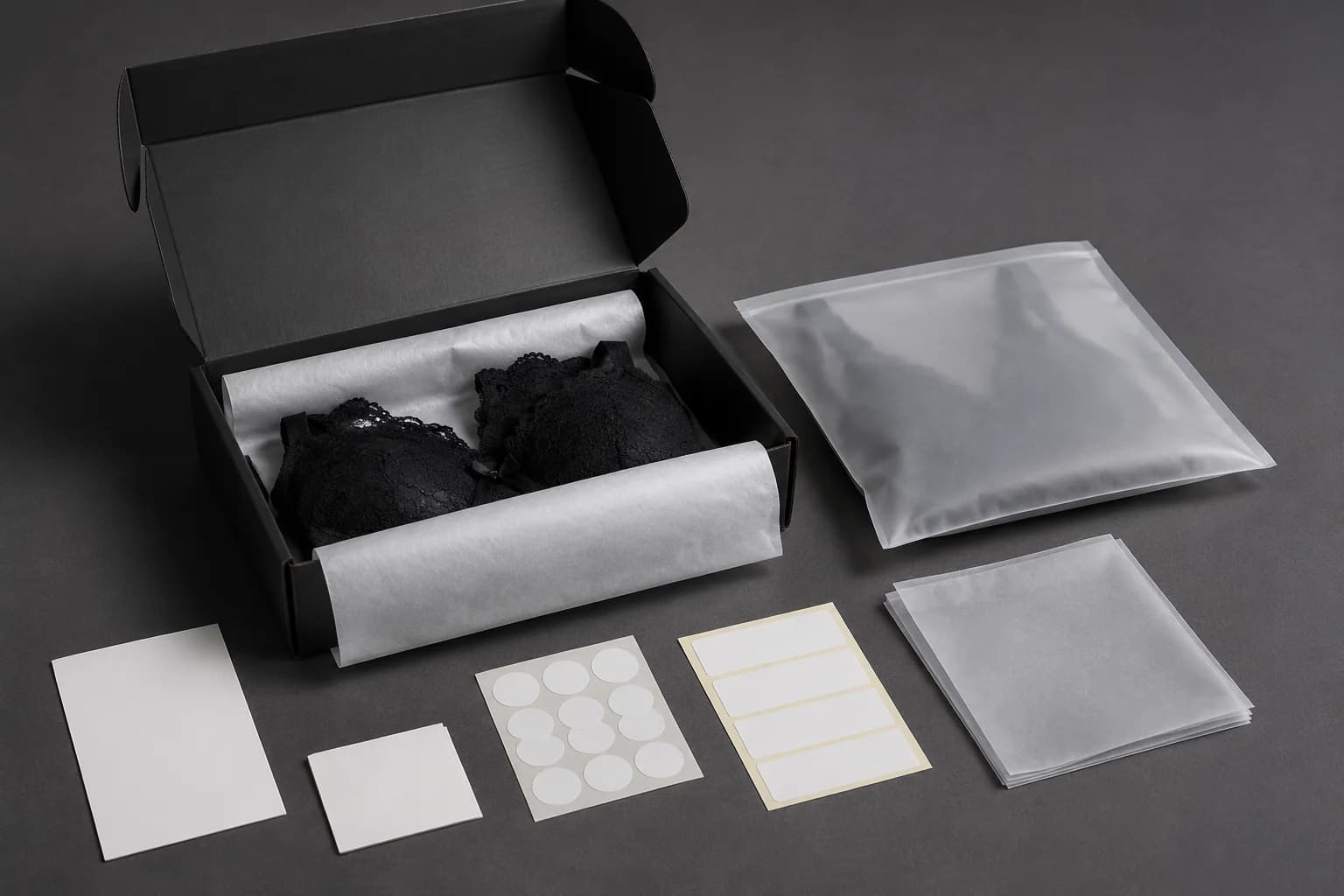
Packaging should be priced before suppliers are compared. Individual polybags, size stickers, care labels, hangtags, barcode labels, tissue, inserts, molded pads, retail boxes, and hangers all affect labor, carton volume, inspection time, and retailer acceptance. If the first order is mainly for market testing, a clean export pack with correct size and color identification may be better than full retail packing.
Freight planning starts with carton data. Example carton calculation to verify in the supplier quote: a 60 cm by 40 cm by 35 cm master carton equals 0.084 cubic meter per carton before carrier rounding rules. Example warehouse handling assumption to verify with the buyer's forwarder, a master carton gross weight below 15 kg may be easier for manual handling than heavier cartons.
Protective packing can reduce carton density. Bralettes with removable pads, retail boxes, hangers, or shape-sensitive inserts usually take more space than flat-packed briefs. Ask for a packed-carton photo set or carton-packing diagram before final inspection so repacking does not delay shipment.
- Packaging fields: individual polybag, recycled-content claim if supported, size sticker, barcode label, hangtag, tissue, insert, retail box, hanger, and carton mark.
- Carton fields: length, width, height, gross weight, net weight, units per carton, color-size assortment, solid-size or assorted-size carton rule, and carton numbering method.
- Freight fields: incoterm, handover location, ready date, inspection date, carton count, total gross weight, total volume, and whether courier, air, sea, or buyer forwarder is planned.
- RFQ wording: please provide carton dimensions, gross weight, net weight, units per carton, and packing method before the buyer compares freight options.
RFQ wording to copy
Send the supplier a controlled RFQ rather than a mood board with a target price. The quote should cover construction, material direction, fit target, order split, packaging, document expectations, delivery terms, and sample approval path. Where the buyer is unsure, write the assumption and ask the supplier to correct it.
The RFQ should also ask which changes trigger requoting. In seamless lingerie, a change to yarn, stitch tension, color count, pad type, label method, or packing can change setup time, material MOQ, production risk, and lead time. A clean quote states validity period, currency, payment term, sample charge, bulk lead time, incoterm, carton data, and document list.
- Quote one seamless bralette and one matching seamless brief using available yarn and standard trims unless otherwise stated.
- State MOQ per style, color, size, yarn lot, pad type, label, polybag, hangtag, barcode sticker, and carton mark.
- Provide a price ladder for the pilot quantity and the next practical bulk quantity; state what changes between the two quotes.
- Include initial sample lead time, correction sample lead time, pre-production sample lead time, and bulk lead time after written approval.
- Confirm measurement tolerances for body length, underband or waistband width, rise, strap length, leg opening, and folded pack size.
- Identify major defect risks for this construction and state the inspection method for shade, barre lines, twisted panels, gusset placement, pad movement, and packing accuracy.
- List available compliance documents and state the exact product, material, component, or packaging scope covered by each document.
- Provide carton length, width, height, gross weight, net weight, units per carton, carton assortment rule, and estimated ready date.
Method and limits
Methodology and source context: the planning ranges in this article are example buyer assumptions to verify in the supplier quote. They are derived from procurement comparison logic for seamless underwear workflows: material selection, circular knitting, dyeing or shade control, heat setting, trimming, gusset attachment, pad handling, label application, inspection, packing, and shipment planning.
Public source contexts used for compliance and inspection framing are OEKO-TEX STANDARD 100 official certificate validity guidance as of calendar year 2025, ISO 2859-1:1999 sampling procedures for inspection terminology, EUR-Lex Regulation (EU) 2023/988, and REACH Regulation (EC) No 1907/2006. Named standards and regulations are included only where they help buyers ask for the right documents; they are not claims about Velora Intimates or any supplier's certification status.
Limitations and what to verify: this article does not confirm Velora Intimates certification status, supplier capacity, factory address, lab result, buyer outcome, retailer approval, or current product availability. Buyers should verify current certificates, document scope, batch reports, fiber composition, care-label basis, destination-market label rules, quote validity, payment terms, production calendar, inspection access, carton data, and freight assumptions before deposit.
- Treat every planning number in this guide as an assumption unless the supplier confirms it in the formal quotation.
- Distinguish a named standard's requirement from a supplier's internal practice or buyer-requested inspection rule.
- Keep approved samples, sample comments, test documents, packing records, inspection reports, invoice, packing list, and shipment file in the same order record.
- Update the RFQ and purchase order after every sample correction so the final approved construction is reflected in the commercial documents.
Procurement checklist
Before you send the inquiry
Target quantity and replenishment plan
Tech pack, reference sample, or construction notes
Fabric, lace, elastic, and hardware preferences
Size range, grading rules, and fit tolerance
Private-label packaging and barcode needs
Destination market and compliance requirements
FAQ
How should a startup use this low MOQ seamless lingerie manufacturer for startup brand guide before sending an RFQ?
Use it as a pre-RFQ checklist. Confirm garment type, seamless base body, size range, color split, material direction, sample path, measurement tolerances, packaging, compliance documents, carton data, and delivery terms before asking for a unit price. The aim is to make suppliers quote the same scope.
What MOQ range is realistic for a startup seamless lingerie pilot?
Planning range: example assumption to verify in the supplier quote, 300 to 800 pieces per style may be workable for simple seamless briefs, thongs, light-control shorts, or bralettes using available yarns, standard trims, and controlled colors. Custom dyed yarn, exclusive elastic, molded pads, complex packaging, or too many colorways can push the practical MOQ higher.
What should the RFQ say if the buyer does not know the exact seamless fabric specification?
State the target instead of leaving the field blank. For example: quote available nylon-spandex seamless yarn suitable for a soft everyday brief, medium recovery, opaque under normal wear, with gusset material identified separately. Ask the supplier to propose available swatches, composition, sample timing, and any MOQ limits.
Should a startup choose seamless lingerie or cut-and-sew lingerie for a small launch?
Seamless lingerie can be useful when the brand needs smooth edges, stretch comfort, clean base-body styling, and reduced visible seams. Cut-and-sew lingerie may be better when the design needs lace placement, structured cups, multiple fabric panels, or visible fashion styling. The decision should follow fit target, material risk, MOQ structure, and sample approval capacity.
What documents should be requested before paying a low-MOQ lingerie deposit?
Request the formal quotation, product specification, sample invoice if applicable, material composition, care-label basis, available test reports or certificates, packaging details, carton plan, lead time, payment term, incoterm, and shipment document list. If a named standard is mentioned, request the current document and confirm the article, material, or component scope.
How many seamless lingerie samples should be approved before bulk production?
Sample path example to verify in the supplier quote: an initial sample, a corrected sample if comments are needed, and a pre-production sample made with bulk-intended materials before mass production. The buyer should keep a sealed approved reference and close measurement, color, construction, label, and packaging comments in writing.
Related sourcing guides
P1 · b2b manufacturing guide
Best Lingerie Manufacturing Model for Startup Brands in 2026
Compare lingerie manufacturing models for startup brands in 2026. Learn how to evaluate MOQ, lead time, materials, QC, packaging, compl...
P1 · lingerie manufacturing
Best Lingerie Manufacturing Model for Startup Brands: How to Choose Without Overbuying
Compare wholesale, private label, ODM, OEM, and hybrid lingerie manufacturing models for startup brands. Includes MOQ checklist, lead t...
P1 · b2b manufacturing guide
Best Lingerie Manufacturing Model for Startup Brands: OEM vs Private Label vs Hybrid Guide
Compare OEM vs private label lingerie manufacturing for startup brands. Learn how to evaluate MOQ, lead time, cost, QC, packaging, comp...
P1 · b2b lingerie sourcing
Best Low MOQ Lingerie Products for Ecommerce Sellers in 2026: Top 5 Picks, Comparison Guide, Costs, MOQ, and RFQ Checklist
Compare Top 5 low MOQ lingerie products for ecommerce sellers in 2026. Review MOQ, cost drivers, lead time, packaging, QC, compliance d...