Short answer
Practical procurement guidance for lingerie buyers who need retail-ready insert cards, UPC or EAN barcode labels, packaging BOMs, carton labels, care label files, MOQs, samples, and QC controls before a retail launch.
Key takeaways
What buyers should remember
- Lingerie packaging inserts and barcode requirements for retail launch should be controlled before artwork is released, because a printed symbol is only useful when it matches the accepted sellable-unit data.
- Barcode ownership, GTIN or UPC/EAN data, retailer SKU mapping, price-ticket rules, and carton-label fields should be checked in one SKU matrix before printing.
- For lingerie, the insert card has to be reviewed against garment shape, lace or mesh snag risk, satin or microfiber surface risk, molded-cup compression, and the actual pack method.
- Ask suppliers to quote garment MOQ and packaging MOQ separately, including hangtags, insert cards, barcode stickers, size stickers, polybags, hangers, retail boxes, export cartons, setup fees, samples, reprints, and waste allowance.
- Approve a physical packed sample before bulk packaging production when barcode scan quality, sticker adhesive, folded size, molded-cup protection, or carton quantity affects the launch.
- Keep the SKU matrix, barcode list, packaging BOM, label artwork, carton plan, retailer manual, inspection checklist, and approval log in one controlled launch file.
Buyer comparison table
Retail Launch Packaging Starts With the Sellable Unit
Lingerie packaging inserts and barcode requirements for retail launch start with one procurement question: what exactly will the retailer sell as one unit? A single bra, a bra-and-panty set, a 3-piece panty pack, a shapewear garment, and a boxed sleepwear set may each need different barcode logic, insert structure, care label placement, and carton packing. Do not let the supplier quote retail-ready lingerie packaging until the sellable unit is fixed.
The second decision is where the unit will be scanned. A barcode on a belly band may work for folded panties but fail on a curved bra pack. A barcode inside a polybag may help warehouse checking but be useless at retail point of sale. A barcode printed on a glossy hangtag may need a different stock or finish if scan contrast is poor.
The third decision is who controls launch data. The buyer should own or approve the SKU matrix that connects vendor style number, retailer SKU, color, size, GTIN or UPC/EAN, ticket price if required, item description, purchase order, and carton plan. If merchandising, compliance, and logistics use different spreadsheets, packaging errors become hard to catch before printing.
Byline: Vincent Xi, Editorial Author, Velora Intimates. Author profile: https://velora-intimates.com/authors/vincent-xi/. This article is based on editorial review of public source contexts and buyer-facing procurement document structures. It does not claim factory testing, retailer approval, certifications, awards, client outcomes, or first-person production experience.
- Lock the sellable unit before barcode artwork is prepared.
- Decide whether the barcode belongs on a hangtag, sticker, belly band, retail box, or other visible unit-pack surface.
- Keep one approved SKU matrix as the reference for artwork, packing lists, carton labels, and inspection.
- Approve a packed physical sample when garment shape or scan position matters.
The Retail-Ready Lingerie Packaging Checklist
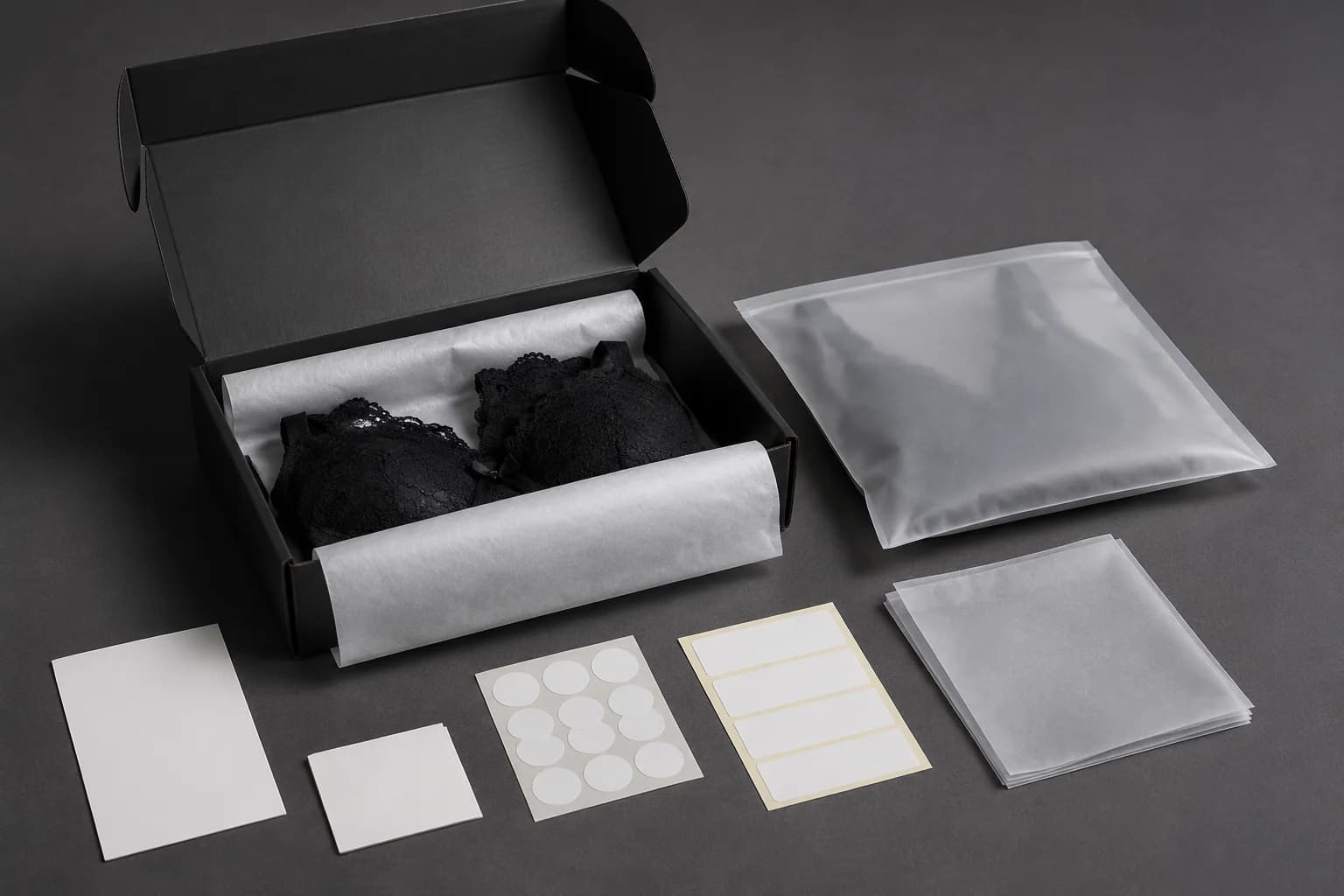
A practical retail-ready lingerie packaging checklist covers more than a printed card and a barcode. Controlled items can include hangtag, sewn brand label, care label, size sticker, barcode sticker, insert card, tissue, cup support, polybag, retail box, hanger, sizer, carton label, destination label, and sometimes a store-allocation label. Each item should have a purpose, owner, approval status, cost line, and MOQ line.
Separate the launch file into three working layers. The consumer layer covers brand presentation, size, fiber content, care information, country-of-origin wording, warnings where applicable, and claim language. The retailer layer covers GTIN or UPC/EAN, retailer SKU, vendor style, color code, size code, price-ticket rules, and item-file descriptions. The logistics layer covers PO number, carton count, carton sequence, pack ratio, gross weight, net weight, carton size, destination, and mixed-carton contents.
Use small calculations to catch missing data early. Example calculation to verify against the final SKU file: 1 bralette style with 3 colorways and 5 sizes creates 15 sellable SKUs as of SKU approval. If each SKU needs 1 barcode and 1 size sticker, the buyer has 30 variable-data items to check before bulk printing. This is a control calculation, not a universal packaging rule.
- Confirm whether the same garment uses different packaging for retail floor, marketplace fulfillment, wholesale replenishment, or private-label delivery.
- State who supplies barcode files: buyer, retailer, nominated ticketing vendor, supplier, or packaging printer.
- Make multipack and set identity explicit before artwork starts.
- Name the final approval owner for SKU data, label content, and carton-label format.
Barcode Ownership Is a Commercial Control
Before discussing label size or print method, settle barcode ownership. In many retail programs, the retailer, brand owner, or approved item-data owner supplies GS1-based GTINs, commonly displayed as UPC-A in the United States or EAN-13 in other markets. GS1 US public guidance reviewed for editorial use in 2026 states that UPC barcodes are built from GS1 Company Prefixes assigned to companies. A supplier can print buyer-supplied barcode artwork, but printing the symbol does not make the supplier the owner of the product identity.
Next, confirm the symbol the retailer accepts. UPC-A, EAN-13, GS1 DataMatrix, Code 128, QR code, and retailer-specific ticket formats serve different purposes. A QR code for product information should not replace a retailer-required sellable-unit barcode unless the retailer says so in writing. If the retailer requires a nominated ticketing vendor, build that vendor's timing into the production calendar.
Then check whether the symbol can actually be scanned after packing. Soft packaging creates risk because labels bend, fold, wrinkle, and shift. Quiet zones, contrast, human-readable numbers, sticker stock, varnish, and placement all matter. A quick smartphone scan can catch obvious data errors, but it is not a substitute for retailer-required barcode verification when the retailer specifies one.
Example calculation to verify with the purchase order: 2 bra styles, 4 colors per style, and 6 sizes per style create 48 sellable SKUs as of final item setup. If the retailer requires separate pre-pack cartons by SKU, the carton plan needs content control for each of those 48 SKU lines unless mixed cartons are approved.
- RFQ field: barcode owner, issuing organization, and whether data is buyer-supplied, retailer-supplied, or vendor-supplied.
- RFQ field: symbology, printed size, quiet-zone requirement, barcode color, background color, label stock, and print surface.
- RFQ field: vendor style, retailer SKU, color name, color code, size, cup size if applicable, GTIN, price if required, and item description.
- QC checkpoint: scan a retained sample from the first printed batch and compare the result with the approved SKU matrix.
- Risk to flag: old barcode artwork reused from a previous season because file names were not controlled.
UPC and EAN Barcode Label Placement for Lingerie
UPC and EAN barcode label placement for lingerie should be checked on the packed product, not only on the label artwork. A hangtag barcode can become curved when it hangs from a bra strap. A belly-band barcode can cross a fold when folded panties are compressed. A box-panel barcode can sit too close to an edge if the box is hand-assembled with poor alignment.
Ask the supplier to mark the barcode position from a fixed point, such as the lower-right corner of a hangtag, sticker, belly band, or retail box panel. For stickers, define whether the adhesive is removable or permanent, whether the sticker touches film, card, or garment, and whether residue is acceptable. For transparent polybags, confirm that the barcode background remains high contrast after the garment color is visible behind it.
A barcode check should include data and usability. Compare the scanned number with the approved SKU matrix, check the human-readable digits, inspect quiet zones, and confirm that the barcode is not wrinkled, scuffed, covered by a price ticket, or blocked by the polybag seal.
- Placement check: barcode remains flat after folding, hanging, boxing, and carton packing.
- Material check: sticker stock, varnish, matte finish, or lamination does not reduce scan contrast.
- Data check: GTIN, UPC-A, EAN-13, or retailer ticket data matches the item file.
- Handling check: sticker adhesive does not mark satin, microfiber, lace, mesh, elastic, or printed film.
Insert Cards Need Product Specs
A bra insert card specification should start with function. A molded bra insert may protect cup shape. A panty belly band may hold a multipack together. A folded leaflet may carry care or product information. A plain card may separate hooks from lace. The function determines thickness, surface finish, size, edge treatment, and where the barcode can sit.
Quote insert material with measurable fields. For a paper insert, specify paper type, paper weight, finished size in millimeters, finish, lamination if any, print colors, folding method, corner radius if used, dimensional tolerance, and whether the insert touches the garment. Example specification to verify in the supplier quote: one insert card, 300 gsm paperboard, 120 mm x 180 mm finished size, 4-color process print, matte finish, and plus or minus 2 mm dimensional tolerance as of packed-sample approval.
Check contact risk before bulk printing. Dark paper can mark light lace. Rough kraft stock can abrade satin. Gloss coating can transfer under humidity. A stiff card can flatten molded cups. Ink odor can be noticeable in sealed polybags. If the insert contacts the garment during packed storage, add rub, odor, abrasion, and dye-transfer checks to the sample review.
Do not merge care labels with removable packaging decisions. Sewn care labels and fiber content statements may be legal labeling requirements, while insert cards are often brand or handling materials. In the United States, the FTC Care Labeling Rule at 16 CFR Part 423 addresses care instructions for covered textile wearing apparel; source context reviewed for editorial use in 2026. Final label wording should be verified for the destination market and exact product category.
- Specification field: insert material, paper weight in gsm, finish, lamination, print colors, and documented material claims.
- Specification field: width, height, fold position, corner radius, tolerance, and contact surface.
- Specification field: hangtag size, string or pin material, attachment point, and snag-risk check for lace, mesh, elastic, and satin.
- Specification field: barcode sticker stock, adhesive type, residue risk, and whether the sticker is removable or permanent.
- Specification field: care label content, language version, placement, seam allowance impact, and comfort risk for skin-contact garments.
Sets and Multipacks Need One Product Identity
Panty multipack barcode requirements are often misunderstood because the individual garment is not always the sellable unit. If 3 panties are sold as 1 retail unit, the outer package usually needs a barcode for the pack. The retailer may also request internal item coding, but that is a separate rule to confirm.
A bra-and-panty set needs the same discipline. Decide whether the set has 1 combined barcode, component barcodes, or both. The answer affects returns, markdowns, stock counts, item descriptions, and replacement handling. It also affects label copy because the size structure may combine bra size and panty size.
Outer labels must match everything inside. A size sticker on a belly band is not enough if pack contents are mixed incorrectly. First-piece inspection should open the pack and confirm component count, colors, sizes, inserts, barcode, and label position before the packing team continues.
- Decision: one sellable-unit barcode for the pack, component codes, or both.
- Decision: whether outer label size wording matches every garment inside.
- Decision: whether the retailer allows mixed-size sets or requires fixed set combinations.
- QC checkpoint: open sample multipacks across colors and sizes during in-process inspection.
Garment MOQ Versus Packaging MOQ
Garment MOQ versus packaging MOQ should be quoted as separate lines. A low garment MOQ does not guarantee a low packaging MOQ. Outside printers may set minimums for hangtags, insert cards, barcode stickers, printed polybags, belly bands, retail boxes, and branded tissue. If these are bundled into one price, the buyer cannot see which component is driving cost, timing, or leftover stock.
Example MOQ scenario to verify in the supplier quote: a 600-piece garment order for one retail launch may still require 1,000 printed insert cards because of printer setup economics. A custom retail box may require 3,000 boxes if sourced from a separate packaging vendor. These are example quantities, not Velora Intimates terms or universal market minimums.
Lead time also needs separate lines. Artwork proofing, barcode data setup, retailer ticketing approval, printed packaging production, incoming packaging check, packing-line setup, final inspection, and shipment booking move on different schedules. Example planning assumption to verify with the supplier, printer, and retailer: 5 to 10 working days for artwork proofing, 7 to 15 working days for printed packaging production after written approval, and 2 to 5 working days for packing-line preparation before inspection.
Decide reprint responsibility before any file is released. If buyer data is wrong, the buyer may own the reprint cost. If the supplier uses an old file, the supplier may own it. If the retailer changes ticketing rules after approval, the commercial impact should be agreed in writing. This belongs in the RFQ, not in a dispute after cartons are packed.
- RFQ field: garment MOQ by style, color, and size.
- RFQ field: packaging MOQ by hangtag, insert card, barcode sticker, size sticker, polybag, hanger, box, and carton label.
- RFQ field: unit packaging cost, setup charge, plate or die-cut fee, sample fee, courier fee, and waste allowance.
- RFQ field: artwork proof timing, physical sample timing, printed packaging lead time, packing start date, inspection date, and shipment booking deadline.
- RFQ field: reprint responsibility for buyer data error, supplier handling error, printer defect, or retailer rule change.
Tolerance Fields That Prevent Receiving Problems
Tolerances turn packaging from a design idea into a production spec. Without them, a supplier may deliver something close to the artwork but still create retail intake problems. Lock dimensions, placement, print method, material, data version, and defect classification before mass printing.
Start with physical measurements. Important fields include insert width and height, hangtag size, sticker size, barcode printed size, polybag dimensions, folded garment size, carton dimensions, and maximum carton gross weight. Example sample-control assumption to verify after packing: a folded molded-bra pack measures 280 mm x 220 mm x 60 mm as of packed-sample review. Carton quantity should be recalculated after that packed-unit size is confirmed.
Placement matters as much as size. A barcode position should be measured from a fixed reference point, such as the lower-right corner of a hangtag or box panel. A size sticker should not cover fiber content, care wording, price ticket, or a retailer-required mark. A hangtag should not sit where it presses into a molded cup during carton packing.
Control file names and approval dates. Avoid names such as final-tag-v3-new.pdf. A stronger file name includes style, market, date, and version. The supplier should confirm that the print file matches the final purchase order and SKU matrix before packaging production starts.
- Tolerance field: insert dimension, such as plus or minus 2 mm if accepted by buyer and printer as of sample approval.
- Tolerance field: barcode location measured from a fixed point on the hangtag, sticker, belly band, or box panel.
- Tolerance field: folded garment size range after insert, tag, sticker, and polybag application.
- Tolerance field: carton gross weight maximum based on retailer, warehouse, or forwarder rules.
- Tolerance field: unacceptable barcode defects, including smudging, missing bars, low contrast, scuffed stickers, and damaged quiet zones.
- Tolerance field: packaging cosmetic defects, including crushed corners, torn polybags, skewed stickers, poor die cuts, and visible ink rub.
Packaging QC Before Final Inspection
Packaging QC needs an early checkpoint. Once the wrong barcode is packed into sealed cartons, correction can require reopening cartons, relabeling units, rebuilding pack ratios, revising packing lists, and delaying shipment. Ask the supplier whether packaging checks are included in the quoted QC scope or priced separately.
Incoming packaging inspection should check quantity, material, color, print position, barcode readability, spelling, size data, artwork version, and damage. This check is especially important when printed packaging arrives from an outside printer after garment production has already started.
First-piece packing inspection should match the correct garment with the correct insert, care label, size sticker, barcode, polybag, hanger or box, and carton label. The first full carton should be weighed, measured, opened, and compared with the SKU matrix and packing list before the packing line continues.
In-process inspection should sample across similar sizes and colors. Seamless panties, sister bra sizes, black and navy shades, and multipack combinations are easy to mix. Molded bras add a different risk: cup deformation from tight cartons or poor nesting may not be visible until a packed carton is opened.
If AQL inspection is used, decide how packaging defects are classified. A wrong barcode is usually a serious operational defect because it can block receiving or distort sales data. A missing legally required label may be critical or major depending on the buyer's classification and market. A scuffed insert may be minor unless the retailer sells the product in visible packaging.
- QC checkpoint: incoming printed packaging count, material, color, damage, and artwork version.
- QC checkpoint: barcode scan and human-readable number comparison against the approved SKU file.
- QC checkpoint: one full carton packed, weighed, measured, labeled, opened, and checked against the carton plan.
- QC checkpoint: molded cups inspected after packing for compression, creasing, and wire distortion.
- QC checkpoint: carton sequence numbers checked against packing list, PO number, destination, and shipping marks.
- QC checkpoint: one approved packed unit and one carton label sample retained for dispute handling.
Compliance Files and Standards
The buyer's launch file should combine product compliance, packaging information, barcode records, and logistics documents. Typical records include care label artwork, fiber content, country-of-origin statement, test reports where applicable, restricted substance declarations where applicable, packaging material information, barcode list, purchase order, packing list, invoice, carton label template, retailer manual, and approval log.
For European market launches, textile fiber naming and labeling rules are governed by Regulation (EU) No 1007/2011; source context: EUR-Lex public regulation text reviewed for editorial use in 2026. For the United States, FTC textile labeling and care labeling frameworks may apply to covered products, including the FTC Care Labeling Rule at 16 CFR Part 423. For barcode identity, GS1 guidance and retailer item setup guides are relevant. These source contexts do not mean Velora Intimates holds a certification or that any specific product is compliant.
Name a standard only when it applies to the exact claim or requirement. If a retailer requires GS1 barcode verification, that is the retailer's requirement. If the buyer asks for FSC-certified paper packaging, current certificate scope and claim permission must be checked before using the mark. If OEKO-TEX, GRS, or another material document is requested, verify whether the current document covers the exact fabric, trim, label, or packaging component.
Methodology note: this guidance is derived from public regulatory source contexts, GS1 barcode guidance, and common retail launch control documents such as SKU matrices, packaging specifications, carton plans, RFQ structures, inspection checklists, and approval logs. Numerical SKU counts, material weights, MOQ quantities, dimensions, and lead-time ranges in this article are example calculations or assumptions to verify in the supplier quote, retailer manual, and physical packed sample.
Limitations note: this article is not legal advice, certification advice, barcode registration advice, or a substitute for retailer onboarding rules. Buyers must verify current legal labeling, retailer routing, barcode ownership, material claims, packaging MOQ, lead time, carton limits, and defect classifications for the exact product, market, supplier, and sales channel.
- Document to request: final care label artwork, language version, fiber content, care symbols or wording, and country-of-origin statement.
- Document to request: barcode list with GTIN, retailer SKU, vendor style, color, size, and sellable-unit definition.
- Document to request: packaging material specification and current documents supporting any environmental or material claim.
- Document to request: carton label template, completed packing list, PO reference, and carton sequence format.
- Document to request: retailer routing guide, ticketing manual, nominated vendor instructions, and approval log.
Lingerie Carton Label Checklist
Carton planning starts after the packed sample, not from the garment measurement alone. Packaging choices change freight cost. A rigid box may improve shelf presentation but increase cubic volume. A thin polybag may save space but offer less protection for molded cups or delicate trims. Inserts add stability but can add bulk. A hanger may be required for floor-ready merchandise but inefficient inside export cartons.
Calculate cartons from the packed unit. Example calculation framework to verify with a real packing trial: if one packed bralette measures 240 mm x 180 mm x 25 mm as of approved packed-sample review, a 600 mm x 400 mm x 300 mm carton gives only a nominal volume comparison. Practical carton quantity may be lower because of compression limits, carton strength, barcode protection, dividers, and worker packing method.
Store allocation changes the carton-label problem. Some retailers require pre-ticketed, pre-packed cartons by store. Others require bulk cartons by SKU for distribution-center allocation. Store-ready cartons may need destination codes, carton sequence numbers, SSCC labels, carrier routing labels, or retailer-specific ticketing. The supplier should receive these fields from the buyer, retailer, or nominated system, not invent them.
Freight booking should wait for packed carton data. If barcode stickers arrive late, sewn goods may be finished but unshippable. If carton labels are delayed, sealed cartons may need reopening. If retail boxes arrive crushed from the packaging printer, the packing line may stop. The launch schedule should follow the latest required packaging component, not only the sewing completion date.
- RFQ field: export carton length, width, height, board grade if specified, and maximum gross weight.
- RFQ field: pack ratio by SKU, color, and size, including mixed-carton permission.
- RFQ field: carton label data source, approval deadline, file format, and responsibility for data errors.
- RFQ field: palletization requirement, SSCC label requirement, or forwarder carton-marking rule if applicable.
- RFQ field: packed-unit dimensions and carton dimensions after physical sample packing.
- Risk to flag: unit packaging increases cubic weight enough to change freight cost materially.
RFQ Wording for Packaging BOMs
A useful RFQ separates the garment from the packaging system. Ask for the garment cost, sewn labels, hangtags, insert cards, barcode stickers, unit packaging, retail boxes, export cartons, inspection, and documentation as separate lines. This shows whether the quote includes the launch work or only the garment.
Ask who handles artwork and who checks data. The buyer should know whether packaging is produced by the lingerie supplier, a local printer, a buyer-nominated packaging vendor, or a retailer-nominated ticketing vendor. That decision affects payment, sample timing, reprint responsibility, and who controls final files.
For low-MOQ launches, keep the packaging route realistic. A custom rigid box can raise minimums, extend lead time, and increase freight volume. A standard polybag with a custom insert and verified barcode label may be easier for a first retail test. For a department-store floor program, hangers, sizers, belly bands, price tickets, and store-allocation labels may be mandatory.
Sample RFQ wording: Please quote unit packaging separately from garment cost. Include MOQ, unit price, setup charge, artwork proof timing, physical sample timing, bulk packaging lead time, barcode print method, barcode verification responsibility, and reprint terms for each packaging component. Quote assumptions must state paper weight, insert size, sticker size, number of barcode versions, polybag size, carton size, pack ratio, and whether retailer ticketing rules are included.
- Company and project: brand, destination market, sales channel, launch date, retailer if disclosure is allowed, and replenishment model.
- Product scope: vendor style number, product type, size range, cup-size range if applicable, colors, estimated order quantity, and set or multipack structure.
- Packaging scope: hangtag, insert, care label, woven label, size sticker, barcode sticker, polybag, hanger, box, carton, pallet label, and store-allocation label if required.
- Barcode scope: owner, GTIN list, symbology, artwork source, verification requirement, placement, variable-data count, and approval owner.
- Cost scope: garment MOQ, packaging MOQ, unit packaging cost, setup fee, sample fee, courier fee, reprint responsibility, and waste allowance.
- Timing scope: artwork proof, physical sample, printed packaging, garment production, packing, inspection, and shipment booking.
- QC scope: AQL plan if used, defect classification, compliance files, packing list, carton label, retained sample, and approval log.
Retail Launch Risk Register
Packaging risk usually comes from mismatched files, not dramatic production failure. A style name changes in the sales file but not the barcode file. A color code changes on the purchase order but not the carton label. A retailer updates ticket placement after hangtags are printed. These are procurement control issues.
Build a short risk register before sample approval. Each risk should have an owner, source file, consequence, checkpoint, and final approver. For example, barcode-data mismatch can block retail receiving, so the checkpoint is scan comparison against the approved SKU matrix before bulk printing and again during first-carton packing.
Use the risk register during changes. If merchandising changes a color name, the GTIN may not change, but hangtag copy and carton descriptions might. If compliance changes care wording, sewn labels and insert language may need revision. If the retailer changes a routing label, carton printing may need to pause.
- Risk: barcode data does not match the retailer item file. Control: buyer-approved SKU matrix and retained barcode scan record.
- Risk: insert stiffness damages molded cups. Control: packed physical sample and cup-shape inspection after carton packing.
- Risk: sticker adhesive marks satin, lace, mesh, or microfiber. Control: adhesive sample check on production-equivalent packaging surface.
- Risk: multipack outer label does not match all pieces inside. Control: first-piece check and in-process sampling across colors and sizes.
- Risk: carton labels omit PO number, destination, or carton sequence. Control: carton label template approval before packing starts.
- Risk: packaging MOQ exceeds garment MOQ. Control: separate MOQ and surcharge lines in the supplier quotation.
Purchase Order Release Check
Before releasing the purchase order, confirm that the supplier has the final SKU matrix, packaging specification, barcode files, care label artwork, carton rules, retailer manual, and inspection criteria. If a field is still open, name the owner and deadline. Bulk packaging should not start with unresolved barcode ownership, label content, or carton routing.
Approve the packed sample as a production reference. It should include the live barcode, final insert, care label, size sticker, hangtag, polybag or box, carton label format, and actual folding method. Keep one retained sample with the supplier and one with the buyer when possible.
Release the order with a change-control rule. Any later change to color name, size wording, barcode file, care instruction, packaging material, carton label, or routing requirement should trigger written confirmation of cost, timing, reprint exposure, and approval status.
A complete launch pack gives the buyer leverage during quotation and inspection: approved garment sample, approved packed sample, live barcode scan record, SKU matrix, packaging BOM, compliance file, carton plan, packing list format, inspection checklist, approval log, and retained sample.
- Do not approve bulk packaging from flat artwork alone when barcode scan or garment shape matters.
- Do not let a supplier create retail identity codes unless the retailer accepts that structure.
- Do not mix legal label content, marketing insert copy, and carton routing data in one uncontrolled file.
- Do not assume packaging MOQ equals garment MOQ.
- Do not book freight until carton dimensions, gross weight, and carton count are confirmed from packed samples or production packing.
Procurement checklist
Before you send the inquiry
Target quantity and replenishment plan
Tech pack, reference sample, or construction notes
Fabric, lace, elastic, and hardware preferences
Size range, grading rules, and fit tolerance
Private-label packaging and barcode needs
Destination market and compliance requirements
FAQ
What are the key lingerie packaging inserts and barcode requirements for retail launch?
The key lingerie packaging inserts and barcode requirements for retail launch are a controlled packaging specification, approved GTIN or UPC/EAN barcode data, care and fiber label content, physical packed-sample approval, carton label rules, and a SKU matrix that matches the retailer item file. Buyers should also check insert stiffness, sticker adhesive, cup protection, folded pack size, multipack identity, and barcode scan position after packing.
Where should a UPC or EAN barcode go on lingerie packaging?
The barcode should sit on the sellable unit where retail receiving or point-of-sale staff can scan it without opening the pack. Common positions include a hangtag, price ticket, belly band, barcode sticker, or retail box panel. Buyers should test the position after folding, hanging, boxing, polybag sealing, and carton packing.
Should the supplier or brand owner provide the barcode?
For most retail launches, the brand owner, retailer, or approved item-data owner should provide the GTIN or barcode data. The supplier may print and apply the barcode, but the buyer should verify ownership and retailer acceptance before artwork release. GS1 US public guidance reviewed for editorial use in 2026 states that UPC barcodes are built from GS1 Company Prefixes assigned to companies.
Can one barcode cover a lingerie set or multipack?
Yes, if the set or multipack is sold as one retail unit, it commonly needs one sellable-unit barcode. Components may also need internal labels depending on the retailer or warehouse process. Buyers should confirm whether the barcode identifies the set, each component, or both before printing the outer label.
What should a bra insert card specification include?
A bra insert card specification should include material, paper weight in gsm, finished size in millimeters, finish, lamination if any, print process, fold method, corner radius if used, dimensional tolerance, contact surface, and packed-sample approval status. For molded bras, buyers should also check cup compression, wire distortion, ink rub, odor, and lace or mesh snag risk.
What packaging sample should be approved before bulk production?
Approve a physical packed sample with the production-equivalent insert, hangtag, care label, size sticker, barcode, polybag or box, and carton label format. The sample should show actual folding, barcode placement, insert contact with the garment, and carton packing method.
Related sourcing guides
P1 · b2b manufacturing guide
Best Lingerie Manufacturing Model for Startup Brands in 2026
Compare lingerie manufacturing models for startup brands in 2026. Learn how to evaluate MOQ, lead time, materials, QC, packaging, compl...
P1 · lingerie manufacturing
Best Lingerie Manufacturing Model for Startup Brands: How to Choose Without Overbuying
Compare wholesale, private label, ODM, OEM, and hybrid lingerie manufacturing models for startup brands. Includes MOQ checklist, lead t...
P1 · b2b manufacturing guide
Best Lingerie Manufacturing Model for Startup Brands: OEM vs Private Label vs Hybrid Guide
Compare OEM vs private label lingerie manufacturing for startup brands. Learn how to evaluate MOQ, lead time, cost, QC, packaging, comp...
P1 · b2b lingerie sourcing
Best Low MOQ Lingerie Products for Ecommerce Sellers in 2026: Top 5 Picks, Comparison Guide, Costs, MOQ, and RFQ Checklist
Compare Top 5 low MOQ lingerie products for ecommerce sellers in 2026. Review MOQ, cost drivers, lead time, packaging, QC, compliance d...