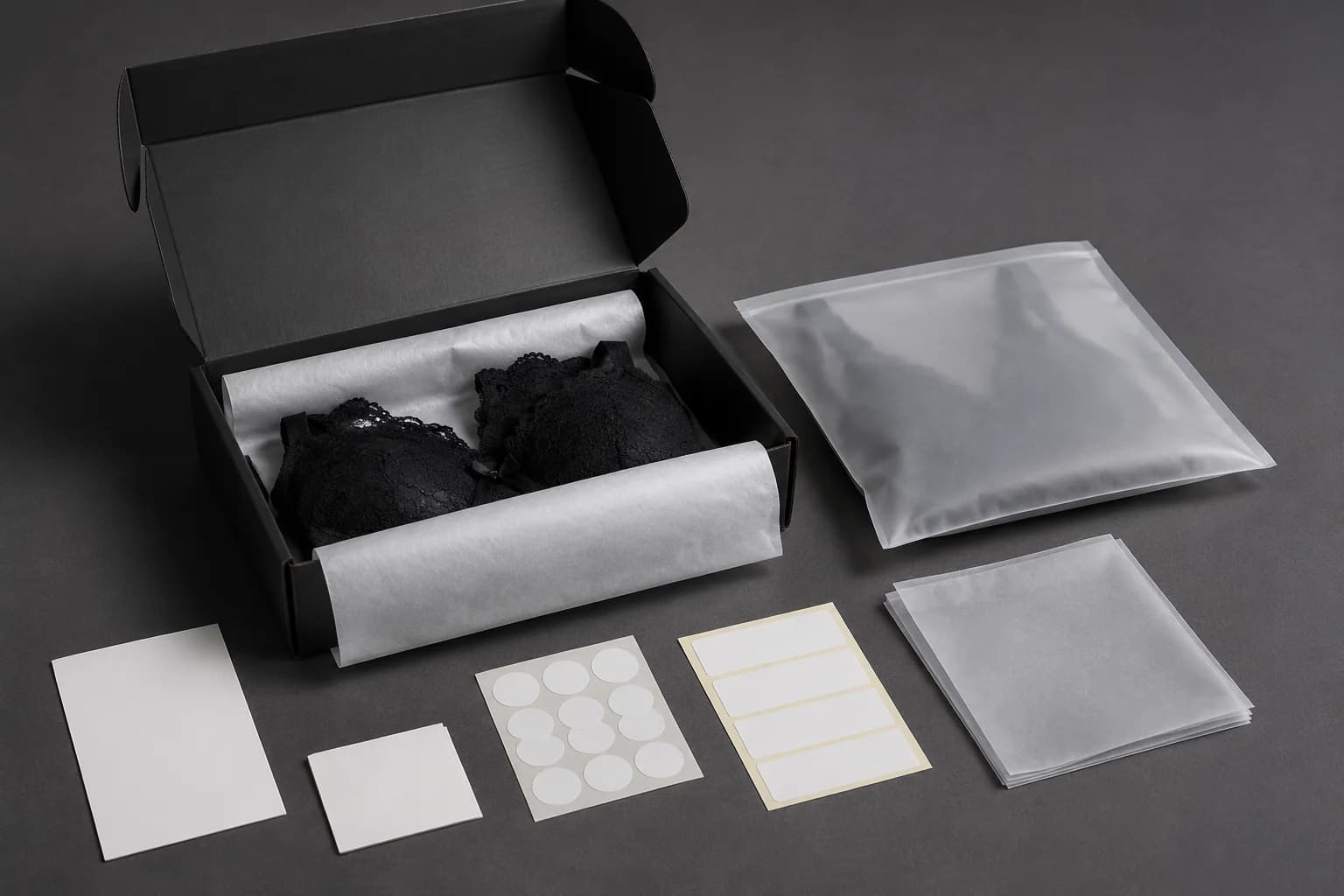
Short answer
A practical procurement guide for lingerie buyers specifying packaging inserts, barcode labels, hangtags, polybags, carton marks, scan checks, packaging MOQ, and RFQ wording before a retail launch.
Key takeaways
What buyers should remember
- Decide the retail selling unit before barcode assignment. A bra, brief, boxed set, multipack, or assortment may need different barcode, insert, carton, and inspection rules.
- Treat barcode data as production data, not decoration. Control the number source, symbology, human-readable digits, label size, quiet zone, print method, placement, SKU mapping, and revision date.
- Approve packaging separately from garment fit. Buyers should check artwork proof, barcode proof, pre-production sample, final packed sample, carton label mockup, and pre-shipment scan results.
- Retail-ready lingerie packaging MOQ may be higher than garment MOQ. Custom boxes, folded inserts, multi-language booklets, printed hangtags, and branded tissue can create leftover stock if SKU data or retailer copy changes.
- Use RFQ fields that force decisions: selling unit, SKU table, size-color breakdown, insert version, barcode owner, label placement, carton packing rule, carton mark format, scan sample size, defect classification, and target delivery window.
Buyer comparison table
Start With the Selling Unit
Lingerie packaging inserts and barcode requirements should be defined before quotation, not after fit approval. The first question is what the retailer will scan and sell: one bra, one brief, one bodysuit, one shapewear short, a two-piece set, a three-pack, or a gift box. That answer drives barcode assignment, insert copy, carton packing, inspection sampling, and warehouse receiving.
If a lace bra and matching brief are sold separately, each SKU needs its own barcode record. If they are sold as a set, the retail unit needs one barcode and the factory needs a packing control so sizes, colors, and components are not mismatched. Distributor orders may also need labels on consumer units, inner cartons, master cartons, or all three.
A shipment can pass garment inspection and still fail at receiving. Common causes are simple: barcode does not scan, insert language is wrong, carton label does not match the packing list, or the selling unit is unclear. These are preventable specification issues.
- Define the selling unit before barcode numbers are assigned.
- Keep one SKU master linking style, color, size, selling unit, barcode, insert version, packaging version, carton mark, and PO line.
- State whether barcode is required on hangtag, polybag, box, pouch, carton, price ticket, or multiple locations.
- Approve artwork, barcode proof, final packed sample, and carton label format before bulk packing.
Where Launches Usually Break
Late packaging problems often come from unclear ownership. The buyer expects the supplier to follow retailer rules. The supplier expects the buyer to provide final barcode artwork, carton labels, insert copy, and packing instructions. A sample room can prepare one neat packed sample without proving the bulk packing process.
Lingerie has a high SKU-mix risk. Black bras in 34B, 34C, and 36B may look nearly identical once folded. Nude color names can also create mistakes when the buyer uses marketing names and the supplier uses fabric mill codes. Sets add another layer because separate production records may need to become one retail unit.
Barcode files fail when they are treated like ordinary artwork. A designer may stretch the code, export a low-resolution image, reduce contrast, remove quiet zones, or place the code too close to a hangtag hole, polybag seal, carton edge, or curved retail box corner. The result may look acceptable in a PDF but fail on a scanner.
- Separate garment approval from packaging artwork approval and final packed-unit approval.
- Flag similar sizes, sister bra sizes, multiple nude shades, and matching-set components as higher-risk SKUs.
- Do not release bulk insert, hangtag, box, or barcode printing until SKU data and required text are approved.
- Use color codes and approved references, not only names such as black, nude, blush, ivory, rose, or pink.
Insert Requirements
A custom lingerie packaging insert specification should say what the insert is for. It may carry care guidance, a brand note, exchange information, fiber content reminder, hygiene notice, fit note, QR code, or market-specific wording. Each purpose affects wording, placement, and compliance review.
Specify material, finished size, paper weight, print colors, finish, folding method, language version, placement, and version code. Common options include coated art paper, kraft paper, FSC-paper if documented, rigid backing cards, matte lamination, spot color printing, folded leaflets, and small care cards. If one order has several markets or retailers, the insert version must be visible in the SKU master and controlled on the packing line.
Avoid broad claims unless the buyer has documents for the exact wording and target market. Do not put certified organic, recycled, antibacterial, dermatologically tested, medical-grade, award-winning, or similar language on inserts, boxes, or hangtags without support.
- Match insert care advice with the sewn-in care label.
- Check that insert ink, paper dust, tissue, adhesive, and coating do not transfer onto light colors.
- Use rounded corners or safer placement if card edges can rub against lace, mesh, satin, embroidery, or delicate trims.
- Classify missing insert, wrong insert, wrong language, and ink transfer as packaging defects.
Barcode Data Buyers Should Control
Send barcode data as a SKU-level table, not screenshots pasted into artwork. The table should include style code, product name, color name, color code, size, cup size where relevant, selling unit, barcode number, barcode type, price field if required, label position, artwork file name, and revision date.
The supplier should confirm the exact file version before printing hangtags, stickers, belly bands, retail boxes, price tickets, or carton labels. If any barcode, color code, size, price field, or selling unit changes, issue a new revision instead of replacing files informally.
Human-readable digits should match the encoded data unless the retailer gives another format. Quiet zones must stay clear. Lingerie barcode label placement should be tested on the actual surface so labels do not wrinkle, peel, cover mandatory text, or sit across a fold, seam, punched hole, hanger opening, polybag seal, or box edge.
- Confirm number source and ownership before printing.
- Specify EAN-13, UPC-A, Code 128, QR code, or retailer-specific carton code where applicable.
- Record barcode type, encoded digits, human-readable digits, label size, print method, placement, and revision date.
- Treat wrong barcode, unreadable barcode, and barcode assigned to the wrong SKU as serious receiving defects.
RFQ Fields That Prevent Guesswork
A useful RFQ does not need to be long, but it must force the decisions that affect receiving. Missing fields should be marked pending with an owner and due date.
For each SKU, include style code, garment type, color name, color code, size, band size, cup size if relevant, selling unit, order quantity, barcode number, barcode type, retail price field if used, packaging version, insert version, polybag size, carton packing rule, and inspection standard.
For sets, add top size, bottom size, set ratio, substitute rule, and whether components may ever be sold separately. For cartons, include units per carton, single-SKU or mixed-SKU rule, maximum gross weight, carton mark position, label template, pallet rule if applicable, and packing list format.
- Use fixed field names so supplier, inspector, and warehouse work from the same data.
- For bras, separate band size, cup size, and international size conversion where applicable.
- For multipacks, state whether the barcode belongs to the consumer unit or each internal item.
- If mixed cartons are allowed, require a visible mixed-carton mark and carton-level SKU breakdown.
Supplier Instruction Wording
Use direct wording in the RFQ, purchase order, and inspection booking. It reduces the chance that packaging is treated as an informal accessory.
Unit packing wording: Please quote retail-ready lingerie packaging for each SKU. Unit packing must include approved main label, care label, size label, hangtag, barcode label, insert card, individual polybag or retail box, and carton packing according to the attached SKU master and carton instruction. Please state which components are included in the garment unit price and which are quoted separately.
Barcode wording: Buyer will provide barcode numbers and approved SKU master. Supplier must not create, replace, resize, or relocate retail barcode numbers without written approval. Barcode proof must be scanned before bulk printing. Final packed sample must include the barcode in the intended position. Pre-shipment inspection must include barcode scan checks against the approved SKU master.
Insert and carton wording: Insert card must match the approved artwork file and version code. Supplier must keep different language or retailer versions separated during packing. Cartons must follow the attached packing rule. Carton label and packing list must show matching PO, style, color, size, quantity, carton number, gross weight, net weight, and carton dimensions.
- Ask which barcode types the supplier can scan in-house.
- Ask for packed-unit dimensions and estimated carton dimensions after packed sample approval.
- Ask for cost impact of sticker barcode versus direct-printed barcode.
- Ask the supplier to identify risks for molded cups, lace, hooks, bonded seams, hygiene liners, satin surfaces, silicone grips, or shapewear panels.
MOQ and Lead Time Traps
Garment MOQ and packaging MOQ can be different. A supplier may accept a modest garment order if fabrics and trims are available, while a custom box, folded booklet, printed tissue, branded belly band, or direct-printed hangtag needs a higher print minimum.
Split the calendar into garment sampling, artwork approval, barcode proofing, packaging production, garment bulk production, packed sample approval, inspection, and freight. A garment schedule can still miss launch timing if printed packaging is approved late.
Ask for layered costs. The garment unit price should state whether it includes main label, care label, size label, hangtag, barcode label, insert, tissue, polybag, retail box, standard carton, and carton marks. Custom retail boxes, molded cup supports, printed belly bands, ribbons, hangers, multi-language booklets, and special carton labels may need separate line items.
For first launches, modular packaging often reduces exposure. A stock polybag with approved insert and adhesive barcode label allows SKU, price, or retailer updates closer to shipment. Direct-printed boxes or hangtags may suit repeat orders once data and volumes are stable.
- Request price breaks by garment quantity and packaging component quantity.
- Clarify responsibility for leftover printed inserts, boxes, hangtags, labels, stickers, and retailer-specific packaging.
- Add artwork proofing and packed sample approval to the launch calendar.
- Do not book freight on garment dimensions; use packed-unit and carton dimensions.
Scan Verification
Barcode checks should happen before the goods are packed into cartons. First, verify the SKU master against the numbers supplied by the buyer or retailer. Second, scan the printed proof or printed packaging component. Third, scan the final packed sample with the code in its real position.
The third scan matters because placement can ruin a correct barcode. Curved box edges, glare on polybags, wrinkles, folds, punched holes, tag strings, opaque stickers, and seals can all affect scanning.
For multi-SKU lingerie orders, include scan verification in pre-shipment inspection. A practical baseline is at least one successful scan per SKU plus random scans across cartons. Higher-risk retailer launches may require larger samples, line-level scan records, or 100 percent packing-line scan.
- Scan printed proofs, not only PDF artwork.
- Compare scan results with the approved SKU master.
- Record failed scans and wrong-SKU scans separately.
- State the required action if any barcode fails or scans as another SKU.
Product-Specific Packaging Risks
Bras need protection for cup shape, wire position, lace surface, padding, and hook-and-eye closures. Molded cups may need nesting, tissue, cup support, or reduced carton compression. Hooks and sliders should not fold against lace panels.
Briefs and bodysuits need clean hygiene presentation. Buyers may require gusset liners, tamper seals, special fold orientation, or opaque polybags depending on channel and market. If adhesive liners are used, check that they do not leave residue or damage fabric.
Shapewear has compression and recovery issues. Tight folding can create temporary lines, distort panels, stress bonded seams, or mark silicone grips. If boxed, confirm that boning, mesh panels, bonded edges, and waist grips are not damaged after storage in the packed method.
Sleepwear and satin items need surface protection. Inserts, hangtags, tissue, and carton dust can mark light colors or glossy surfaces. Request packed sample photos and, where possible, a short packed-storage check before approving bulk packing.
- Use a packaging bill of materials with artwork file name, version code, and approval date.
- Check molded cup shape after packed storage, not only immediately after folding.
- Confirm tissue, insert, and polybag materials do not stain, scuff, or crease the garment.
- Define inspection criteria by product type: bra, brief, bodysuit, shapewear, sleepwear, robe, camisole, or set.
Compliance and Retailer Paperwork
Packaging, inserts, labels, and online product data must not contradict each other. If the care label says hand wash only, the insert should not suggest machine washing unless testing and labeling are updated. If fiber content appears on a box or insert, it must match the approved composition.
State destination country and retail channel early. Importers and retailers may require fiber content, country of origin, care labeling, restricted substance documents, test reports, packaging material declarations, routing guide compliance, carton label templates, or vendor setup data.
Retailer paperwork can affect physical packaging. Vendor manuals may define price tickets, EDI fields, advance shipping notice data, carton label format, routing guide requirements, and delivery booking rules. The factory may not manage every document, but it needs the physical label and packing requirements before carton labeling starts.
Keep a document checklist with owner, due date, revision status, and approval status. A test report or packaging declaration that arrives after shipment may be too late for delivery booking or retailer intake.
- Align care label, hangtag, insert, box, and product data wording.
- Avoid unsupported eco, antibacterial, recycled, medical-grade, certified, or performance claims.
- Specify restrictions on PVC, pins, plastic type, warning text, recycling marks, ventilation holes, silica gel, suffocation warning, or excessive packaging where applicable.
- Attach retailer label and carton templates to the PO when available.
Carton Planning and Receiving
Carton structure affects freight cost, receiving speed, store allocation, and inventory accuracy. Decide whether cartons are packed by single SKU, size ratio, color assortment, store allocation, or distributor requirement before bulk packing.
Carton size and weight should be checked with the final packed unit. Retail boxes, molded cup spacing, padded hangers, inserts, and tissue can increase carton cube. Air freight cost may rise sharply if volume is high, while warehouse handling still needs weight limits for sea shipments.
Carton marks should be structured data. They may need buyer name, PO number, style, color, size, quantity, carton number, gross weight, net weight, carton dimensions, country of origin, destination, and carton barcode. The packing list should mirror carton data so receiving teams can reconcile quickly.
Common receiving failures include carton label says 36B but carton contains 34B, barcode scans as another color, carton count does not match the packing list, or mixed cartons are unmarked. Packing-line controls should include one SKU at a time, component issue control, carton audit, barcode scan, and sealed-carton photos.
- Define carton packing by single SKU, mixed SKU, size ratio, assortment, or store allocation.
- Set maximum gross weight and carton label fields before production packing.
- Ask for estimated carton dimensions at quotation and confirmed dimensions before shipment.
- Audit mixed cartons more heavily than single-SKU cartons.
Inspection Before Shipment
A retail-ready lingerie inspection should cover garment quality and packaging accuracy in the same booking. Garment checks include measurement, workmanship, stains, color variation, seam strength where relevant, trim placement, cup shape, elastic tension, closure function, and appearance after packing.
Packaging checks should include label content, insert version, barcode scan, polybag or box condition, size sticker, hangtag attachment, carton mark, and packing list accuracy. If AQL is used, define packaging defects in the inspection standard, not only garment defects.
Some defects should be classified as major or critical depending on retailer rules: missing insert, wrong insert, wrong barcode, unreadable barcode, wrong size sticker, damaged retail box, incorrect carton label, and mixed SKU carton without approval.
Ask for structured photos. Useful records include front and back of packed unit, barcode close-up, insert placement, hangtag attachment, size label, carton label, open carton arrangement, and sealed carton marks.
- Require scan results against the approved SKU master.
- Check packed garment condition, especially molded bras and shapewear.
- Inspect light colors for staining from tissue, inserts, hangtags, or carton dust.
- Require repacking to follow the approved packed sample method.
Launch Checklist
A vague RFQ such as black lace bra with retail packaging leaves too much to assumption. The launch file should identify product details, size-color quantities, packaging components, barcode handling, carton method, compliance needs, inspection requirements, and shipment plan.
If barcode numbers are not ready, give the expected release date and ask whether packaging production can wait. If retailer approval is pending, request both a standard packaging quote and a custom packaging quote. If launch quantity may change, request price breaks by garment quantity and packaging MOQ.
- Product: style code, garment type, construction, cup type, wire or wire-free structure, closure, strap adjustment, size range, colorways, and target quantity by SKU.
- Materials: fabric composition, lace, mesh, elastic, cups, wire, closure, trims, color standard, and approved substitute rules.
- Measurements: point of measure list, tolerance by size, grading rules, fit sample size, size set requirement, and packed measurement concern if relevant.
- Packaging: main label, care label, size label, hangtag, insert, tissue, polybag, box, hanger, pouch, carton type, carton liner, and barcode label.
- Insert: size, paper weight, finish, print colors, language version, placement, artwork owner, version code, and approval owner.
- Barcode: number source, barcode type, encoded digits, human-readable digits, SKU table, label size, placement, print method, scan proof, revision control, and defect classification.
- Carton: single-SKU or mixed rule, units per carton, maximum gross weight, carton label fields, carton number sequence, packing list format, and photo requirement.
- Compliance: destination market, care labeling, fiber content, country of origin, testing, restricted substances, packaging rules, and retailer manual pages.
Small and Mid-Size Buyer Approach
For a first retail launch, controlled customization is usually safer than heavy packaging complexity. Customize the parts that affect brand presentation and retailer compliance, while keeping SKU data and price tickets flexible until they are stable.
A branded insert, clean hangtag, approved sticker barcode, and accurate carton label may be more practical than a custom box system before sell-through is proven. Direct-printed packaging can be added later when barcode data, retailer rules, and repeat volume are clearer.
Limit the SKU matrix where the commercial plan allows. Four colors, ten bra sizes, and matching briefs can create dozens of barcode records. Every extra SKU increases the chance of label mix-ups, carton errors, scan failures, and obsolete printed packaging.
When comparing suppliers, ask how they control packing lines. The answer should cover SKU separation, packaging component issue control, label verification, packed sample use, inspection cooperation, and carton mark checking. If inserts and barcode labels are treated casually, tighten the written requirements before order placement.
- Use modular packaging until barcode, price ticket, and retailer requirements are stable.
- Keep approval gates for barcode data, packaging printing, final packed sample, carton dimensions, and packing list format.
- Compare suppliers on packing control and data accuracy, not only garment price.
- Keep one approved launch pack for production, inspection, freight, and repeat orders.
Procurement checklist
Before you send the inquiry
Target quantity and replenishment plan
Tech pack, reference sample, or construction notes
Fabric, lace, elastic, and hardware preferences
Size range, grading rules, and fit tolerance
Private-label packaging and barcode needs
Destination market and compliance requirements
FAQ
What are the key lingerie packaging inserts and barcode requirements for retail launch?
Buyers need a defined selling unit, approved insert artwork, correct care and fiber wording, SKU-level barcode data, barcode type, label size, barcode label placement, scan verification, retail-ready unit packing, carton label format, and a packing list that matches carton contents.
Should lingerie barcode labels be printed directly or applied as stickers?
Direct printing can look cleaner, but it is risky if SKU data, price fields, or retailer instructions may change. Adhesive labels are usually more flexible for first launches, retailer tests, and orders with late SKU updates.
What MOQ issues should buyers expect with custom lingerie packaging inserts or boxes?
Garment MOQ and packaging MOQ should be requested separately. Custom boxes, folded booklets, direct-printed hangtags, branded tissue, printed belly bands, and special carton labels may each have their own minimum quantity and lead time.
How should buyers verify that lingerie barcodes scan correctly?
Verify the SKU master, scan the printed proof, and scan the final packed sample with the barcode in the intended position. Retail shipments should also include barcode scans during pre-shipment inspection, especially for multi-size bra and set orders.
Which packaging defects can delay retail receiving?
Wrong barcode, unreadable barcode, missing insert, wrong insert version, wrong size sticker, mixed sizes in cartons, carton label mismatch, damaged retail boxes, and packing list errors can delay intake even when garment quality passes.
What RFQ details help a lingerie manufacturer quote retail-ready packaging accurately?
The RFQ should include style details, size-color quantity breakdown, selling unit, packaging bill of materials, insert specifications, barcode data owner, barcode placement, carton packing rule, carton label fields, compliance documents, inspection standard, freight assumptions, and target delivery window.
Related sourcing guides
P1 · b2b manufacturing guide
Best Lingerie Manufacturing Model for Startup Brands in 2026
Compare lingerie manufacturing models for startup brands in 2026. Learn how to evaluate MOQ, lead time, materials, QC, packaging, compl...
P1 · lingerie manufacturing
Best Lingerie Manufacturing Model for Startup Brands: How to Choose Without Overbuying
Compare wholesale, private label, ODM, OEM, and hybrid lingerie manufacturing models for startup brands. Includes MOQ checklist, lead t...
P1 · b2b manufacturing guide
Best Lingerie Manufacturing Model for Startup Brands: OEM vs Private Label vs Hybrid Guide
Compare OEM vs private label lingerie manufacturing for startup brands. Learn how to evaluate MOQ, lead time, cost, QC, packaging, comp...
P1 · b2b lingerie sourcing
Best Low MOQ Lingerie Products for Ecommerce Sellers in 2026: Top 5 Picks, Comparison Guide, Costs, MOQ, and RFQ Checklist
Compare Top 5 low MOQ lingerie products for ecommerce sellers in 2026. Review MOQ, cost drivers, lead time, packaging, QC, compliance d...