Short answer
A buyer-side lace vs microfiber underwear comparison for RFQs, MOQ planning, fabric consumption, sample approval, AQL inspection, carton planning, and document checks.
Key takeaways
What buyers should remember
- Quote lace vs microfiber underwear as separate RFQ lines. The material choice changes fabric consumption, cutting loss, sewing difficulty, MOQ pressure, inspection criteria, and carton density.
- Choose stretch lace underwear when visible design detail supports the retail offer and the buyer can control motif placement, scallop position, transparency, shade, fray, and trim comfort.
- Choose microfiber underwear when the program depends on smoother fit, repeat replenishment, flatter packing, and fewer decorative alignment risks.
- Do not compare FOB garment price alone. Ask for fabric cost, trim cost, cutting loss, labor, packaging, inspection, inland charges, carton CBM, and surcharge below MOQ.
- Set different QC rules. Lace needs objective limits for motif mismatch, scallop unevenness, broken yarn, rough edges, and fray. Microfiber needs limits for pinholes, barre lines, shine, opacity failure, curling, and elastic growth.
- Check document scope before purchase order release. A named standard is useful only when the supplier provides a current document covering the right component, product, and destination requirement.
Buyer comparison table
Byline and Scope
Byline: Vincent Xi, Editorial Author. Author profile: https://velora-intimates.com/authors/vincent-xi/.
This lace vs microfiber underwear comparison is for buyers deciding whether to develop the same adult women's brief in lace or microfiber. It focuses on purchase-order risk: MOQ, quote structure, fabric consumption, sampling, inspection, packing, document checks, and landed-cost variables.
Experience basis: this article uses the approved Velora Intimates author profile for Vincent Xi as the first-party attribution basis. It does not claim factory visits, client outcomes, certifications, awards, laboratory testing, or first-person production experience.
- Source context as of July 2026: ISO 2859-1:1999 from the International Organization for Standardization is referenced only as a sampling-plan context. It does not define underwear defect severity and does not prove any supplier practice.
- Source context as of July 2026: ISO 3801:1977 from the International Organization for Standardization is referenced as one context for determining textile fabric mass when buyers use fabric mass as a control field.
- Source context as of July 2026: OEKO-TEX Standard 100 from the OEKO-TEX Association and EU REACH Regulation (EC) No 1907/2006 from the European Chemicals Agency are referenced as compliance-document contexts. They are not certification claims for Velora Intimates or any supplier unless a current document is supplied.
Fast Material Choice
Choose stretch lace underwear when the range needs visible texture, scallop detail, or a more decorative retail presentation. The buyer must budget for more approval work because motif balance, transparency, edge comfort, shade control, and fray risk can affect sellability.
Choose microfiber underwear when the program needs a smoother line under clothing, repeat replenishment, simpler color planning, or multipack economics. The buyer still needs surface controls because plain fabric makes pinholes, oil marks, barre lines, shine, opacity failure, and seam pucker easy to see.
If the buyer is still undecided, quote lace vs microfiber underwear against the same brief shape, size ratio, color plan, packaging, inspection level, Incoterms, and shipment window. Any other difference will hide the true fabric effect.
- Lace decision risk: visual inconsistency can downgrade a premium-looking product.
- Microfiber decision risk: plain-surface defects can make a basic product look cheap even when fit is acceptable.
- Procurement rule: compare total program cost, not only the garment unit price.
Price Is Not One Line
For lace, the buyer needs to know whether the quoted price includes motif placement, scallop use, mirrored cutting, extra trimming, and additional sewing care. A low lace fabric price can disappear if the marker wastes fabric or the sewing line spends more time controlling edges.
For microfiber, the buyer needs to know whether the price includes the requested opacity, recovery, finish, handfeel, and edge construction. A basic microfiber quote may not cover a higher-density fabric, clean-finish leg opening, bonded edge, or premium elastic.
Ask the supplier to separate the cost drivers in the RFQ. This makes negotiation more practical because the buyer can remove a cost item, change a material, or adjust packaging without reopening the whole quote.
- RFQ line: Quote stretch lace and microfiber as separate options for the same adult brief style, same size range, same packing method, and same shipment term.
- Cost fields: fabric, cutting loss, elastic, gusset liner, thread, care label, brand label if any, hangtag if any, polybag, carton, labor, inspection, inland handling, and surcharge below MOQ.
- Consumption field: state whether fabric is priced by meter, kilogram, or average garment consumption across the requested size ratio.
MOQ Triggers
Lace MOQ often rises when the buyer requests custom color, special motif, dyed-to-match trim, or strict scallop placement. The issue may sit with the fabric mill, dye lot, trim minimum, or marker efficiency rather than the sewing factory alone.
Microfiber underwear MOQ is often easier to control when stock fabric, standard elastic, existing colors, and simple packaging are accepted. It can still rise if the buyer requests a special fabric mass, custom finish, unusual color, bonded edge, or dedicated packaging run.
Example July 2026 RFQ assumption to verify in the supplier quote: custom-color lace briefs may be planned at 1,000-3,000 finished pieces per color/style, while stock-fabric microfiber briefs may be planned at 600-1,500 finished pieces per color/style. These are buyer-side planning ranges, not guaranteed supplier minimums.
- Ask for MOQ per fabric article, per color/style, per color, and per size where applicable.
- Ask whether XS-XL can be included without surcharge under the proposed size split.
- Ask whether black, white, nude, or available seasonal colors reduce MOQ.
- Ask whether elastic, label, hangtag, barcode sticker, polybag, and carton marks have their own minimums.
Calendar Risk
A lace schedule should show time for lab dip, motif or scallop approval, trim matching, fit sampling, pre-production sample approval, bulk cutting, sewing, finishing, packing, documents, and shipment handover. The buyer should not let bulk timing start before the pre-production sample is approved in writing.
A microfiber schedule should show fabric availability, fabric relaxation before cutting where needed, opacity approval, elastic recovery check, sample correction, bulk sewing, pressure-mark review, packing approval, documents, and shipment handover.
Example July 2026 schedule assumption to verify in the supplier quote: first fit sample may take 7-14 calendar days after a complete tech pack and available fabric are confirmed. Pre-production sample may take 10-20 calendar days after fit comments, color approval, trim card, label artwork, and packing artwork are closed.
- RFQ fields: lab dip lead time, fit sample lead time, revised sample lead time, pre-production sample lead time, material booking time, bulk sewing time, packing time, document preparation time, and shipment handover date.
- Approval gates: fabric article, color standard, trim card, care label, barcode, carton mark, packaging sample, size set, and pre-production sample.
- Quote note: state whether lead time assumes stock fabric, greige fabric dyeing, custom lace development, or nominated buyer materials.
Lace Spec Fields
A lace spec must turn appearance into measurable production instructions. Lock the lace article, composition, color standard, shade lot rule, motif direction, motif repeat, fabric width, usable scallop edge, stretch direction, transparency level, lining coverage, and thread color.
Decide where lace is used before approving the cost. A full-body lace brief has different opacity, recovery, and skin-contact risk from a microfiber brief with lace trim. The construction choice affects fabric consumption and inspection time.
Define which holes are part of the lace design and which are defects. This avoids disputes when inspectors find open areas, broken yarn, or fray around the motif.
- Spec fields: lace article code, composition, fabric width, motif repeat, usable scallop edge, stretch direction, color standard, lining area, gusset liner composition, and seam construction.
- Construction fields: waistband elastic width, leg-edge treatment, trim position, label position, bar-tack position if used, thread color, and allowable thread-end length.
- QC fields: broken yarn, fray, motif skew, scallop unevenness, rough edge, scratch point, shade variation, seam distortion, and left-right imbalance.
Microfiber Spec Fields
A microfiber spec should control performance, not just softness. State fabric article, composition, fabric mass, color standard, stretch direction, recovery target, opacity under stretch, finish, approved handfeel sample, and edge construction.
Smooth knit microfiber exposes machine and packing problems. Needle size, seam tension, cutting accuracy, fabric relaxation, elastic joining, fold method, and carton pressure can all change the finished garment's appearance.
Example July 2026 spec range to verify in the supplier quote: an adult microfiber brief sample may be requested at 150-190 g/m2 fabric mass, while an adult stretch lace brief sample may be requested at 80-140 g/m2 fabric mass depending on motif openness and elastane content. These are buyer request ranges, not standards. If fabric mass is controlled, ask which method is used; ISO 3801:1977 is one source context for fabric mass determination.
- Spec fields: fabric article code, composition, fabric mass, color standard, stretch direction, recovery target, opacity check, finish, and approved handfeel sample.
- Construction fields: seam type, edge construction, elastic width, gusset liner composition, label position, wash-care wording, and packing fold method.
- QC fields: pinhole, needle cut, oil mark, barre line, shine mark, pressure line, edge curling, seam pucker, fabric skew, opacity failure, and elastic growth.
Fit and Tolerances
Set tolerance by point of measure because elastic underwear can look acceptable flat and still fail fit. The buyer and supplier should agree whether measurements are taken relaxed, flat, after steam, after rest time, or after a defined stretch check.
For lace, the decision is whether visual balance or fit measurement controls the correction. A garment may pass waist tolerance but fail approval if seam tension twists the motif or scallop position is uneven.
For microfiber, the decision is whether recovery is strong enough after extension. A garment may pass relaxed measurement but fail wear performance if the elastic or fabric grows after handling.
- Example July 2026 buyer draft tolerance to verify: adult lace brief waist flat +/-0.5 cm per garment, leg opening +/-0.5 cm per garment, side seam height +/-0.3 cm per garment, and gusset length +/-0.5 cm per garment.
- Example July 2026 buyer draft tolerance to verify: adult microfiber brief waist flat +/-0.5 cm per garment, leg opening +/-0.5 cm per garment, back rise +/-0.7 cm per garment, and front rise +/-0.7 cm per garment.
- RFQ fields: measurement method, rest time before measuring, garment position, point-of-measure table, size-set sample requirement, and whether tolerance failure is major, minor, or rework.
Inspection Plan
Do not wait for final inspection to discover material-specific problems. Use incoming material inspection for article, shade, width, fabric mass method where required, stains, holes, stretch, recovery, and trim matching.
At cutting, lace needs motif direction, scallop use, left-right balance, panel alignment, and fray checks. Microfiber needs fabric relaxation, skew, edge curling, shade continuity, cutting accuracy, and surface-mark checks.
At inline and final inspection, separate construction defects from material defects. This helps the supplier decide whether to re-cut panels, adjust machine tension, replace elastic, re-trim thread, or hold affected lots.
- Example July 2026 inspection assumption to verify in the supplier quote: a buyer may request critical defects at zero acceptance, major defects at AQL 2.5, and minor defects at AQL 4.0 using ISO 2859-1:1999 as a sampling-plan context.
- Important limitation: ISO 2859-1:1999 provides sampling-plan structure; it does not define underwear defect lists or select the buyer's acceptable quality levels.
- Inspection checkpoints: incoming material, cutting, inline sewing, finishing, packing, final random inspection, and document match.
Defect Decisions
Classify defect severity before bulk sewing. A lace motif mismatch may be major on a front panel for a boutique range but minor in a hidden seam allowance. The purchase order should say which locations matter.
For microfiber, opacity failure and surface shine need agreed checks. A buyer selling smooth everyday briefs may treat these as major defects because the product promise depends on a clean surface and reliable coverage.
Ask for a defect photo sheet before production. It should show acceptable and unacceptable examples for lace motif balance, scallop position, fray, microfiber shine, pinholes, opacity, seam pucker, and pressure marks.
- Possible critical defect: broken needle contamination, unsafe sharp trim, wrong legally required fiber content label, or restricted-substance document failure where required by the destination policy.
- Possible major lace defect: visible broken yarn, uncontrolled fray, asymmetric scallop, severe motif skew, scratchy skin-contact trim, panel shade mismatch, or seam twist affecting fit.
- Possible major microfiber defect: opacity failure under agreed stretch check, oil stain, needle cut, pinhole cluster, obvious barre line, severe shine mark, seam pucker affecting appearance, or elastic growth affecting fit.
- Possible minor defect: thread end within agreed tolerance, small packaging fold that recovers after unpacking, or shade variation within the approved shade band.
Documents and Labels
Treat compliance as a shipment file, not as a sales statement. The buyer should request fabric composition, care-label content, country-of-origin marking, restricted-substance reports where required, colorfastness reports where required, packing list, commercial invoice, and certificate of origin where applicable.
If OEKO-TEX Standard 100 documentation is requested, ask for a current certificate with scope, issue date, expiry date where applicable, applicant name, and covered components. The standard name alone is not proof that a fabric, trim, or finished garment is certified.
For EU programs, buyers may ask how materials are controlled against REACH restricted-substance requirements under Regulation (EC) No 1907/2006. The supplier's answer should be supported by current documents relevant to the material and destination.
- Document fields: current test report or certificate, issue date, expiry date where applicable, tested component, material scope, applicant or supplier name, laboratory name, and destination relevance.
- Label fields: fiber content, care symbols or care wording, country-of-origin marking, size format, importer or distributor details where required, barcode, SKU, and carton mark.
- Calendar fields: latest approval date for care label, barcode, hangtag if any, polybag artwork if any, carton mark, and document submission before shipment booking.
Carton and Freight Planning
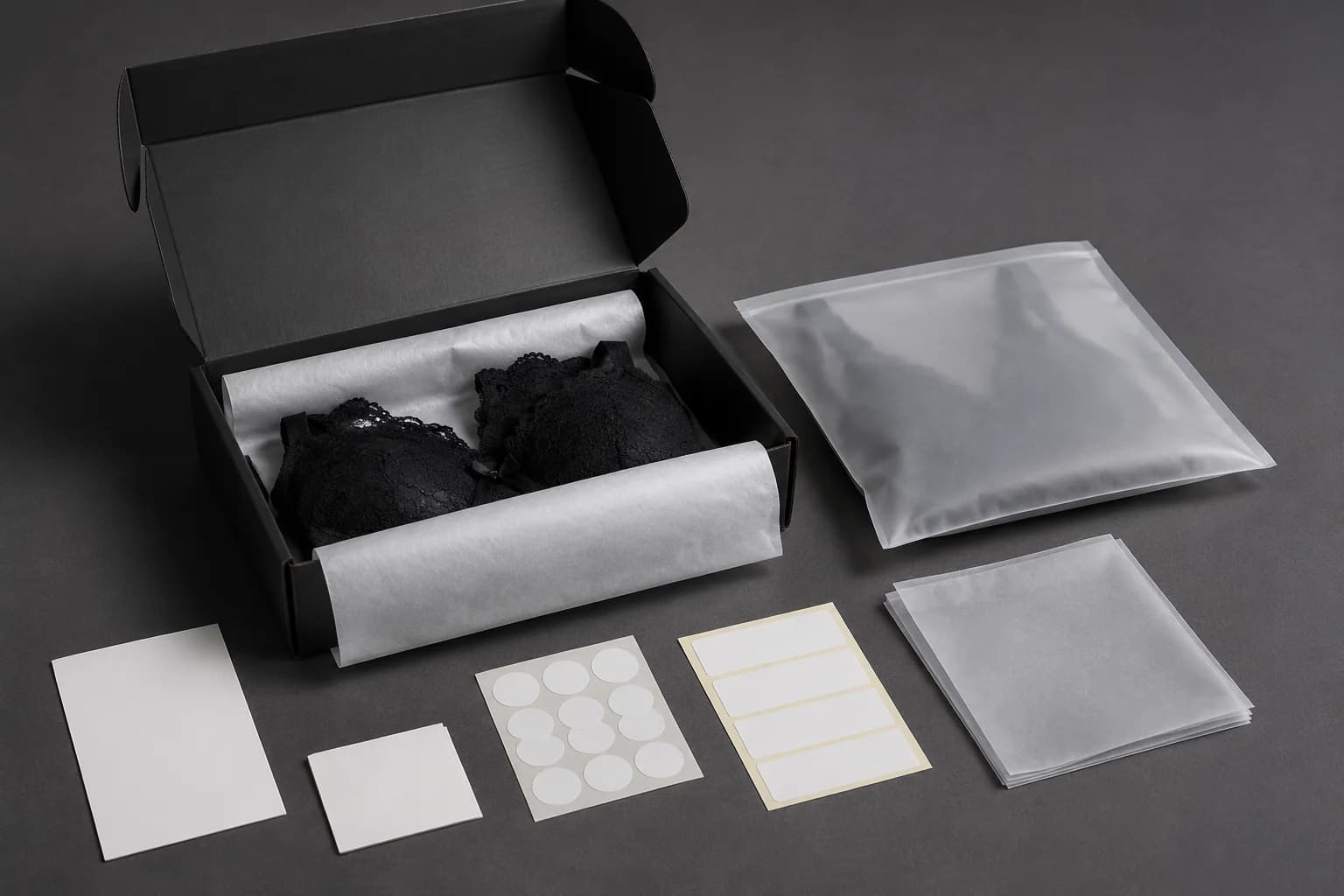
Lace can lose landed-cost efficiency when the product needs lower compression, tissue, separators, or extra care around raised texture and scallop edges. The buyer should price those requirements before choosing lace for a low-margin program.
Microfiber can pack flatter, but pressure marks, fold shine, and heat-related surface changes can still create claims. Light colors and smooth finishes need particular attention during packing approval.
Example July 2026 carton calculation to verify in the supplier quote: a planning carton for 120 individually polybagged adult briefs may measure 60 cm x 40 cm x 35 cm and weigh 13-16 kg gross per carton. Carton volume is 0.084 m3 per carton, calculated from 0.60 m x 0.40 m x 0.35 m. This is an example freight-planning calculation, not published Velora packing data.
- RFQ fields: carton length, width, height, gross weight, net weight, pieces per carton, inner pack method, polybag size, master carton strength, carton mark layout, and carton CBM.
- Lace packing question: does the style require tissue, reduced carton density, separators, or a special fold method, and what is the added cost per garment or carton?
- Microfiber packing question: does the style need pressure-mark control, flat-pack testing, or reduced compression for light colors?
- Approval request: provide packed-carton photos before final sealing when the order uses a new packing method.
Quote Wording to Send
The RFQ should force comparable answers. Ask the supplier to quote lace vs microfiber underwear for the same adult women's brief, with the same size range, color plan, gusset liner, waistband type, care label, individual polybag, carton mark, Incoterms, and shipment window.
Ask the supplier to explain what changes by fabric. The useful answer is not which material is better; it is which material changes MOQ, cutting loss, sample approvals, defect risk, packing density, document availability, and re-order timing.
- Please quote adult women's brief style in two fabric options: stretch lace and microfiber. Use the same size range, size ratio, color plan, gusset liner, waistband type, care label, individual polybag, carton mark, Incoterms, and shipment window.
- For each fabric option, provide fabric article code, composition, fabric mass or weight method, width, stretch direction, color availability, MOQ per color/style, MOQ per size if applicable, and surcharge below preferred MOQ.
- Provide lab dip time, fit sample time, revised sample time, pre-production sample time, bulk lead time after approval, and re-order lead time for the same fabric article.
- Provide estimated cutting loss, sewing difficulty comments, main defect risks, inline QC points, final inspection AQL assumption, and measurement tolerance table.
- Provide carton dimensions, pieces per carton, gross weight, net weight, packing method, carton mark format, carton CBM, and any difference in packing density between lace and microfiber.
- Provide current compliance documents available for fabric and trims, including scope, issue date, tested component, and destination relevance. Do not list a standard unless a current document can be supplied.
Method and Limits
Methodology note: the concrete figures in this article are example July 2026 RFQ assumptions and example calculations for comparing supplier responses. They are based on common underwear sourcing variables: fabric article, color plan, trim stock, sample stage, size split, packaging format, carton data, inspection level, and document requirements.
Limitations note: the figures are not Velora published prices, guaranteed MOQs, factory capacity claims, or market averages. Final cost, MOQ, lead time, and QC plan depend on current fabric inventory, dye schedule, trim availability, machine loading, labor allocation, packaging requirement, destination compliance file, inspection level, shipping mode, Incoterms, and payment terms.
Before purchase order release, the buyer should verify the material article, approved sample record, tolerance table, defect definitions, AQL assumption, packing method, and document scope. Before shipment, verify carton data, quantity, marks, packing list, commercial invoice data, country-of-origin marking, and required certificates where applicable.
- Verify quote comparability: same style, same size split, same colors, same packing, same inspection level, same shipment term, and same document responsibilities for both fabric options.
- Verify material controls: fabric article, composition, fabric mass method where used, color standard, trim card, shade lot rule, approved sample, and care-label content.
- Verify standard-related claims: current document, scope, tested component, issue date, expiry date where applicable, applicant or supplier name, and whether the document covers fabric, trim, finished product, or only one component.
Visual Brief for Product Image
ImagePrompt: Create a realistic B2B procurement flat-lay scene on a neutral inspection table comparing two adult women's underwear samples for a lace vs microfiber underwear sourcing article. One sample is black stretch lace with visible scallop edge, repeated floral or geometric motif, elastic waistband, aligned side seam, controlled thread trimming, and light cotton gusset liner. The second sample is nude microfiber with smooth knit surface, clean leg opening, elastic waistband, aligned seam, flat fabric recovery, and light cotton gusset liner.
Add procurement objects that support the article topic: lace and microfiber fabric swatches, elastic trims, loose thread snips, measuring tape, small calipers, folded clear polybags, shade swatches, and an open export carton behind the samples. Use bright even QC-room lighting, realistic fabric texture, and a practical inspection-desk mood. If carton proportions are visible, use the example planning ratio from this article: 60 cm x 40 cm x 35 cm.
No text, logos, watermarks, badges, certificate graphics, rankings, supplier identities, impossible machinery, or identifiable people should appear. The lace and microfiber samples should be equally prominent so the buyer comparison is clear at article-header size.
- Show lace motif direction, scallop placement, seam alignment, gusset position, and trimming detail clearly.
- Show microfiber smoothness, leg-opening shape, surface continuity, seam pucker control, and packing pressure risk clearly.
- Keep the scene commercial and inspection-focused rather than fashion editorial.
Procurement checklist
Before you send the inquiry
Target quantity and replenishment plan
Tech pack, reference sample, or construction notes
Fabric, lace, elastic, and hardware preferences
Size range, grading rules, and fit tolerance
Private-label packaging and barcode needs
Destination market and compliance requirements
FAQ
What should a lace vs microfiber underwear RFQ compare?
A lace vs microfiber underwear RFQ should compare the same garment shape, size range, size ratio, color plan, packing method, inspection level, Incoterms, and shipment window. For each fabric, request article code, composition, fabric mass or weight method, stretch direction, MOQ per color/style, sample schedule, bulk lead time, cutting loss, measurement tolerance, defect list, carton data, and available compliance documents.
Which fabric is easier for a small private-label underwear test order?
Microfiber is often easier when the buyer accepts stock fabric, available colors, standard elastic, and simple packaging. Example July 2026 RFQ assumption to verify in the supplier quote: microfiber underwear MOQ may be planned at 600-1,500 pieces per color/style, while custom-color lace underwear may be planned at 1,000-3,000 pieces per color/style. Final MOQ depends on fabric article, trim, color, size split, packaging, and supplier loading.
Does lace always cost more than microfiber for underwear?
No. Lace cost depends on yarn, motif, width, dye method, elastane content, scallop use, cutting loss, and sewing control. Microfiber cost can rise when the buyer requires high opacity, premium handfeel, bonded edges, special finish, or stronger elastic recovery. Compare total program cost, including wastage, labor, rework, inspection, packing, and freight.
Can one QC checklist cover lace and microfiber underwear?
One sampling framework can cover both materials, but the underwear QC checklist should differ by fabric. ISO 2859-1:1999 is a sampling-plan context only; it does not define lace motif defects or microfiber opacity failure. Lace inspection should cover motif balance, scallop placement, fray, broken yarn, and rough edge. Microfiber inspection should cover opacity under stretch, pinholes, needle cuts, shine, barre lines, curling, and elastic growth.
What documents should buyers request before bulk production?
Request fabric composition, care-label artwork, trim card, approved sample record, color approval, restricted-substance reports where required, packing specification, commercial invoice data, packing list format, country-of-origin marking, and certificate requirements by destination. If OEKO-TEX Standard 100 or REACH-related documents are requested, verify current scope instead of relying on a supplier statement.
How does carton planning affect lace vs microfiber underwear sourcing?
Carton planning affects landed cost and defect risk. Example July 2026 carton calculation to verify in the supplier quote: 120 individually polybagged adult briefs in a 60 cm x 40 cm x 35 cm carton equals 0.084 m3 per carton. Lace may need gentler folding or lower carton density. Microfiber may pack flatter but still needs pressure-mark control.
Related sourcing guides
P1 · b2b manufacturing guide
Best Lingerie Manufacturing Model for Startup Brands in 2026
Compare lingerie manufacturing models for startup brands in 2026. Learn how to evaluate MOQ, lead time, materials, QC, packaging, compl...
P1 · lingerie manufacturing
Best Lingerie Manufacturing Model for Startup Brands: How to Choose Without Overbuying
Compare wholesale, private label, ODM, OEM, and hybrid lingerie manufacturing models for startup brands. Includes MOQ checklist, lead t...
P1 · b2b manufacturing guide
Best Lingerie Manufacturing Model for Startup Brands: OEM vs Private Label vs Hybrid Guide
Compare OEM vs private label lingerie manufacturing for startup brands. Learn how to evaluate MOQ, lead time, cost, QC, packaging, comp...
P1 · b2b lingerie sourcing
Best Low MOQ Lingerie Products for Ecommerce Sellers in 2026: Top 5 Picks, Comparison Guide, Costs, MOQ, and RFQ Checklist
Compare Top 5 low MOQ lingerie products for ecommerce sellers in 2026. Review MOQ, cost drivers, lead time, packaging, QC, compliance d...