Underwear OEM Packing Requirements for United States Manufacturing RFQs
By Vincent Xi, Editorial Author
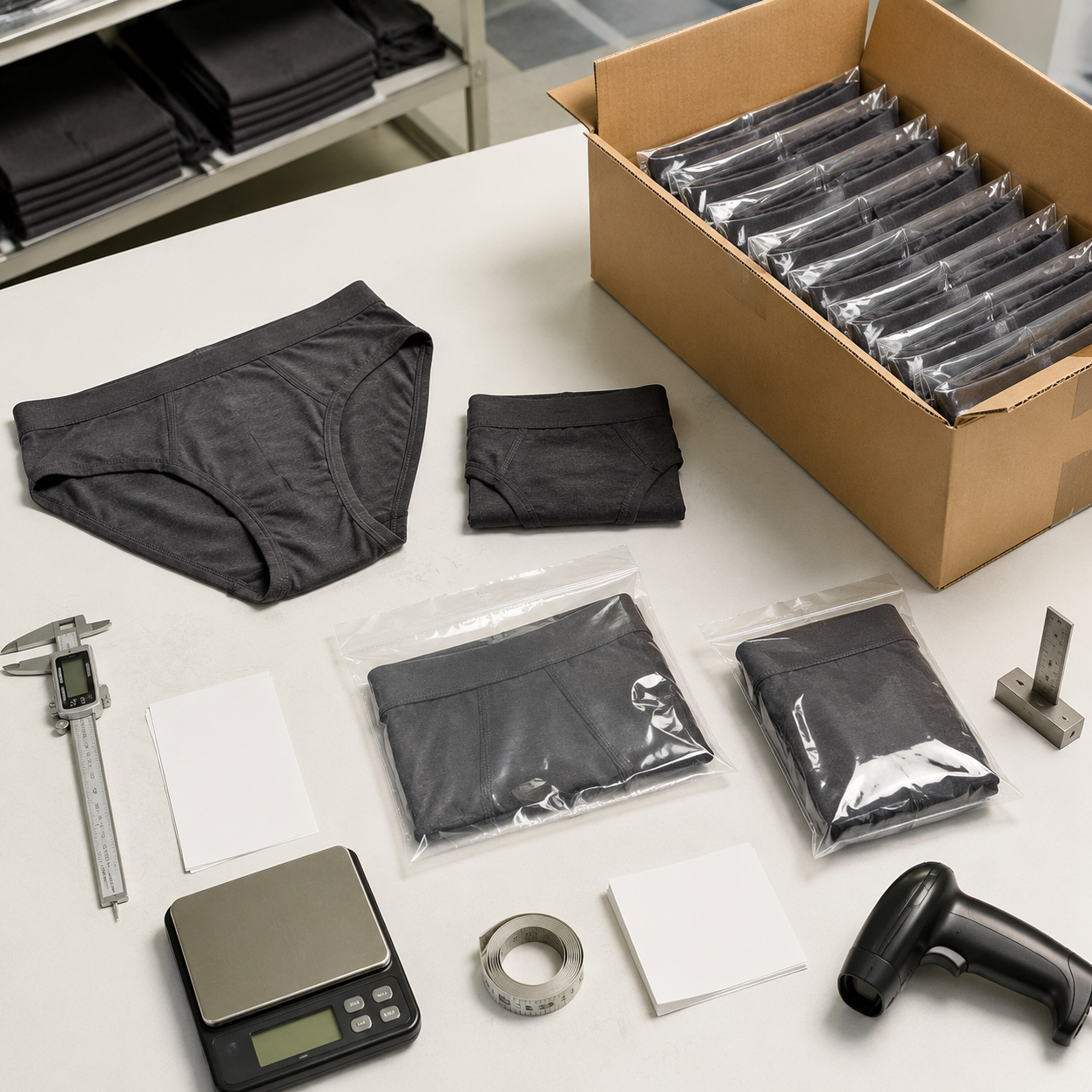
For a United States buyer, underwear OEM packing requirements are a manufacturing RFQ control, not a general presentation note. Issue them as a revision-controlled, SKU-level schedule that follows the supplier quote through packed-sample approval, purchase order, inspection, freight booking, and shipment release.
The schedule should define the garment fold, orientation, direct-contact material, finished pack dimensions, closures, approved label data, item identifiers, carton construction, assortment, measurement methods, freight data, and change controls. A response such as standard individual bag or export carton is not measurable enough for quotation or approval.
Require the supplier to confirm each buyer-issued field or return a marked deviation that identifies the proposed specification, price effect, schedule effect, and evidence available for review. Keep the approved baseline and every alternative on separate quote lines. Packing approval does not establish that the underlying underwear, disclosures, customs marking, or package claims satisfy United States requirements; those conclusions require evidence within their respective scopes.
United States Packing Requirements to Lock Before Quotation
A pack-out is ready to quote when the supplier can price the specified configuration without filling gaps from customary practice.
| Decision block | Buyer-issued requirement | Supplier return | Release evidence |
|---|---|---|---|
| Document control | Specification title, revision, applicable SKU, purchase-order reference, and approval status | Matching revision with every field confirmed, marked as not applicable, or shown as a deviation | Controlled response linked to the purchase order |
| Unit presentation | Fold sequence, facing direction, permitted compression, direct-contact material, closure, finished dimensions, tolerances, and measurement method | Field-level confirmation, component specification, and proposed packed sample | Production-representative packed sample and measurement record |
| Labels and item data | Buyer-approved artwork, disclosure data, item identifier, barcode file, placement, revision, and verification criterion | Artwork proof, production-print sample, material details, and verification result | Approved artwork and packed sample tied to the applicable SKU |
| Assortment and carton | Units by SKU, inner-pack rules, mixed-carton policy, carton construction, sealed outside dimensions, gross-mass limit, closure, and shipping marks | Packing matrix, carton drawing, expected carton count, dimensions, and gross mass | Sealed-carton measurements and physical count reconciled to the packing list |
| Protection and cleanliness | Permitted inserts, garment-contact restrictions, moisture controls, residue, odor, contamination, seal, and appearance criteria | Proposed materials, declarations, controls, and inspection format | Production-material check and packed-goods inspection record |
| Commercial and delivery data | Component, printing, setup, tooling, packing-labor, carton, pallet, rework, freight-data, milestone, and change-cost fields | Baseline and alternatives priced separately, with dated milestones and disclosed dependencies | Approved quote configuration reconciled before cargo release |
Mark each field as Buyer fixed, Supplier proposed, or Not applicable. A blank field remains unresolved. It should not be treated as approval of the supplier's usual packing method.
Build the SKU-Level Pack Specification
Create a separate packing-matrix row whenever style, size, color, construction, sales channel, or receiving instruction changes the pack-out. Each row should cover the following fields where applicable:
- Fold and garment condition: Define the fold sequence, garment orientation, compression limit, inserts, clips, tissue, finished appearance, and acceptable condition after unpacking.
- Direct-contact pack: State the material name and grade, thickness tolerance, flat dimensions, closure, venting, surface requirement, odor criterion, and required material documentation.
- Secondary presentation: Identify any band, box, hanger, insert, seal, size marker, coating, adhesive, print process, dieline, finished dimension, and prohibited component.
- Finished unit pack: Define the measurement points, measurement timing, length, width, depth, packed mass when required, and allowable variation.
- Product and package labels: Assign the content owner, substrate, placement, attachment method, visibility, artwork reference, and revision.
- Item data: Supply the buyer-controlled identifier and barcode file, then define placement, contrast, quiet-area, scan, or verifier criteria relevant to the buyer's system.
- Assortment: State the quantity by SKU, color, and size; inner-pack configuration; mixed-carton rules; and shortage or overage treatment.
- Master carton: Specify construction, sealed outside dimensions, gross-mass ceiling, closure, edge protection, stacking orientation, permitted void fill, and shipping-mark placement.
- Transit and moisture controls: Define cleanliness, dryness, liner or desiccant policy, barrier placement, conditioning, and any buyer-required test procedure.
- Handoff configuration: State whether the shipment is palletized or floor loaded and provide the applicable pattern, height, mass, wrapping, corner-protection, or loading-plan requirements.
The measurement clause should state whether a direct-contact bag is measured flat before filling, whether a finished pack is measured immediately or after a defined settling condition, and whether carton dimensions are outside measurements taken after sealing. Identify the instrument, measurement points, sample basis, rounding rule, and record format whenever they affect acceptance.
Issue a packaging bill of materials that identifies every component by function and measurable specification. For elastic, lace, mesh, molded areas, bonded seams, raised print, or hardware present on the quoted SKU, define acceptable packed and post-unpack condition and verify that condition on a production-representative sample.
A supplier declaration is not independent certification. When a standard, certification, restricted-substance program, or test is required, request the current document and verify its issuer, holder, manufacturing site, material or product scope, validity, and relationship to the quoted pack. A certification mark should not be released from a general component statement that does not cover the actual package.
The XS Lingerie manufacturer-selection guide, Union Source underwear-sourcing article, and S-Shaper supplier article are manufacturer-published commercial sources. They may suggest procurement questions, but they do not verify a quoted supplier's capability, compliance, certification, minimum quantity, price, lead time, quality result, or delivery performance.
Labeling Evidence for United States Underwear Packs
Keep legal product disclosures, customs marking, optional package copy, item data, and warehouse labels as separate approval lines. They can appear on the same physical pack while having different owners and evidence requirements.
| Control | Source context | RFQ instruction | Evidence boundary |
|---|---|---|---|
| Textile disclosures | The FTC textile-labeling guidance explains fiber-content, country-of-origin, and responsible-business identification for covered textile products | Buyer or qualified reviewer supplies approved wording; supplier reports the actual material and manufacturing facts needed for review | General guidance does not determine coverage or approve wording for the quoted SKU |
| Care instructions | The FTC Care Labeling Rule guidance describes care-label responsibilities and the reasonable basis needed for instructions on covered apparel | Buyer supplies instructions supported by the actual fabric, trim, print, and construction; any repetition on packaging is controlled separately | Packed-sample approval does not establish the basis for a care instruction |
| Customs origin marking | The US Customs and Border Protection marking guidance provides federal context for country-of-origin marking | Buyer and customs broker confirm wording, placement, legibility, permanence, and any applicable exception before artwork release | Review must use the actual manufacturing facts and import transaction |
| Product classification and intended age | The CPSC clothing business guidance provides entry points to federal clothing requirements and related resources | RFQ identifies the intended age group and product classification so the buyer can determine the applicable testing, tracking, labeling, and record controls | The source is not product-specific approval or certification |
| Environmental package claims | The FTC environmental-claims guidance addresses substantiation and qualification of environmental marketing claims | Omit unsupported wording and symbols; require buyer approval and substantiation tied to the actual material, claim, and disposal context | A declaration supports only the facts and scope stated in that document |
FTC textile disclosures and CBP origin marking remain separate review items even when both involve origin information. A shipping-carton mark does not, by itself, demonstrate that a product-level disclosure or customs-marking requirement has been satisfied.
The buyer should issue item identifiers and production barcode files, define placement and verification criteria, and identify the accepted evidence format. A scan or verifier result supports only the data and print criteria tested. It is not government approval or evidence of unrelated product compliance.
When a United States warehouse or retailer manual applies, attach the current transaction-specific revision to the RFQ. Extract its package warnings, routing labels, carton limits, pallet rules, appointment data, and shipment-data fields into the controlled schedule so the supplier can acknowledge and price them.
Example Pack-Out and Landed-Cost Comparison
Example status and source: Every exact value in this section is an undated editorial assumption created solely to demonstrate RFQ arithmetic for a hypothetical adult underwear SKU. These values are not market rates, supplier capabilities, route quotes, or committed specifications. Verify each value in the applicable dated supplier quote and, for freight or import inputs, in the relevant forwarder or customs-broker response.
The hypothetical SKU is a cotton-elastane brief placed in a clear, unprinted direct-contact bag. Its actual composition, construction, bag grade, and film thickness remain buyer-controlled fields.
| Input | Undated example assumption | Transaction-specific verification |
|---|---|---|
| Finished unit-pack outside dimensions | 180 mm x 130 mm x 25 mm per hypothetical packed unit | Supplier measurement of the production-representative packed sample |
| Packed-unit gross mass | 0.10 kg per hypothetical packed unit | Supplier mass record using the buyer-approved configuration |
| Master-carton pack count | 60 packed units per hypothetical sealed carton | Supplier packing matrix and physical count |
| Master-carton outside dimensions | 500 mm x 400 mm x 300 mm per hypothetical sealed carton | Supplier measurement after sealing |
| Empty carton and shared packing-material mass | 0.80 kg per hypothetical carton | Supplier component and mass record |
| Freight dimensional divisor | 5,000 cm3/kg for the hypothetical route quote | Forwarder's dated route-specific quote and calculation rule |
| Order scope | 12,000 packed units per hypothetical order | Dated supplier quote and purchase order |
Under these undated example assumptions, carton gross mass is (0.10 kg per packed unit x 60 packed units per carton) + 0.80 kg per carton = 6.80 kg per carton. Converting the example carton dimensions to centimeters, dimensional mass is (50 cm x 40 cm x 30 cm) / 5,000 cm3/kg = 12.00 kg per carton. If the hypothetical route quote charges the greater value, example chargeable mass is 12.00 kg per carton.
For an undated fold alternative, assume the hypothetical sealed-carton height changes from 300 mm per carton to 250 mm per carton, subject to supplier verification of garment condition and carton performance. Example dimensional mass becomes (50 cm x 40 cm x 25 cm) / 5,000 cm3/kg = 10.00 kg per carton. With example gross mass unchanged at 6.80 kg per carton, the example chargeable-mass difference is 2.00 kg per carton.
At the undated example scope of 12,000 packed units per order and 60 packed units per carton, the arithmetic produces 200 cartons per order. Example baseline volume is 12.00 m3 per order, while example alternative volume is 10.00 m3 per order. Example chargeable mass changes from 2,400 kg per order to 2,000 kg per order, a difference of 400 kg per hypothetical order. The forwarder must verify the actual divisor, minimums, rounding method, and chargeable-mass rule in its dated quote.
A separate undated packaging-price example assumes USD 0.04 per hypothetical packed unit for the direct-contact bag, USD 0.03 per hypothetical packed unit for an insert, and USD 0.02 per hypothetical packed unit for allocated carton cost. The calculated example baseline is USD 0.09 per hypothetical packed unit.
The undated alternative assumes USD 0.30 per hypothetical packed unit for a box, USD 0.04 per hypothetical packed unit for tissue, and USD 0.02 per hypothetical packed unit for allocated carton cost. The calculated example alternative is USD 0.36 per hypothetical packed unit. The example difference is USD 0.27 per hypothetical packed unit, or USD 3,240 per hypothetical 12,000-packed-unit order. Every price and allocation must be replaced with a dated supplier quote before a purchase decision.
That packaging delta is not the full landed-cost difference. Preserve ownership of each transaction input:
| Input owner | Evidence to obtain for the quoted pack-out |
|---|---|
| Supplier | Component prices, print setup, tooling, packing labor, testing, export packing, carton, pallet, rework, unused custom materials, and quote validity |
| Freight forwarder | Pack-out-specific volume, gross mass, chargeable-mass method, route, handoff point, surcharges, and domestic-delivery assumptions |
| United States customs broker | Classification, origin treatment, valuation inputs, duties, taxes, marking, and documents for the actual transaction |
| Receiving facility | Carton limits, routing labels, pallet rules, appointments, shipment data, receiving fees, noncompliance charges, and disposal rules |
Keep assumptions, supplier quotes, forwarder inputs, broker inputs, and receiving charges in separate columns. Do not transfer an example value into the purchase order as though it were quoted evidence.
Approval, QC, and Delivery Controls for United States Orders
Packing approval should use documented gates tied to the same revision used for quotation and production.
| Gate | Required evidence | Stop condition |
|---|---|---|
| Quotation | Returned packing matrix with confirmations, deviations, price effects, schedule effects, and proposed evidence | Blank fields, bundled alternatives, or undocumented customary practice |
| Artwork and components | Approved dielines, artwork, material specifications, item data, shipping marks, and claim substantiation where applicable | Inferred legal wording, obsolete revisions, unapproved materials, or unsupported claims |
| Packed sample | Production-representative sample checked for fold, orientation, dimensions, appearance, closure, labels, item-data result, and garment condition | Empty component samples or unresolved dimensional, material, label, or appearance deviations |
| Production readiness | Confirmation that approved materials and revisions are available, with substitutions and schedule risks disclosed before pack-out | Unapproved component, artwork, material, construction, or pack-out change |
| Shipment release | Inspection result, carton data, count, packing list, marks, freight data, and corrective evidence reconciled to the approved revision | Quantity, SKU, mark, mass, dimension, document, or inspection mismatch |
The purchase order should state measurement methods, defect classes, sampling plan, acceptance limits, evidence format, rework authority, reinspection responsibility, and post-correction approval. No universal sampling level or acceptance limit is stated here because no buyer requirement, SKU risk assessment, or transaction-specific inspection plan was supplied.
When transit testing is required, identify the current procedure, distribution condition, package configuration, conditioning, test facility, and buyer-approved pass criteria. ISTA procedures are published for defined distribution contexts. A procedure becomes a purchase requirement only when the buyer incorporates the applicable procedure and pack configuration into the controlled specification. Naming a procedure does not certify a supplier or predict shipment performance, and a supplier's customary drop check remains its own practice unless the buyer expressly adopts it.
Require the supplier's final commercial response to connect packing decisions to these fields:
| Commercial control | RFQ response required |
|---|---|
| Price structure | Currency, quote date, validity, baseline component and labor prices, alternative prices, tooling, setup, testing, carton, pallet, rework, and disposal charges |
| Quantity conditions | Packaging minimums, order multiples, unused custom-material treatment, shortage or overage policy, and effect on the underwear order quantity |
| Delivery allocation | Buyer-selected commercial term, named place, applicable rule edition, and responsibility for export packing and transport documents |
| Milestones | Artwork approval, component release, packaging-material arrival, packed-sample approval, pack-out start, inspection, cargo-ready date, and handoff date |
| Freight data | Finished unit-pack dimensions, sealed-carton dimensions, gross mass, carton count, cargo-ready volume, pallet data where applicable, and loading method |
| Import review | Customs-broker confirmation of classification, origin treatment, valuation inputs, marking, and documents for the actual product and transaction |
| Receiving requirements | Buyer-issued warehouse or retailer carton, mass, routing-label, pallet, appointment, and shipment-data requirements |
| Change control | Written notice, buyer approval, revised sample or evidence, price effect, and schedule effect for every proposed substitution or data change |
A commercial delivery term allocates stated transaction responsibilities. It is not evidence that the package complies with United States law or a receiving manual. The supplier, forwarder, customs broker, and receiving facility should each verify the inputs within their documented scope.
Underwear OEM Packing Requirements RFQ Release Checklist
- [ ] The controlled schedule identifies every applicable underwear SKU and revision.
- [ ] Every field is confirmed, marked not applicable, or returned as a priced deviation.
- [ ] Baseline packing and each alternative have separate component, labor, setup, tooling, and freight data.
- [ ] Fold, orientation, direct-contact material, closure, dimensions, tolerance, and measurement method are measurable.
- [ ] Buyer-approved disclosure artwork and item data are linked to the correct SKU and revision.
- [ ] Carton construction, assortment, sealed dimensions, gross mass, closure, marks, and loading method are defined.
- [ ] Material declarations, tests, and certification documents match the actual component, site, scope, and validity required by the buyer.
- [ ] The packed sample uses production-representative garment and packaging materials.
- [ ] Inspection criteria cover count, fold, dimensions, labels, seals, cleanliness, odor, residue, moisture, appearance, and garment condition.
- [ ] Supplier, forwarder, customs-broker, and receiving inputs are separated in the landed-cost comparison.
- [ ] Artwork, component, sample, inspection, cargo-ready, and handoff milestones are dated in the transaction documents.
- [ ] Every substitution requires written buyer approval, revised evidence, and disclosure of price and schedule effects.
- [ ] Final physical count, packing list, marks, carton data, freight data, and inspection result reconcile before cargo release.
Evidence Method, Author Scope, and Limitations
Methodology: Official FTC, CBP, and CPSC pages were used only to identify United States regulatory review topics within their stated scope. No product-specific legal conclusion was inferred from those general pages. The ISTA source was used to distinguish a published test procedure from a supplier's own practice or a certification claim. Manufacturer-published sourcing pages were treated only as commercial procurement context, not as independent evidence of supplier capability or performance. Numerical outputs were derived solely from the explicitly labeled undated example assumptions and the arithmetic shown in the example section.
Source boundaries: The FTC textile-labeling, care-labeling, and environmental-claims pages provide federal guidance within their respective subjects. The CBP source provides customs-marking context, and the CPSC source points businesses to clothing-safety resources. These pages do not approve the actual underwear SKU, packaging artwork, import transaction, supplier, or shipment. The ISTA procedure page identifies available procedures; it does not establish supplier certification or future package performance.
Author scope: Vincent Xi's profile identifies him as an Editorial Author. It provides no approved basis for a first-person factory, testing, certification, customer-outcome, or supplier-performance claim, so no such claim is made here.
Limitations and required verification: No actual underwear specification, dated supplier quote, receiving manual, state-law analysis, customs ruling, route quote, item-data result, packaging-material document, transit-test report, final artwork, or inspection plan was supplied. Before ordering, verify current federal and applicable state requirements with qualified counsel, classification and marking with a United States customs broker, receiving requirements with the destination facility, physical performance with approved samples and required testing, document validity with the issuer, and all prices, dimensions, masses, quantities, lead times, milestones, freight methods, and delivery terms in dated transaction-specific documents.
Discuss Your Requirements
Review our manufacturing capabilities, then share your specifications for a supplier-fit review.