Lingerie Teddy OEM Sustainability Sourcing Criteria for Europe
By Vincent Xi, Editorial Author · Author profile
B2B buyers in Europe who commission a custom teddy OEM run should put lingerie teddy OEM sustainability sourcing criteria into the RFQ and tech pack before sampling. Treat that pack as a document-and-verify sequence: specify evidence, compare factories on this teddy style, verify lots, approve a production-line trial, then order.
Where an organic-fibre claim will be used, require current mill scope certificates for GOTS or OCS. Where a recycled-content claim will be used, require GRS. In both cases, require Transaction Certificates (TCs) that match the certified lots and quantities allocated to that purchase order. Pair those papers with OEKO-TEX Standard 100 evidence covering every component that forms the garment, including lace, elastics, sewing thread and hardware; a recent social-compliance audit such as BSCI for the sewing site; an ISO 9001 quality system for the manufacturing legal entity; and a written multi-stage QC plan covering incoming fabric checks, in-process stitching reviews and final AQL inspections.
Name the exact destination as an EU member state, an EEA country, or the United Kingdom. Chemical restrictions, fibre-composition labelling and enforcement are not uniform across Europe, so a single undefined “Europe-ready” pack is not a safe assumption.
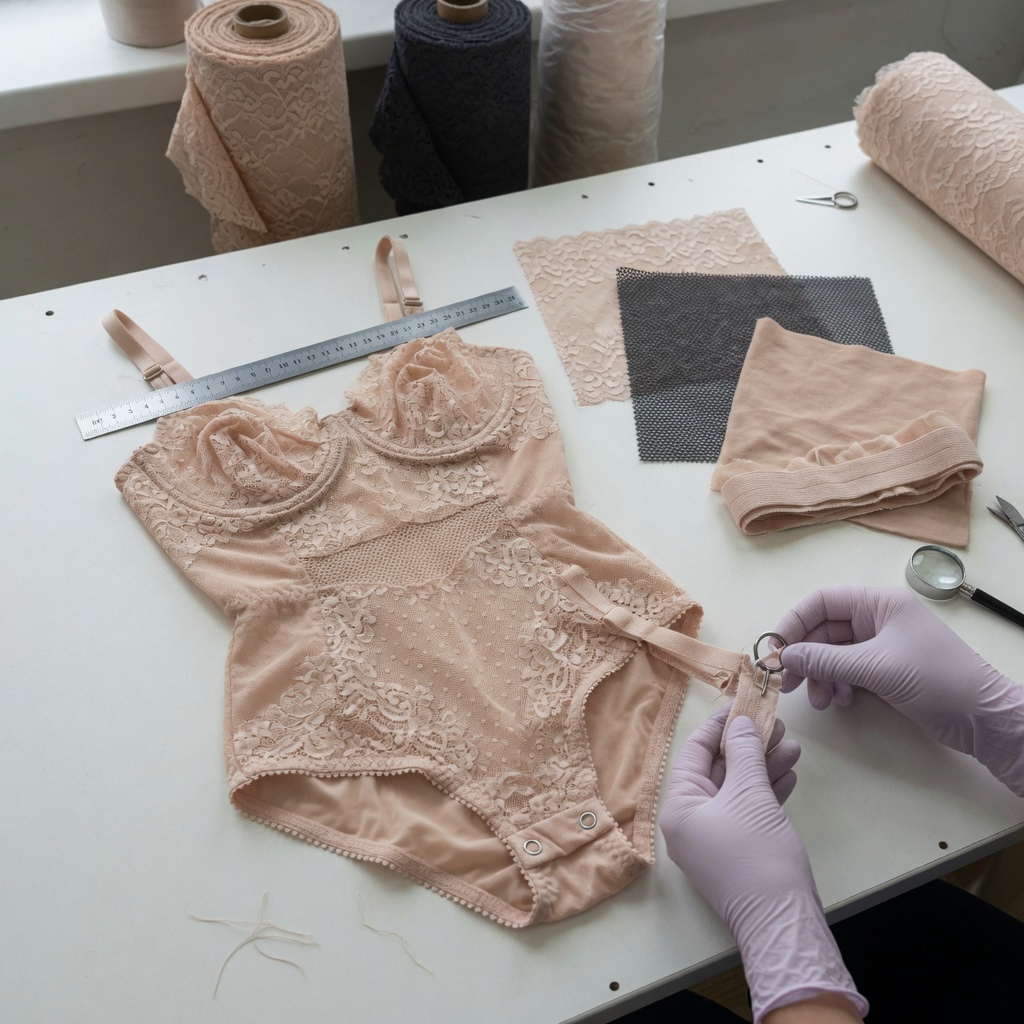
A teddy bodysuit typically mixes stretch lace, jersey or power mesh, plush elastics and findings in a skin-contact construction. An uncertified lace, elastic or snap can break a recycled, organic or chemical claim after the goods are cut. Price mill booking time, certified-lace palette limits and document labour against retailer rejection, blocked onboarding, or destination-access risk. Do not cut bulk fabric until the evidence pack for this style is complete.
Decision sequence (keep this order): specify the evidence pack in the RFQ → compare OEM responses on documents for this teddy style → verify lot-level TCs against planned cut kilograms → approve a production-line trial in the bulk factory → order only after a written document-review gate.
Sustainability sourcing criteria for teddy bodysuit manufacturing destined for Europe
Work backwards from claims that will actually be sold or labelled. Recycled claims need GRS (or a retailer-accepted chain-of-custody equivalent) plus lot-level TCs. Organic claims need GOTS or OCS plus matching TCs. The cited B2B guides describe OEKO-TEX Standard 100, labour audits and quality-system certificates as buyer-requested evidence to pair with material documents. Those papers are not, by themselves, a legal determination for every destination in Europe.
Claim-to-source map (document types only). Three public B2B source contexts shape which papers to request:
- Buyer-facing teddy/babydoll sourcing guidance recommends prioritising GOTS, OEKO-TEX Standard 100 and GRS, incorporating third-party labour audits, and collecting mill water or CO2 data only where they can be supported. Definitive Guide to Sourcing Babydoll Teddy Lingerie
- Manufacturer-side guidance on launching a certified lingerie line states that factories should provide GRS or OCS certificates plus Transaction Certificates for traceable recycled or organic fabrics, and should be vetted with BSCI, GRS and OEKO-TEX documentation, facility visibility and small trial orders before scale. Launching a Sustainable Lingerie Line
- An OEM/ODM lingerie manufacturing guide calls for ISO 9001, BSCI and OEKO-TEX Standard 100 testing of every component—including fabrics, lace, threads and hardware—plus multi-stage QC and AQL inspections for orders into regulated markets. Sourcing Lingerie Manufacturing
Named standards appear here only as evidence those guides say a buyer should request. A standard’s labelling rule is not Velora Intimates practice, and this page does not state that any factory is certified.
Concrete data point (example calculation/assumption to verify in the supplier quote): If a GRS recycled claim is used, calculate certified fibre share from the bill of materials in grams per size (unit: grams per size, then kilograms on the TC; scope: this teddy style’s fabric, lace and mesh panels; as-of: the mill scope certificate and TC issue dates supplied for this purchase order). Example buyer threshold: at least 20 percent of total fabric weight from GRS-certified input. This is an assumption to verify against the current mill scope certificate, mill invoices and TC quantity, not a universal legal minimum.
Concrete data point (example recency window to overwrite in the RFQ): Require the social-audit report for the sewing site that will produce the teddies to show a printed audit date within the previous 12 months of the planned bulk cut date (unit: months; scope: named legal entity and sewing address; as-of: the date printed on the report) and to include corrective-action status.
Concrete data point (example piece range to overwrite in the RFQ): Release a first-style production-line trial of 50–150 finished teddy bodysuits (unit: finished pieces; scope: the bulk factory and the same construction, shade and document pack as mass production) before committing bulk fabric. The piece range is an assumption, not a measured factory minimum order quantity.
A mill marketing PDF is not a scope certificate. A scope certificate is not a TC. A TC that does not match the kilograms cut does not support the garments in the carton.
Certified fibres, Transaction Certificates and teddy construction constraints
Teddies multiply chain-of-custody work because one style often combines recycled polyester lace, organic cotton jersey, recycled polyamide mesh and conventional elastane. GRS and GOTS/OCS claims hold only if certified input is allocated and documented. TCs are the documents that tie a certified mill or trader shipment to the garment factory for a defined quantity.
Put these construction constraints into the RFQ as questions, not as assumed mill capacity:
- Can certified lace and narrow elastic be booked in the required colour, stretch and motif scale, and on which mill lead time?
- If certified and non-certified panels are mixed, which on-garment claim will be used, and does that claim match the documented share and the standard’s labelling rules?
- When will TCs be issued relative to fabric delivery, and is that date on the critical path before cutting?
Ask the factory, in the RFQ response, to map each BOM line to fibre, mill, certificate number, validity, whether a TC will be issued, and whether the component sits inside the OEKO-TEX article. Optional mill water or climate figures for a named fabric quality may be collected if a number will be published. Treat those figures as lot-, method- and year-specific. They do not replace chain-of-custody documents.
Risk control: reconcile mill invoices, TC kilograms and the cutting ticket for this purchase order before bulk cutting. Mixed leftover lots without a new allocation record fail the recycled or organic claim even if a scope certificate is still in date.
Chemical evidence, trims and destination rules across EU, EEA and UK
Skin-contact construction puts trims in scope. The OEM/ODM lingerie manufacturing guidance cited above names OEKO-TEX Standard 100 as the scheme for testing fabrics, lace, threads and hardware, not only the body fabric. Request certificates or extracts that identify the tested article and remain valid at bulk production, not only at quotation.
Destination must be named in the RFQ as separate fields: EU member state(s), EEA country or countries, and/or the United Kingdom. Do not copy a test pack prepared for one of those destinations onto another destination line. Care-label language, fibre-composition rules and the identity of the economic operator belong in the tech pack by named country, not under a generic “Europe” line.
This briefing does not reproduce legal annexes and does not state that any one chemical or labelling rule applies across all of Europe. The procurement action is to list destinations in the RFQ, require the factory to state which tests and certificates they will supply for those destinations, and have the importer’s compliance function confirm sufficiency. OEKO-TEX is a practical harmful-substance screen for lace and elastics as described in the cited OEM guide; it is not, by itself, proof that every national rule is met. Rings, sliders, snaps, hooks and printed or silicone-gripped elastics are the usual gaps—list them as separate BOM lines with a certificate-or-test flag.
Social compliance, ISO 9001 and multi-stage QC for intimates
Material certificates do not prove the sewing floor. The cited OEM lingerie partnership guidance calls for ISO 9001 quality systems, BSCI ethical labour audits, and multi-stage QC: incoming fabrics, in-process stitching, and final AQL inspections. For teddies, in-process checks should include strap length and symmetry, elastic tension, snap or hook alignment, gusset finish and lace-motif placement. Those defects are easy to miss if the only protocol is a folded-carton visual audit copied from a basic cut-and-sew PO.
Concrete data point (example AQL assumption to overwrite in the RFQ): Write the final-audit AQL for majors and minors into the purchase order (example apparel levels such as 2.5 majors / 4.0 minors; unit: AQL; scope: the finished teddy inspection lot; as-of: the inspection date on the report). These figures are assumptions until specified. Verify the factory’s sampling procedure and whether inspection is internal or third-party.
Request the latest BSCI (or accepted equivalent) report for the sewing site, the result, and open corrective-action items. A website badge is not the report. Confirm the audited legal entity is the factory that will sew the teddies. Virtual tours or time-stamped photos of the intimates line, not a showroom, help. Small trial orders remain the lowest-cost test of whether TCs, shade lots and QC paperwork actually travel with the goods.
Buyer decision table: comparing teddy OEM partners on sustainability sourcing criteria
Use the table to score RFQ responses. Every row is a specify, compare, verify, approve or order action.
| Criterion | What to specify in the RFQ | Evidence that counts | Teddy-specific check | Compare / fail signal |
|---|---|---|---|---|
| Organic claim (if used) | Fibre and GOTS vs OCS intent | Current scope certificate plus TCs in kg for allocated lots | Which panels (body vs lace) carry the claim | Expired scope; TC kg below cut kg |
| Recycled claim (if used) | Fibre, GRS, claimed share of garment or named panel | Current GRS scope plus TCs matching BOM kg | Recycled lace vs mesh vs uncertified elastic | Hangtag claim exceeds documented share |
| Harmful-substance testing | OEKO-TEX Standard 100 (or named equivalent) on all components | Certificates listing lace, elastic, thread, hardware | Snaps, rings, printed elastic, dye lots | Body fabric certified; trims omitted |
| Social compliance | Named scheme (e.g. BSCI) and recency | Full audit report, date and corrective-action status | Intimates sewing line is inside the audited site | Website badge only; different legal entity |
| Quality system | ISO 9001 for the sewing site | Valid certificate for that legal entity and address | SOPs for elastic attach and hygiene gusset | Certificate for a trading company only |
| QC stages | Incoming, in-process, final AQL | Written plan plus recent inspection reports | Strap, snap, lace-motif, shade-band checks | Final AQL only; no incoming shade approval |
| Traceability pack | Mill-to-factory lot map | TCs, invoices, cutting records | One TC per certified input | Lots mixed after cutting without records |
| Trial before bulk | Quantity in the production factory | Trial goods plus the same document pack as bulk | Wash, stretch recovery, hardware after trial | Sample-room piece; missing TCs |
| Destination | EU member / EEA / UK country list | Tests and labels stated for that destination | Care and fibre languages; importer identity | “Europe” as one undefined market |
| Optional mill metrics | Water or CO2 for a named quality, method, year | Report tied to that quality | Only if a number will be published | Generic industry average, not this lace |
Score whether the OEM can attach evidence to this teddy style, not whether a certificate ever existed for another product.
RFQ checklist for teddy bodysuit manufacturing
Copy these lines into the RFQ. Each item supports specify, compare, verify, approve or order.
- List destination countries separately (EU member states, EEA countries and/or the UK). Do not write “Europe” only.
- Name the importer of record for each destination group (EU member state, EEA country, United Kingdom) and require the factory to state which tests and certificates they will supply for each named destination.
- Attach the full BOM: every fabric, lace, mesh, elastic, thread, ring, slider, snap or hook, and brand label, with fibre content and intended claim (none / recycled / organic).
- Require current GRS and/or GOTS or OCS mill scope certificates, including validity dates, certified products and certified percentages.
- Require Transaction Certificates for the specific lots and kilogram quantities reserved for this purchase order, available before or with bulk fabric delivery.
- Require a mill-to-cut reconciliation: certificate numbers, TC numbers, kilograms allocated versus kilograms planned to cut, leftover handling, recorded before bulk cutting.
- Require OEKO-TEX Standard 100 (or named equivalent) coverage for lace, elastics, thread and hardware, valid at bulk production.
- Require the latest BSCI (or named equivalent) audit report for the sewing site, including printed date, result and open corrective actions (example recency: within the last 12 months of the planned bulk cut date; use the date on the report).
- Require ISO 9001 for the manufacturing legal entity and site that will sew the teddies.
- Require a QC plan covering incoming shade and width; in-process strap, elastic tension, hardware and lace placement; and final AQL with stated levels (write the numbers; example 2.5 majors / 4.0 minors remains an assumption until specified).
- Specify a production-line trial quantity (example 50–150 pieces per colourway) in the bulk factory, with the same document pack as mass production, before bulk fabric commitment.
- Require fibre-composition and care-label artwork in the languages required for each named destination, plus placement on the teddy.
- Require written confirmation that uncertified substitution of lace, elastic or dye lots is not permitted without a new TC and re-test.
- Ask for a virtual tour or time-stamped photos of the intimates sewing line, elastic attaching and final inspection table.
- If water or CO2 figures will be published, require the mill method, year, unit (example: litres per kilogram of fabric, or kg CO2e per kilogram of fabric) and whether the figure is product-specific; verify against the mill report.
- State Incoterms, inspection location, and that TCs and certificates travel with or before the commercial documents.
- Set change control: any mill, dye lot or trim change restarts the certificate and TC check before cutting.
- Require a declaration of which legal entity holds which certificate, so a trading-company certificate cannot stand in for an unaudited sewing floor.
- Set a document-review gate: no bulk cutting until TCs, OEKO-TEX component coverage and audit recency are approved by the buyer.
These lines are order-release gates, not a brochure request.
Methodology, source context, limitations and author note
How this briefing was derived. Criteria and document types (scope certificates, Transaction Certificates, OEKO-TEX component tests, BSCI, ISO 9001, multi-stage AQL QC, trial orders) are taken from the three publicly available B2B sourcing guides listed above, on teddy/babydoll lingerie, certified lingerie lines, and OEM/ODM lingerie manufacturing. Each numbered claim-to-source item is limited to the document types those pages describe as buyer-requested evidence. Destination splitting (EU member state vs EEA country vs United Kingdom) is a procurement risk control so one rule is not treated as applying across all of Europe; it is not copied from a legal annex. Percentage, kilogram, piece-count, recency-window and AQL figures above are labelled examples for the RFQ, not measurements of a factory or of Velora Intimates.
Limitations and what to verify. Certification versions, approved certifiers, and national chemical and labelling rules change. Scope certificates expire. TCs are lot-specific. A United Kingdom placement-on-market path is not automatically the same as an EU member-state path or an EEA path. Retailer manuals may demand additional schemes. Water and CO2 numbers are mill- and method-specific. This article is not legal advice, does not reproduce GOTS, GRS, OEKO-TEX, BSCI or ISO 9001 standard text, and does not state that Velora Intimates or any unnamed factory is certified, audited, or able to issue TCs. Before purchase order, verify every certificate with the issuing body, match TC kilograms to the cutting ticket, re-confirm destination-country obligations with the importer of record, and overwrite every example threshold with signed RFQ values.
Editorial note: Written by Vincent Xi, Editorial Author (https://velora-intimates.com/authors/vincent-xi/). No factory visit, laboratory test, client programme, or first-hand production experience is claimed.
Discuss Your Requirements
Review our manufacturing capabilities, then share your specifications for a supplier-fit review.