Lingerie Teddy OEM Material Options for Europe RFQs
By Vincent Xi, Editorial Author
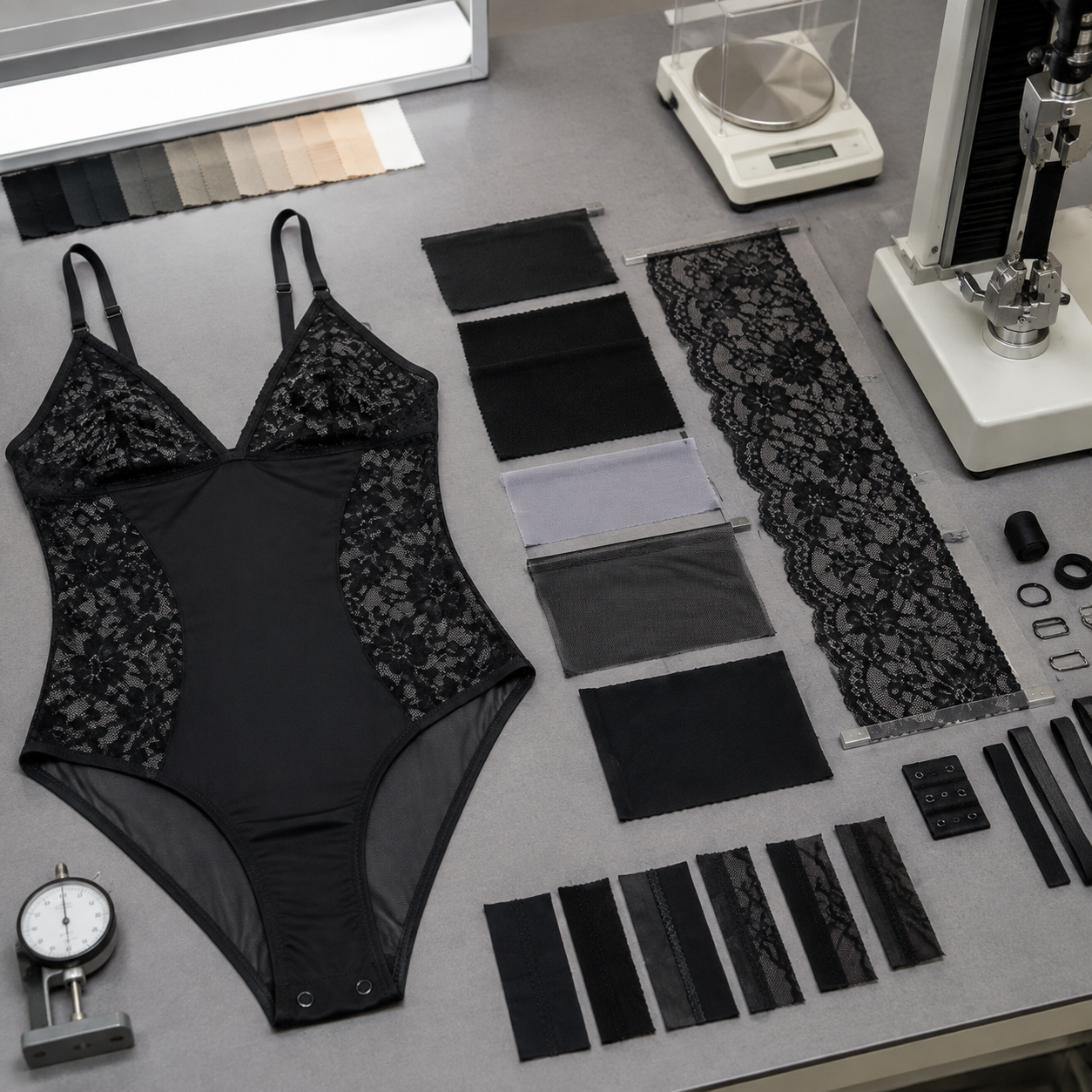
For a Europe-bound RFQ, lingerie teddy OEM material options should be specified component by component. A fabric-family name, photograph, or loose swatch does not identify everything used in a teddy bodysuit. The RFQ should separately cover the main-body textile, lace, mesh, lining, gusset, elastic, binding, thread, closures, and hardware present in the design.
The procurement decision should connect each component to a supplier article, measurable quote fields, an assembled sample, commercial terms, destination evidence, and a substitution rule. Hold an offer when the supplier omits usable width or colour minimums, uses unreported test conditions, submits evidence for a different article, or relies on a generic Europe-compliant statement. The supplied sources do not establish that a particular material, product, supplier, or factory meets any performance or compliance threshold.
Author note: The approved author profile identifies Vincent Xi as an Editorial Author. It does not document factory visits, physical testing, supplier audits, certifications, or procurement outcomes, so no first-hand experience claim is made.
Europe RFQ matrix for lingerie teddy OEM material options
This matrix is a buyer-created RFQ framework, not a statement about Velora products, supplier capabilities, or legal requirements. Candidate materials remain conditional until they are linked to the proposed pattern, construction, sample, and destination brief.
| Component | Material options to request when the design uses them | Evidence needed for comparison | Hold the offer when |
|---|---|---|---|
| Main-body panels | An identified supplier-proposed stretch knit | Fibre composition by mass, article code, finish, colour reference, finished mass, usable width, directional extension and recovery procedures, dimensional-change procedure, tolerances, and revision | The offer provides only a generic fibre name, handfeel description, photograph, or nominal roll width |
| Lace and mesh panels | Identified stretch or non-stretch articles appropriate to the proposed pattern and construction | Composition by mass, usable pattern width, repeat and scallop treatment where relevant, direction, colour reference, extension procedure, placement trial, seam trial, and defect rule | Cuttable width is not separated from nominal width, or the sample cannot be linked to the quoted article |
| Gusset and lining | A separately identified textile for each location present in the design | Composition by mass, finish, finished mass, usable width, colour, placement, dimensional-change procedure, article code, and revision | The component is missing from the bill of materials or treated as an unidentified factory default |
| Elastic, binding, and straps | An identified article for every edge, support, or adjustment location | Component dimensions and tolerances, extension and recovery procedure where relevant, colour reference, attachment trial, article identity, and revision | One generic trim description is used for components with different locations or functions |
| Thread, closures, and hardware | Identified components used in the approved construction | Material or finish identity, dimensions, colour, attachment method, sample representation, and risk-based evidence specified by the buyer | A body-fabric result is presented as evidence for a trim, attachment, or complete assembly |
A supplied commercial manufacturer-evaluation article recommends defining the product category, target market, quality level, size range, customization, MOQ, price position, and order model before supplier outreach (source). For a material-focused teddy RFQ, that general screening context should be narrowed to component identities, quote units, sample scope, colour exposure, approval responsibility, and the intended European destination. The source does not provide teddy-specific measurements, test results, acceptance thresholds, or supplier performance evidence.
Material options and comparable quote fields
The following fields are proposed procurement controls. They are not presented as legal thresholds, published performance benchmarks, or Velora manufacturing specifications.
Material identity
Assign a supplier article code, source or mill reference where disclosed, finish, colour code, and revision to every textile and trim. Request fibre composition by mass for each component instead of describing the complete garment only by its main-body composition.
The quote, technical sheet, physical swatch, sample record, test report, and purchase order should use matching identities. A document for another colour, finish, source, or revision should be treated as separate evidence until its applicability is demonstrated.
Finished mass and usable width
Request finished mass with its result unit, procedure, conditioning details, and supplier tolerance. Record nominal width and usable cuttable width separately. For patterned lace, define how scallops, incomplete motifs, repeats, edge zones, and visible defects affect usable width.
Normalize textile prices using the supplier's purchasing unit and usable width. Keep that calculation separate from approved-pattern consumption, because panel direction, placement, motif matching, size mix, cutting loss, and defect allowance can change garment-level usage.
Extension, resistance, and recovery
For any stretch comparison, state the tested direction, specimen orientation, conditioning, load or target extension, hold period, cycling procedure, recovery interval, result unit, and buyer-set acceptance rule. Competing materials should be measured under the same agreed procedure before their results are compared.
A maximum-stretch statement without the applied force and test procedure is incomplete for an RFQ decision. Descriptions such as firm, supportive, soft, or shaping should be tied to an approved reference sample and a defined measurement route rather than treated as standalone specifications.
Dimensional and colour controls
Identify the processing or care condition represented by dimensional-change evidence, the measurement directions, sample identity, and acceptance criteria. For colour approval, define the reference, viewing condition, comparison route, lot-grouping rule, and permitted variation.
Evidence should represent the proposed component, colour combination, finish, care route, and construction. A generic pass statement does not show whether the quoted article or assembled garment was evaluated.
Assembly evidence
Select checks according to the proposed component and anticipated failure mode. Relevant RFQ fields may include seam interaction, bursting, seam slippage, snagging, pilling, edge curling, elastic recovery, attachment security, or hardware corrosion. Each requested result should identify the method and edition, specimen, orientation, result unit, testing party, report date, and buyer-set threshold.
Review both the loose material and a complete sample made with the proposed thread, elastic, needle, stitch, seam allowance, panel direction, closure, and attachment method. Loose-material evidence should not be presented as evidence for an untested seam or finished assembly.
Example normalization of main-body material options
Example basis: Every figure below is a buyer-created assumption for a hypothetical main-body quote comparison as of 15 February 2025. The figures are not supplier data, market benchmarks, product specifications, or sourced performance claims. Verify and replace every value with a dated supplier quote, identified technical sheet, and corresponding sample before making a purchasing decision.
| Hypothetical main-body quote | Assumed composition by mass | Assumed finished mass | Assumed usable width | Assumed price | Assumed material MOQ | Example usable-area price |
|---|---|---|---|---|---|---|
| Option A | 85% polyamide and 15% elastane by mass | 165 g/m2 of finished fabric | 1.50 m of cuttable width | EUR 6.20 per linear m | 500 linear m per colour | EUR 6.20 per linear m divided by 1.50 m usable width = EUR 4.13/m2 |
| Option B | 90% polyester and 10% elastane by mass | 150 g/m2 of finished fabric | 1.55 m of cuttable width | EUR 4.80 per linear m | 800 linear m per colour | EUR 4.80 per linear m divided by 1.55 m usable width = EUR 3.10/m2 |
This calculation compares assumed usable-area prices only. It does not establish material suitability, teddy bodysuit consumption, or total manufacturing cost. Replace the assumptions and add approved-pattern consumption by ordered size, panel direction, placement loss, motif matching where applicable, cutting loss, defect allowance, testing charges, colour-minimum exposure, surcharges, and responsibility for unused material.
A lower area price is not a release decision. Material identity, comparable test conditions, assembled-sample evidence, commercial exposure, and destination documentation still require review.
Europe destination evidence for material options
Europe is the sole sales-market scope of this RFQ, but it is not a single regulatory jurisdiction. Record the actual destination and keep EU, EEA, UK, country-specific, and retailer evidence separate. These controls describe procurement handling and are not legal advice.
| Destination scope | What the supplied evidence supports | RFQ control and limitation |
|---|---|---|
| EU | A supplied commercial sourcing page identifies REACH as a concern for EU underwear buyers (source) | Use the statement as a prompt for current official review, not as complete legal evidence or proof of compliance. The responsible importer or compliance adviser should define the applicable article scope, substance information, declarations, reports, dates, and destination requirements |
| EEA | The supplied citations do not establish how the EU-related point applies in each EEA destination | Record the specific destination and obtain a current scope determination from the responsible compliance owner. Do not extend an EU-scoped document to an EEA destination without documented review |
| UK | The supplied citations do not establish current UK requirements for the proposed materials | Request a separate UK review and evidence list. Do not treat an EU-oriented declaration or report as proof that UK obligations have been addressed |
| Country-specific and retailer scope | The supplied citations do not provide a complete national or retailer requirement set | Name the destination country and retailer protocol where applicable. Define required language, material information, product-safety evidence, packaging evidence, restricted-substance evidence, and document dates before release |
The same commercial sourcing page mentions OEKO-TEX, ISO, and GOTS in a general supplier-selection context (source). That mention does not establish that a particular standard or scheme applies to the proposed material, is legally required, or is held by Velora, a supplier, or a manufacturing site.
When a buyer requests a standard or voluntary scheme, record the exact document or scheme, holder, covered site, scope, applicable product or material, identifier, validity period, and verification route. Keep these evidence types distinct:
- A legal requirement applies only within its verified jurisdiction, article scope, and effective context.
- A buyer acceptance criterion remains the buyer's RFQ requirement; it does not become law because it appears in a specification.
- A voluntary certificate supports only the holder, site, scope, material or product, and validity shown on the current document.
- A supplier declaration is not an independent test report.
- A test report supports the identified specimen under the stated method; it does not automatically cover a changed material or complete assembly.
Sample, traceability, and substitution controls
Approval chain: Link the technical sheet, identified swatch, colour submission, development sample, pre-production sample, quote, purchase order, incoming material identity, test report, and inspection record through the same article code, colour code, finish, and revision. Mark unlinked evidence as unresolved.
Sample representation: Record which body fabric, lace, mesh, lining, gusset, elastic, thread, closure, and hardware are represented in each sample. Keep loose-material and assembled-sample results separate. Approval of a swatch should not be written as approval of an untested edge, strap, closure, seam, or complete garment.
Incoming control: Before bulk cutting, define buyer-selected checks for article identity, roll or package traceability, shade grouping, usable width, finished mass, visible defects, received quantity, and risk-based retesting. Assign hold authority and state what evidence is required to release a nonconforming lot.
Substitution control: Require written disclosure before any proposed change to source or mill, yarn, fibre composition, dye route, finish, mass, usable width, colour route, or article code. State who may approve the change, which documents must be resubmitted, whether a new assembled sample is required, and which previous approvals cease to apply.
Practical RFQ checklist for Europe teddy bodysuit material options
Use this copy-ready checklist to make missing inputs, supplier exceptions, and release holds visible in the RFQ. An unchecked field remains unresolved until the responsible party supplies the requested information or records an approved exception.
- [ ] Identify the buying entity, style name, style revision, intended European destination, ordered size range, colour scope, and material decision owner.
- [ ] State the forecast and order quantity by size and colour without treating either figure as an agreed manufacturing MOQ.
- [ ] List every body, lace, mesh, lining, gusset, elastic, binding, strap, thread, closure, and hardware location present in the design.
- [ ] Mark each component as supplier-stocked, buyer-nominated, or custom-developed and identify who owns the resulting specification.
- [ ] Request the article code, source or mill reference where disclosed, fibre composition by mass, finish, colour code, revision, finished mass, usable width, and supplier tolerances for each textile.
- [ ] Request dimensions, materials or finishes, attachment methods, tolerances, and article identities for elastics, bindings, straps, thread, closures, and hardware.
- [ ] Define extension and recovery conditions, specimen direction, conditioning, load or target extension, cycling, hold period, recovery interval, result unit, and buyer acceptance rule where relevant.
- [ ] For patterned lace, define usable pattern width, repeat, scallop treatment, placement direction, matching rule, visible edge zones, and defect limits.
- [ ] Request currency, purchasing unit, usable-width basis, quote validity, material-price adjustment terms, material MOQ, colour MOQ, and responsibility for unused material.
- [ ] State the delivery term and named place, payment terms, sampling charges, colour-development charges, testing charges, tooling charges, and custom-development charges separately.
- [ ] Request approved-pattern consumption by ordered size and document panel direction, placement, motif matching, cutting loss, and defect-allowance assumptions.
- [ ] Define the required sample stages, material represented at each stage, approval owner, resubmission route, sample charge, and lead-time start event.
- [ ] Request material-development, sample, testing, bulk-production, and delivery lead times with the event that starts each period and the assumptions that could change it.
- [ ] Identify the exact EU, EEA, UK, country-specific, and retailer scope relevant to the order without combining jurisdictions by default.
- [ ] Assign responsibility for current destination review, material information, declarations, testing, document verification, buyer acceptance, and release approval.
- [ ] Require each declaration, report, or voluntary certificate to identify its issuer or holder, covered site, article or material, colour or finish where relevant, scope, issue date, validity, and verification route.
- [ ] Define incoming checks for article identity, traceability, shade grouping, usable width, finished mass, visible defects, received quantity, and risk-based retesting before bulk cutting.
- [ ] Define hold conditions for missing, expired, mismatched, unidentified, changed, or destination-incomplete evidence and name the person authorized to release a hold.
- [ ] Prohibit substitutions until the supplier discloses the proposed change and the buyer completes documented review, resampling, retesting, or reapproval as required.
- [ ] Require the supplier to list every exception, assumption, and unpriced item instead of treating silence as acceptance of the RFQ.
Methodology, source context, and limitations
Methodology: The article derives the RFQ structure by mapping each possible teddy bodysuit component to a material identity, measurable quote field, sample record, commercial exposure, destination scope, and change-control decision. The controls are procurement recommendations rather than claimed legal thresholds or supplier capabilities. Supplier declarations, test reports, buyer acceptance criteria, and voluntary certificates are treated as separate evidence types. The worked example divides an assumed linear-metre price by assumed usable width to calculate an illustrative usable-area price before pattern consumption is considered.
| Statement used | Source context | Boundary of support |
|---|---|---|
| Vincent Xi is the named Editorial Author | Approved author profile | Supports the displayed identity and role only; it does not support first-hand manufacturing, testing, audit, or procurement claims |
| Product category, target market, quality level, size range, customization, MOQ, price position, and order model are presented as pre-outreach screening fields | Commercial manufacturer-evaluation article | General sourcing context only; no teddy-specific material measurements, acceptance limits, supplier results, or legal conclusions are taken from it |
| Materials, REACH for EU buyers, and certification categories are discussed in a sourcing context | Commercial underwear-sourcing article | Supplier-screening context only; it is not official legal evidence, a current certificate, a test report, or proof concerning a particular material, product, company, site, or shipment |
Limitations and points to verify: The supplied sources do not include current official legal text, complete test methods, teddy-specific laboratory reports, dated supplier quotations, identified traceability records, current certificates, or country-by-country requirements. They do not establish Velora's manufacturing capacity, material availability, performance, certification status, MOQ, price, lead time, or customer outcomes. No physical testing, factory inspection, supplier audit, certificate validation, or legal determination supports this article. Before approval, verify every composition, dimension, tolerance, test result, commercial figure, sample identity, certificate scope, and destination requirement against current documents issued for the proposed article and order.
Discuss Your Requirements
Review our manufacturing capabilities, then share your specifications for a supplier-fit review.