Lingerie Costume OEM Packing Requirements for Canada
By Vincent Xi, Editorial Author
Author note: The approved author profile confirms Vincent Xi's role as Editorial Author. It does not document first-hand product use, factory visits, testing, or customer outcomes, so no such claims are made here.
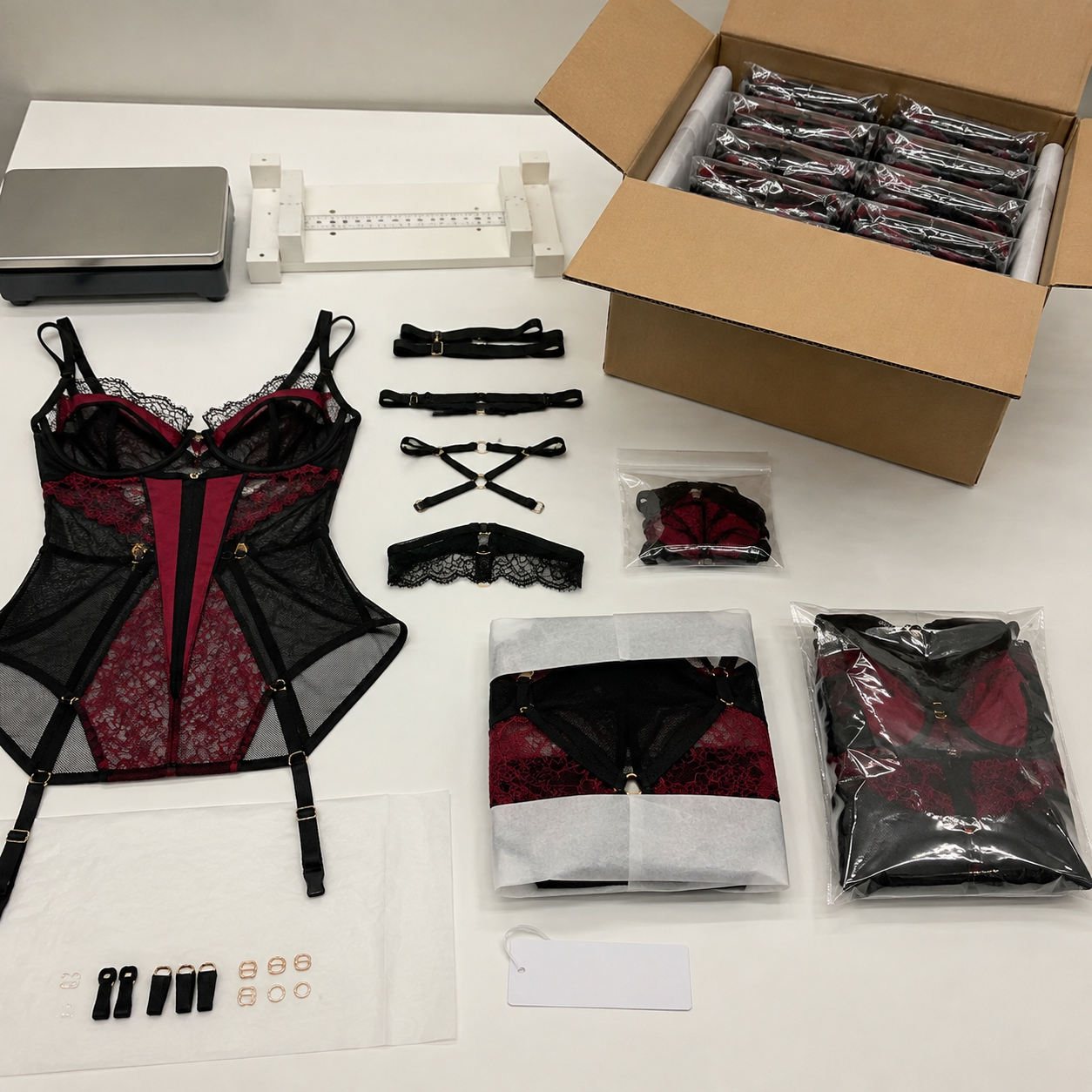
For a Canadian B2B buyer, a lingerie costume OEM packing RFQ should define more than a pouch and carton price. It should connect the role play costume component manifest, packaging bill of materials, fold and protection method, controlled artwork, sealed-unit measurements, carton configuration, inspection evidence, and quote assumptions.
The purchasing decision is narrow: does the quoted pack match the production-equivalent sample, and can the supplier reproduce that approved pack during bulk role play costume manufacturing? The buyer should hold release when the quote, sample, artwork, measurements, or packaging BOM refer to different revisions.
This article covers packing requirements only. The supplied evidence supports a specification-first sourcing process, packaging customization questions, prototyping, fulfilment-weight inputs, pre-shipment inspection, and target-market compliance planning. It does not establish the actual materials, dimensions, label wording, Canadian language treatment, supplier capability, certification, or production performance of a specific role play costume.
Canada packing requirements for the OEM RFQ
Issue a controlled packing record for each SKU or variant whose components, artwork, finished pack, mass, or carton arrangement differ. The controls below are RFQ recommendations rather than claims about a supplier's current practice or Canadian legal requirements.
| RFQ field | Buyer-controlled requirement | Evidence before release |
|---|---|---|
| Pack identity | SKU, size, color, trim, intended Canadian channel, technical-pack revision, and quote revision | Matching identifiers on the quote, sample, manifest, artwork, and inspection record |
| Component manifest | Garment pieces, attached parts, detachable accessories, inserts, required quantities, and pack locations | Completed manifest and pack-out photographs |
| Packaging BOM | Material, construction, finish, closure, dimensions, tolerance, print method, and substitution status for every component | Itemized quote, material specification, and production-equivalent sample |
| Fold and protection | Fold sequence, protected surfaces, accessory isolation, restraint, sealing method, and opening sequence | Approved packed sample and inspection reference images |
| Artwork control | Approved file, revision, variable-data owner, placement, print method, and proof status | Current proof and application sample |
| Unit measurements | Sealed-unit dimensions and gross mass, including measurement definitions | Recorded results, method, equipment identifier, and photographs |
| Carton configuration | Carton construction, internal protection, pack orientation, quantity, external dimensions, closure, and gross mass | Physically packed and closed production-equivalent carton |
| QC and changes | Defect descriptions, sample selection, acceptance rule, disposition authority, and deviation workflow | Inspection report and approved deviation record where applicable |
| Commercial scope | Packaging materials, print, labels, inserts, labor, cartons, samples, inspection, and freight inputs | Itemized inclusions, exclusions, assumptions, and change charges |
The XS Lingerie sourcing guide identifies packaging as a customization decision and recommends defining the product category, target market, quality level, size range, customization, order type, and MOQ expectations before approaching manufacturers. That supports a specification-first RFQ process. It does not establish a role play costume pack specification, Canadian requirement, or supplier result.
Lock the sell-unit packing requirements
Attach a controlled component manifest to the RFQ. For every garment piece, attached part, detachable accessory, and insert, state the required quantity, location in the sealed pack, protection method, and substitution status. The purchase order, packed sample, and inspection report should all reference the same manifest revision.
Build the packaging BOM at component level. Include every pouch, tissue sheet, accessory pouch, support, closure, seal, label, insert, and carton component included in the quote. Record material and construction without adding unsupported environmental, durability, or compliance claims. When an attribute affects the purchasing decision, ask the supplier to identify the document or test that substantiates it.
Define each physical pack level actually used, from the sealed sell unit through any intermediate grouping to the master carton. Mark unused levels as not applicable. Do not carry dimensions or carton quantities across sizes or trim variants until a production-equivalent fit check confirms that they use the same approved configuration.
| Measurement | RFQ definition | Control purpose |
|---|---|---|
| Sealed-unit dimensions | Measure outer length, width, and depth in the stated order after final sealing, with the pack resting naturally and without manual compression | Keeps nominal empty-pouch dimensions separate from the filled sell-unit envelope |
| Sealed-unit gross mass | Weigh the complete sell unit with all manifested components and unit packaging included | Provides a defined packed-mass input for quote comparison |
| Closed-carton dimensions | Measure the fully packed and closed carton at its outermost points and state the dimension order | Prevents internal dimensions or an empty carton from being reported as the shipping envelope |
| Closed-carton gross mass | Weigh the closed carton with sell units, carton material, and internal protection included | Ties the logistics input to the approved pack-out |
| Carton quantity | Count finished sell units in the approved orientation and identify any mixed-SKU arrangement | Prevents a nominal carton count from overriding physical fit |
| Equipment record | Record the measuring equipment identifier and current calibration status under the buyer's quality procedure | Makes the measurement evidence traceable without implying certification |
Protect the product inside the approved pack
The technical pack must drive the protection method. Stretch mesh, lace, satin elastic, small metal closures, and detachable accessories are relevant only when the actual SKU uses them. They are conditional risk examples, not claims about a particular product.
For the applicable materials and components, the RFQ should define:
- A repeatable fold sequence tied to identifiable garment landmarks.
- Buyer-approved no-contact zones for surfaces at risk from hardware, abrasion, snagging, or compression.
- The location and restraint method for detachable accessories.
- Every tissue, support, internal pouch, or separator as a packaging BOM line.
- The closure and seal method, including the intended opening sequence.
- The acceptable condition of the garment, trim, accessories, closure, and outer package after sealing.
Use named packing defects in the inspection checklist. Relevant descriptions may include a missing component, incorrect fold direction, loose accessory, unapproved packaging material, open seal, product trapped in the closure, hardware touching a protected surface, visible abrasion, permanent fold damage, trim deformation, or residue. Photographs can document appearance and pack arrangement; retain the approved physical sample wherever release depends on compression, surface condition, or hand assessment.
Control artwork for Canada-bound packs
The supplied sources do not establish current Canadian label wording, language treatment, importer or distributor wording, or claim requirements for a specific role play costume. Those decisions should remain with the buyer's current Canadian compliance review rather than being inferred from a supplier template or this article.
After that review, provide controlled artwork and identify the owner of every variable field. The supplier should reproduce the approved file without independently changing wording, translations, claims, identifiers, placement, or print method. Require proof approval and an applied sample before bulk printing or packing.
The inspection record should identify the applied artwork revision, variable data, placement, legibility, print condition, and interaction with the package seal. These are buyer-defined controls, not representations of Canadian statutory requirements.
No packaging standard or test method is named because the supplied evidence does not establish one for the SKU. If the buyer adds a standard, the RFQ should identify its current edition, scope, conditioning, sample configuration, pass criteria, and responsible party. A supplier's internal procedure is not automatically a requirement of a named standard, and certification should not be claimed without a current document covering the relevant product and scope.
Measurable packing requirements for quote comparison
Every numerical value in this section is an editorial example assumption to verify in the supplier's current quote and a production-equivalent packed sample. The values are not sourced product data, legal limits, carrier limits, approved tolerances, or shipment measurements.
| RFQ field | Example assumption to verify in the current supplier quote | Defined scope |
|---|---|---|
| Sealed-unit envelope | Example assumption to verify: 240 mm length x 180 mm width x 35 mm depth | Outer dimensions of each sealed hypothetical sell unit at natural rest |
| Sealed-unit gross mass | Example assumption to verify: 260 g per sealed hypothetical sell unit | Includes every manifested component and all unit packaging |
| Master-carton quantity | Example assumption to verify: 32 sealed hypothetical sell units per closed master carton | Applies only to the assumed SKU and pack revision |
| Master-carton envelope | Example assumption to verify: 510 mm length x 390 mm width x 310 mm depth | External dimensions of the fully packed and closed hypothetical carton |
| Closed-carton gross-mass cap | Example assumption to verify: 12.0 kg per fully packed and closed hypothetical carton | Includes sell units, carton material, and internal protection |
Example mass calculation to verify in the current supplier quote: 32 sealed sell units per carton x 0.260 kg gross mass per sealed sell unit = 8.32 kg of packed-unit contents per hypothetical carton. Under the example 12.0 kg closed-carton cap, the example remaining allowance is 12.0 kg - 8.32 kg = 3.68 kg for the carton, internal protection, documented additions, and process variation. These arithmetic results are not freight estimates or shipment measurements.
Example external-volume calculation to verify from the measured closed carton: 0.510 m x 0.390 m x 0.310 m = 0.061659 m3 per hypothetical carton. This calculation converts only the example external dimensions. It does not establish internal fit, billable weight, a dimensional-weight divisor, a carrier limit, or a freight rate. Confirm fit with a physically packed carton under the buyer-approved compression condition.
Compare packing quotes and Canada logistics inputs
Normalize supplier quotes against the same manifest, packaging BOM, artwork revision, measurement scope, carton configuration, sample requirement, and inspection requirement. A lower unit price is not comparable when a pack component, print operation, inspection step, or carton assumption is excluded.
| Quote input | Supplier response required | Decision risk controlled |
|---|---|---|
| Unit-pack materials | Material, construction, dimensions, finish, closure, quantity basis, and substitution status | Exposes omitted or altered pack components |
| Printing and labels | Artwork revision, print method, variable-data scope, setup charge, and application cost | Separates artwork and application assumptions |
| Packing labor | Included fold, component-counting, accessory-placement, sealing, and rework operations | Makes the quoted labor scope visible |
| Carton and protection | Carton construction, closure, internal protection, quantity, and allocation basis | Aligns the shipping configuration used in the quote |
| Samples and QC | Production-equivalent pack-out sample, inspection, report, and buyer-requested test charges | Includes approval evidence in the commercial comparison |
| Logistics inputs | Measured carton data, shipment configuration, manufacturing origin, Canadian destination, service assumptions, pack revision, quote date, and exclusions | Keeps the current logistics quote tied to the approved pack |
The S-SHAPER adhesive-bra page discusses product weight in relation to fulfilment and also discusses prototyping and QC in an adjacent intimate-apparel context. That supports requesting production-equivalent samples, measured packed mass, and QC evidence. It does not provide a role play costume material, dimension, weight, carton configuration, Canadian requirement, or supplier-performance result.
For a Canada-bound quote, send the forwarder or carrier the measured closed-carton external dimensions, gross mass, carton quantity, destination, service assumptions, pack revision, and quote date. Obtain current pricing against that exact record. None of the supplied sources provides a current freight, duty, tax, brokerage, or import-charge figure, so no such amount should be inferred from this article.
Approve pack-out QC and control changes
Bulk packing authorization should reference the same requirements used to approve the production-equivalent sample.
| Inspection area | Evidence to record | Hold condition |
|---|---|---|
| Identity and contents | SKU, variant, manifest revision, component identity, quantity, and pack location | Any mismatch with the controlled manifest |
| Packaging BOM | Material, construction, finish, closure, separator, and substitution status | Any unapproved component or construction |
| Fold and protection | Fold sequence, protected zones, accessory restraint, seal, and visible product condition | Any unapproved contact, movement, damage, or deformation |
| Unit measurements | Sealed dimensions, gross mass, method, equipment identifier, and tolerance result | Any result outside the buyer-approved requirement |
| Artwork | File revision, variable data, print condition, placement, and proof reference | Incorrect or unapproved artwork, data, or placement |
| Carton configuration | Quantity, orientation, construction, closure, internal protection, external dimensions, and gross mass | Any mismatch with the approved carton record |
| Disposition | Defect class, affected quantity, containment, correction, approval owner, and deviation reference | Missing evidence or unresolved buyer disposition |
The Union Source underwear sourcing playbook discusses quality inspection before shipment and planning for target-market compliance. That supports a pre-shipment inspection record and buyer-owned Canadian compliance review. It does not establish an inspection sample size, acceptance threshold, Canadian label text, packing standard, certification, or supplier capability for role play costume manufacturing.
Define sample selection, defect classes, acceptance rules, failed-lot disposition, and approval authority in the RFQ. Do not insert an acceptance threshold that is absent from the evidence. If a transit test is required, identify the method, current edition, conditioning, sample configuration, pass criteria, and responsible inspection or laboratory party. Do not represent an informal handling demonstration as compliance with a named test method.
Require written approval before changing packaging material, construction, finish, closure, artwork, dimensions, carton quantity, fold method, component location, or subcontracted operation. The deviation should identify the affected SKU and revisions, reason for the change, cost and schedule effects, existing-stock impact, containment action, and buyer disposition.
RFQ release checklist
- [ ] Match the SKU, variant, Canadian channel, technical-pack revision, and quote revision across all records.
- [ ] Attach the controlled component manifest and packaging BOM.
- [ ] Define the fold sequence, protection zones, accessory restraint, seal method, and opening sequence.
- [ ] Identify every physical pack level and mark unused levels as not applicable.
- [ ] Require production-equivalent sealed-unit and closed-carton samples before bulk authorization.
- [ ] Define packed-unit and closed-carton measurement methods, inclusions, tolerances, and evidence.
- [ ] Supply controlled artwork only after the buyer's current Canadian compliance review.
- [ ] Separate materials, print, labels, labor, cartons, samples, inspection, and logistics inputs in the quote.
- [ ] Record quote inclusions, exclusions, assumptions, revision, date, and change charges.
- [ ] Define inspection selection, defect descriptions, acceptance rules, evidence, and failed-lot disposition.
- [ ] Prohibit unapproved packaging, artwork, measurement, carton, and pack-method changes.
- [ ] Obtain a current Canada-bound logistics quote using measurements from the approved closed-carton pack-out.
Evidence methodology and limitations
Methodology: Each supplied page was used only for the context attributed to it. The XS Lingerie sourcing guide supports specification-first outreach and packaging as a customization decision. The S-SHAPER page supplies adjacent context for fulfilment weight, prototyping, and QC questions. The Union Source playbook supplies adjacent context for pre-shipment inspection and target-market compliance planning. The Vincent Xi profile supports only the author name, role, and profile URL. Buyer controls derived from those contexts are identified as RFQ recommendations rather than source-stated product requirements.
The numerical values are deliberately constructed RFQ examples rather than reported observations. The packed-unit contents result is derived by multiplying the example sealed-unit mass by the example carton quantity. The remaining allowance is derived by subtracting that result from the example closed-carton cap. The external volume is derived by converting the example carton dimensions to metres and multiplying them.
Limitations and items to verify: The supplied evidence does not establish the actual component list, product materials, packaging materials, dimensions, tolerances, mass, carton construction, carton quantity, artwork, Canadian language or legal wording, importer or distributor details, inspection threshold, test method, certification, freight rate, or import charges for a specific SKU. Verify those fields against the current technical pack, buyer-approved artwork, supplier quote, production-equivalent pack-out, current Canadian compliance advice, inspection record, and current forwarder or carrier quote. Obtain a current document covering the relevant product and scope before relying on any standard, test, or certification claim.
Discuss Your Requirements
Review our manufacturing capabilities, then share your specifications for a supplier-fit review.