Plus Size Bra OEM Packing Requirements for Europe
By Vincent Xi, Editorial Author
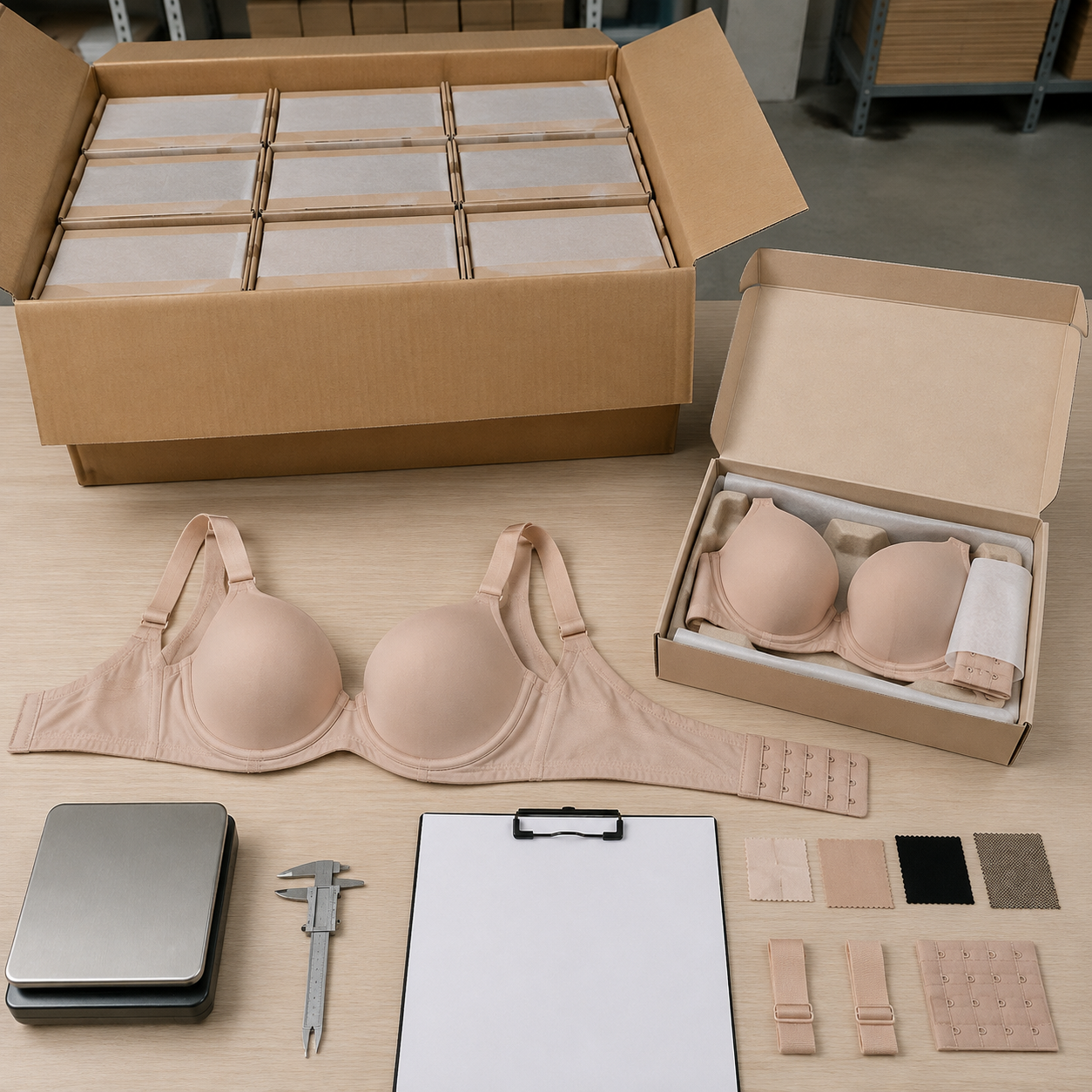
For European B2B buyers, the packing section of a plus-size bra OEM RFQ should make supplier quotes comparable and the approved pack reproducible. Require the supplier to define the pack by SKU or approved pack group, explain how the bra construction will be protected, provide sealed-unit dimensions and gross mass, document the loaded-carton configuration, identify destination-specific revisions, and return traceable QC evidence. A response limited to standard export packing is not ready for technical or commercial comparison.
For plus size lingerie manufacturing RFQs, approve packing by product construction and destination rather than by category label. Keep EU destinations, non-EU EEA destinations, the UK, and applicable country- or retailer-specific instructions on separate approval lines. This is a procurement control, not a claim that any cited commercial source establishes European packaging law.
Author basis: The approved profile confirms Vincent Xi's name and Editorial Author role. It does not document factory visits, product tests, certifications, customer outcomes, or other first-person manufacturing experience, so none is attributed here (Vincent Xi author profile).
Unless a cited source is expressly identified, the requirements and acceptance gates below are buyer-created RFQ tools. They are not legal requirements, independent standards, supplier test results, or statements of a named company's packing practice.
Plus size bra OEM packing requirements for European RFQs
Use the following schedule to determine whether an OEM quote contains enough packing information for review.
| RFQ control | Buyer must issue | OEM must return | Hold the quote when |
|---|---|---|---|
| Pack applicability | SKU, size, colour, construction details, and any proposed packaging-size groups | A matrix linking every quoted SKU to a controlled pack format and revision | A SKU is unmapped or assigned only by a broad product category |
| Packing sequence | Required retail opening condition and prohibited folds, pressure points, fastenings, or compression | The fastening, strap-setting, folding, cup-support, trim-isolation, loose-component, and sealing sequence | The sequence does not address the construction of the included styles |
| Component bill | Required component-data fields and substitution rules | Material description, component mass, finish, coating, adhesive, supplier reference, and substitution status for each bag, box, insert, tissue, hanger, seal, label, carton, divider, or void-fill component proposed | A component is unnamed, undocumented, or subject to unapproved substitution |
| Packed-unit measurement | Closed and sealed measurement state, required fields, and measurement-record format | Packed length, width, height, and gross mass by pack group, plus method, instrument identification, resolution, calibration status, individual readings, and reported maximum | Values come only from an empty dieline, nominal drawing, or unsealed garment |
| Master-carton configuration | Assortment, handling, delivery, and validation constraints | Internal and external dimensions, construction, unit count, orientation, dunnage, closure, gross mass, and physically loaded-carton evidence | The quoted unit count has not been checked in a representative loaded carton |
| Destination revision | Named EU, non-EU EEA, UK, country, and retailer scopes applicable to the order | A destination matrix, component data, artwork proof, and pack revision for each applicable scope | The response relies on an undefined claim such as Europe compliant |
| QC and change control | Defect definitions, inspection method, release owner, and reapproval triggers | Packed samples, inspection records, deviations, and change requests traceable to SKU, destination, pack revision, and shipment lot | Evidence cannot be matched to the ordered configuration or a proposed change bypasses approval |
Tie the pack to the specified bra construction
Apply only the rows that match the SKU technical pack. The features below are conditional review points, not claims that every plus-size bra uses the same construction.
| Specified construction feature | Packing proposal required from the OEM | Approval evidence |
|---|---|---|
| Moulded or padded cups | Cup orientation, nesting method, support component, contact surfaces, and any folding or compression restrictions | Representative packed sample and unpacking record assessed against buyer-defined cup-condition criteria |
| Underwires or side supports | Wire position, pressure-point controls, and separation from adjacent hardware or products | Approved packing sequence and post-unpacking inspection record |
| Wide wings or longline panels | Folding points, panel support, fastening position, and crease criteria | Sample representing the construction limit of the proposed pack group |
| Extended hook-and-eye closures or decorative hardware | Fastening state, hardware retention, and fabric-contact isolation | Close-up packing record and inspection for snagging, marking, or incorrect fastening |
| Padded straps or removable components | Strap adjustment, pad position, retention method, and loose-component control | Approved sample showing the required retail opening condition |
Do not accept a shared pack footprint until representative boundary SKUs show that the proposed space, folding method, and support components meet the buyer's agreed presentation and product-condition criteria. Any grouping decision should be recorded in the applicability matrix rather than left to packing-line judgment.
Europe destination packing requirements and approval ownership
Do not use one Europe approval line. Name the actual destination and the party responsible for reviewing materials, data, artwork, and retailer instructions. The OEM's role is to return the requested evidence; legal approval remains with the buyer's appointed reviewer unless the contract assigns responsibility differently.
| Destination scope | Buyer must identify | OEM must return | Approval control |
|---|---|---|---|
| EU destination | Each named sales country, channel, legal-review owner, and requested material or artwork field | Component-level material data, masses, coatings, adhesives, artwork proof, and the revision proposed for that destination | Review current official EU sources and official national sources for each named destination before approval |
| EEA destination outside the EU | The named country, channel, review owner, and any required local pack revision | A destination-specific response separated from EU assumptions, even where physical components are shared | Check current official sources for the named EEA country; do not automatically reuse an EU approval record |
| UK | UK-specific data fields, artwork ownership, buyer-requested reporting inputs, and retailer instructions | A distinct UK response and artwork proof identifying any components shared with another destination | Approve the UK revision separately for the named order |
| Country- or retailer-specific layer | Buyer-confirmed language, artwork, material, hanger, shelf-format, sorting, recycling-presentation, or delivery-carton instructions that apply | A destination-to-revision matrix identifying the exact pack proposed for the order | Check current official material and the applicable retailer manual rather than inferring approval from usual supplier practice |
Where a physical pack is proposed for several European destinations, require a line-by-line compatibility review covering component materials, requested data, artwork, approval ownership, and retailer instructions. Shared components do not remove the need for destination-specific review.
Example carton calculation to verify in the OEM quote
Numeric-data basis: Every figure in this section is a buyer-created example assumption as of 31 January 2025 for one quotation-comparison scenario. The values are not supplier measurements, legal limits, transport limits, test results, or company packing practices. The supplier must verify each input using sealed production-representative units, the actual component set, a physically loaded carton, and the agreed logistics review.
| Example input | Value and scope | Source and verification status |
|---|---|---|
| Sealed packed-unit envelope | 300 mm length x 240 mm width x 80 mm height for each example packed bra | Buyer-created assumption as of 31 January 2025; verify by measuring the proposed sealed unit |
| Packed-unit gross mass | 0.42 kg for each example packed bra, including its unit packaging | Buyer-created assumption as of 31 January 2025; verify by weighing representative packed units |
| Master-carton internal dimensions | 620 mm length x 500 mm width x 270 mm height for each example carton | Buyer-created assumption as of 31 January 2025; verify the actual usable internal space |
| Case pack | 12 packed bras in each example master carton | Buyer-created assumption as of 31 January 2025; verify through physical loading |
| Empty carton and dunnage mass | 0.80 kg for each example empty carton, including proposed dividers and void fill | Buyer-created assumption as of 31 January 2025; verify by weighing the actual component set |
| Buyer handling ceiling | 6.00 kg gross mass for each example loaded carton | Buyer-created assumption as of 31 January 2025; confirm or replace in the supplier quote and logistics review |
The same dated assumptions produce these preliminary quote checks:
- Internal carton volume:
0.620 m x 0.500 m x 0.270 m = 0.0837 m^3 per example carton, calculated by the buyer as of 31 January 2025. - Combined rectangular unit envelope:
12 packed bras x 0.300 m x 0.240 m x 0.080 m = 0.06912 m^3 per example carton, calculated by the buyer as of 31 January 2025. - Geometric fill ratio:
0.06912 m^3 divided by 0.0837 m^3 = 82.6% of the example carton's internal volume, calculated by the buyer as of 31 January 2025. This ratio does not prove acceptable compression, clearance, orientation, or product condition. - Calculated loaded-carton gross mass:
12 packed bras x 0.42 kg plus 0.80 kg = 5.84 kg per example loaded carton, calculated by the buyer as of 31 January 2025. - Calculated mass margin:
6.00 kg minus 5.84 kg = 0.16 kg per example loaded carton, calculated by the buyer as of 31 January 2025. Production variation must be measured rather than assumed to fit within that margin.
Use the calculation only to normalise quotations and expose missing inputs. Packing approval still requires representative measurements, a physically loaded carton, buyer-defined product-condition criteria, and the agreed transport-validation method.
Packing QC and shipment release evidence
Define packing evidence before the OEM prices inspection and validation work. Each record should identify the applicable SKU or pack group, destination, controlled revision, and shipment lot.
| Release stage | Buyer-defined scope | Supplier evidence | Release control |
|---|---|---|---|
| Packed-sample approval | Applicable constructions, opening condition, dimensions, mass, appearance, and defect criteria | Labelled representative samples, packing sequence, measurement record, and approval status | Block production use when the sample does not identify the controlled pack revision |
| Component approval | Controlled component list, specifications, and permitted tolerances | Current specifications and samples for each proposed direct-contact and logistics component | Block unlisted components and unapproved substitutions |
| Artwork approval | Destination, SKU, size, colour, order, responsible-party, and identifier fields supplied or approved by the buyer | Artwork proof, revision identifier, placement record, and requested print or scan verification | Release only the approved destination-specific revision |
| Packing-line verification | Approved sequence, component revisions, assortment, and segregation controls | Line-side instruction, setup record, photographs, and discrepancy report | Stop or segregate output when setup differs from the approved record |
| Loaded-carton validation | Approved unit arrangement, dunnage, closure, conditioning, handling, and acceptance criteria | Actual sample configuration, measured dimensions and mass, observations, photographs, and disposition | Do not transfer results to a materially different SKU or pack revision without approval |
| Pre-shipment inspection | Contract-defined lot, sampling method, defect classes, and disposition rules | Inspection report tied to the shipment, inspected quantity, defects, corrective action, and release status | Hold shipment when lot identity, revision identity, or authorised disposition is missing |
If a standard becomes contractually relevant, state its title, edition, scope, sample configuration, method, severity, and acceptance criteria in the RFQ. Keep the standard's stated requirements separate from the buyer's own acceptance criteria and the supplier's packing instruction. Do not describe a supplier, facility, component, material, or pack as certified without a current document identifying the holder, issuer, validity, scope, and covered site or material.
Copy-ready RFQ checklist for plus size bra packing requirements
- [ ] Attach the complete SKU, size, colour, and construction matrix covered by the quote.
- [ ] Map every SKU to a proposed pack group and controlled revision.
- [ ] Define the required retail opening condition and prohibited folding, pressure, or compression conditions.
- [ ] Request the complete fastening, strap-setting, folding, cup-support, trim-isolation, loose-component, and sealing sequence.
- [ ] Require a controlled bill of materials for every unit-pack and master-carton component.
- [ ] Define the closed and sealed state for measuring packed-unit dimensions and gross mass.
- [ ] Request the measurement method, instrument details, individual readings, and reported maximum by pack group.
- [ ] Request representative samples covering the construction limits of every proposed pack group.
- [ ] Put EU, non-EU EEA, UK, and applicable country- or retailer-specific revisions on separate RFQ lines.
- [ ] Identify who prepares, reviews, and approves destination artwork and packaging data.
- [ ] Request carton construction, internal and external dimensions, arrangement, unit count, dunnage, closure, and measured gross mass.
- [ ] State the buyer's carton-mass ceiling, measurement condition, and action required when it is exceeded.
- [ ] Define packing defects, inspection evidence, disposition rules, and shipment-release authority.
- [ ] Require a price breakdown by component, packing operation, validation activity, and master carton.
- [ ] Prohibit unapproved changes to materials, dimensions, artwork, component sources, unit count, or packing sequence.
- [ ] Put the approved packing specification, bill of materials, artwork revision, and carton plan into the purchase order.
Methodology, source use, and limitations
Methodology: The article begins with the packing decisions needed to compare European OEM quotations, maps each decision to evidence the supplier must return, and assigns a hold or approval control. Product-specific fields are conditional on the SKU technical pack. Destination fields are separated to prevent a general Europe label from replacing EU, non-EU EEA, UK, national, or retailer review. The carton worksheet uses explicitly hypothetical buyer inputs; no numerical benchmark was taken from a cited commercial source.
| Source context | How the source is used | What is not inferred |
|---|---|---|
| Vincent Xi author profile | Supports Vincent Xi's identity and Editorial Author role | Factory experience, product testing, credentials, certifications, or customer outcomes |
| XS Lingerie sourcing article | Supports the limited sourcing principle that category, size range, customisation, packaging, and order-model inputs can be considered before manufacturer selection | Legal compliance, plus-size pack dimensions, packing performance, or independent standards |
| Union Source China sourcing article | Supports the limited procurement principle of reviewing the target retail market and connecting compliance considerations with supplier selection and QC planning | Current EU, non-EU EEA-country, UK, national, retailer, or carrier requirements |
| S-Shaper adhesive-bra article | Supports only the documentation principle that QC statements should be backed by reviewable records | Transfer of adhesive-bra materials, tests, dimensions, results, or acceptance criteria to plus-size bra packing |
Limitations and points to verify: The supplied sourcing pages are commercial sources. They are not official EU, non-EU EEA-country, UK, or national legal sources; independent packing standards; verified plus-size bra measurements; component declarations; or shipment-test reports. They do not establish a legal requirement, carton threshold, approved material, test severity, supplier capability, certification, or company packing practice.
Before order placement, verify sealed-unit dimensions and unpacked product condition with production-representative samples; verify component identity and direct-contact properties against current supplier documents; verify carton performance using the buyer-approved logistics method; and verify destination obligations against current official sources for every named European market. Check the current retailer manual and carrier constraints for the actual delivery route. Record unresolved requirements as RFQ hold points rather than relying on an unsupported compliance statement.
Discuss Your Requirements
Review our manufacturing capabilities, then share your specifications for a supplier-fit review.