Plus Size Bra OEM Communication Workflow Review for Europe
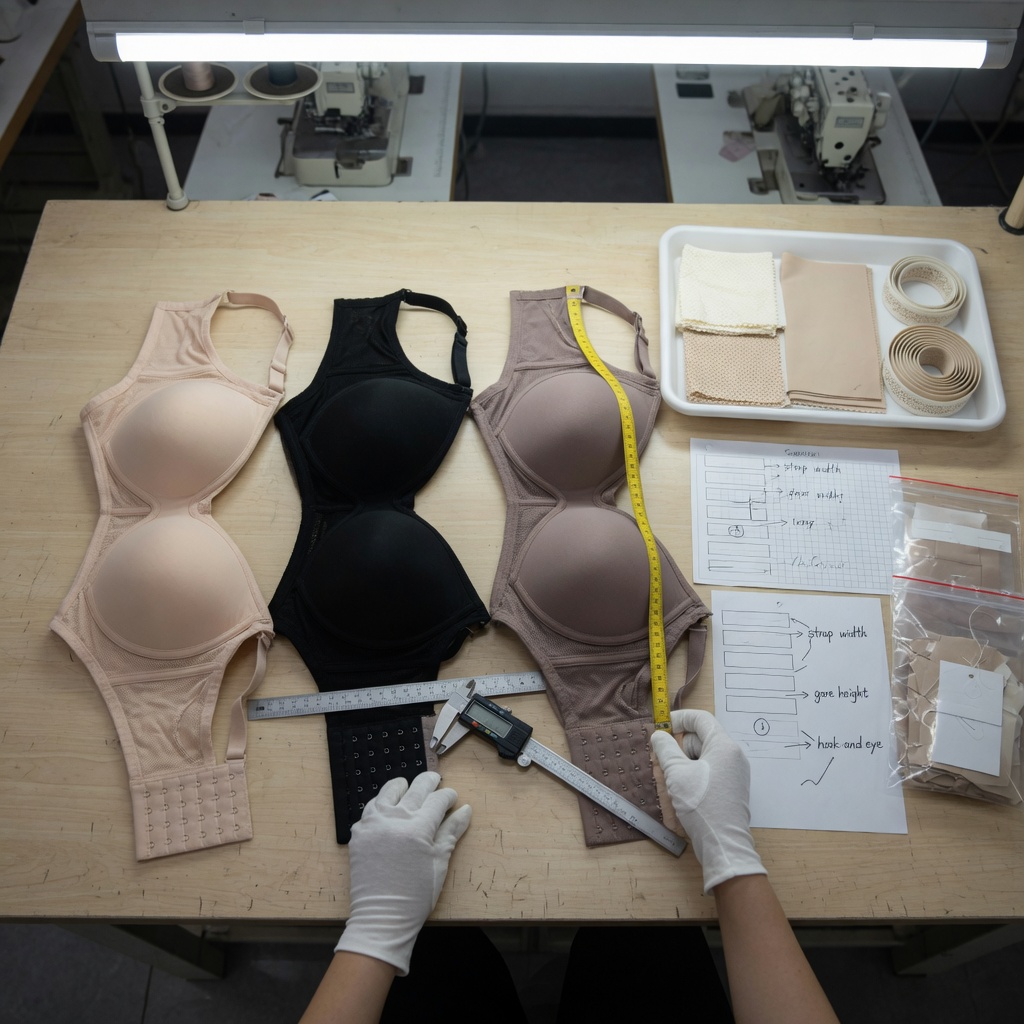
Editorial by Vincent Xi, Editorial Author. Author profile: https://velora-intimates.com/authors/vincent-xi/. The experience basis for this page is limited to that published profile. This review does not add factory visits, tests, awards, certifications, client names, customer outcomes, or first-person sampling claims.
Treat a plus size bra OEM communication workflow review as a gated step in B2B procurement for Europe, not a post-award courtesy. Specify named confirmation nodes (tech-pack freeze, fabric and trim approval, size-set, pre-production sample, and weekly work-in-progress reporting), an English-language response target with a named covering time zone, annotated feedback templates, and dual sign-off before any bulk deposit. Write those nodes into the RFQ and sign the SOP as a dated contract exhibit. Plus-size bras need extra grading, cup-volume, underband, and strap-width checks; unstructured email threads leave those checks without an auditable owner.
One plus-size specialist offering OEM and wholesale programmes from XL to 6XL states a 24-hour English response target, a 48-hour sample turnaround, and a 50-unit minimum order quantity (hours and units as stated on that supplier page dated 2025-07-11; scope is that supplier’s XL–6XL plus-size bra OEM/wholesale offer). Treat those figures as examples to verify in the supplier quote, not as an industry standard. The cited apparel production SOP recommends weekly WIP reports plus confirmation at fabric approval and PPS. For plus size lingerie manufacturing shipped into Europe, the same workflow must also carry the destination market’s labelling and chemical-documentation package. EU, EEA, and UK rules are not interchangeable, and a named member state can add official-language or packaging requirements. This review maps those communication nodes, trade-offs, a comparison table, and an RFQ checklist so procurement teams in Europe can specify, compare, verify, and approve an OEM partner before order.
Decision path: (1) Specify nodes, clocks, artefacts, owners, and the named market in Europe in the RFQ. (2) Compare shortlisted OEMs on the same table. (3) Verify with a paid proto, a test technical question, and a redacted WIP pack. (4) Approve only cells that are documented. (5) Place the order only after the communication SOP is a dated contract exhibit and dual sign-off is complete. Reject verbal assurances and chat-only threads.
Confirmation nodes that belong in a plus size bra OEM communication workflow review
Start with a written list of freeze points. The cited apparel production SOP structures alignment from design to delivery around confirmation nodes such as fabric approval and PPS, plus weekly WIP reports, because tech-pack misreads are a stated source of error in that SOP’s apparel production guidance, including intimates. Supplier communication SOP for apparel production Practical nodes to specify for plus size bras are:
- Tech-pack freeze, including graded measurement chart, cup construction, underband elastic spec, strap width and stretch, hook-and-eye or closure, and any wire or sling geometry.
- Fabric, foam, and trim approval with lot photographs, stretch and recovery data, and colour-fastness notes.
- Size-set or fit sample covering the contracted plus-size run, including the largest contracted size, not only a mid-size proto.
- Pre-production sample (PPS) in bulk fabric, with sealed comments.
- Top-of-production (TOP) or first-bulk photo and measurement pack before the remainder of the PO is cut.
- Weekly WIP with cutting, sewing, and packing quantities plus exception photos.
Cited plus-size manufacturer notes emphasise pattern structure, size grading, and sample rounds for fit because support depends on wide straps and underbands across published L–6XL ranges (size-range codes as stated on that manufacturer page; no version date verified in this review). Plus size bra manufacturer OEM notes That page also states that clear measurements reduce later revision cycles when customising support, fabrics, and construction; treat that as manufacturer-stated guidance, not as an audited outcome. Ask the OEM to name the owner of each node (buyer technician, factory merchandiser, or both), the artefact required (annotated photo, measurement table, or signed PDF), and the clock that starts only after a complete artefact is received.
Response clocks and reporting cadences to verify before approval
Published supplier pages give a starting SLA to test, not a guarantee. The same XL–6XL OEM/wholesale page dated 2025-07-11 states communication needs that include clear English, responses within 24 hours, and transparent production-timeline updates, together with a 48-hour sample turnaround and a 50-unit MOQ (24 hours, 48 hours, and 50 units as stated on that page; scope is that supplier’s XL–6XL plus-size bra OEM/wholesale offer). Wholesale plus size bra OEM communication notes Treat those numbers as an example to verify in the RFQ rather than as an industry standard.
A 24-hour technical-response window (hours as stated on the 2025-07-11 XL–6XL supplier page; example to verify) is usable for a buyer in Europe only if the OEM also names the covering time zone and the escalation path after 24 hours. Do not assume one zone covers every destination in Europe; name the importer’s working zone for the named market (for example CET/CEST in much of the EU, or GMT/BST in the UK) in the RFQ. A 48-hour first-sample clock (hours as stated on the same 2025-07-11 page; example to verify) can compress the calendar but collides with plus-size fit reality: cup volume, band tension, and strap load often need a graded size-set, not a single mid-size proto rushed in two days. Weekly WIP reporting, as recommended in the cited apparel SOP, is the minimum cadence that lets an importer for Europe see whether a delay will miss a labelled season or a retailer ship window. Daily chat without a written WIP pack is not a substitute; it creates an unsearchable thread that cannot be attached to a quality file. Incomplete packs do not start the SLA clock.
Europe documentation nodes: EU, EEA, UK, and named member states
Procurement into Europe is not a single rule set. Put the destination market in the first RFQ paragraph so every confirmation node produces the matching documents. Do not ask a factory for “Europe compliance” as one box. Specify EU, EEA, and UK separately, then add any named member state. Ask instead for:
- Fibre composition and care labels in the language(s) required for the named country of sale.
- Chemical-restriction declarations aligned to the applicable EU or UK list the importer names, due at the fabric-approval node, not after shipment. A factory email is not a certificate; keep the declaration in the importer’s file. Do not treat an EU-formatted pack as automatically complete for a UK sale, or as automatically complete for every EEA destination.
- A product-information or technical file the importer can keep, including the measurement and comment history from the size-set and PPS nodes.
- Packing-list and invoice fields that match the importer’s customs broker template.
Country-specific add-ons (for example extra language on a hangtag sold only in one member state) belong in the tech-pack freeze, not in a post-production email. Include a document matrix: which artefact is due at which node, for EU, for EEA, for the UK, and for any named member state. If the OEM cannot produce that matrix in writing, the buyer still owns the market-access risk. Verify current labelling language and chemical-restriction duties with the importer’s counsel and broker; this page does not replace that check.
Tech-pack annotation and dual sign-off that cut plus-size bra revisions
Tech-pack miscommunication is the failure mode the cited apparel SOP exists to prevent. Solutions listed in that SOP include annotated images, comment forms, dual sign-offs, and digital tools rather than free-text email. For plus size bras the annotations that matter most are:
- Band width, elastic modulus, and hook count at the largest contracted size, not only at a sample size.
- Strap width, ring-and-slider position, and stretch at the shoulder for the upper end of the range.
- Cup depth, gore height, and any inner sling or side-wing geometry after grading.
- Seam allowance and coverstitch bulk that can change comfort on a fuller cup.
Use a single comment form per sample round: the buyer lists measured vs. spec, photo call-outs with arrows, and a pass / revise / reject box; the factory replies on the same form with a new measurement table. Dual sign-off (buyer technician + factory merchandiser) at fabric approval and at PPS is a control to specify so a verbal “looks fine” cannot authorise bulk. The cited plus size bra manufacturer notes similarly stress that clear measurements reduce revisions when customising support, fabrics, and construction for plus-size runs; again, that is manufacturer-stated guidance to test, not a measured customer outcome. Digital tools help only when the OEM uses the same file the buyer commented on; a screenshot of a chat thread is not an auditable record for a quality file used in Europe.
Buyer decision table for OEM communication workflow comparison
Score two or three shortlisted OEMs on the same RFQ. Every row is a specify / compare / verify / approve / order action.
| Criterion | What the buyer specifies in the RFQ | How to verify before PO | Example published figure or practice (to re-confirm) | Europe-market check |
|---|---|---|---|---|
| Technical response SLA | Hours for English measurement or construction queries, covering the importer’s named time zone | Send a test tech question; require the SLA in the contract | 24-hour English responses stated by one XL–6XL specialist (page dated 2025-07-11; hours as stated; scope is that supplier’s XL–6XL plus-size bra OEM/wholesale offer) | Name the factory time zone and after-hours escalation; do not assume one zone for all of Europe |
| First-sample clock | Calendar hours or working days for proto vs. size-set; clock starts only on a complete pack | Track actual vs. promised on a paid proto | 48-hour sample turnaround claimed on the same 2025-07-11 page (hours as stated; same XL–6XL OEM/wholesale scope; example to verify) | Align with EU, EEA, or UK season and retailer intake, not factory convenience |
| Confirmation nodes | Named freeze points: fabric, size-set, PPS, TOP | Request the factory SOP and last redacted example pack | Fabric approval and PPS plus weekly WIP (cited apparel SOP) | Attach the importer-named chemical-restriction declaration to the fabric node |
| Reporting cadence | WIP photos, quantities, and exception log | Require a sample weekly pack from a current style | Weekly WIP reports recommended for apparel including intimates | Include packing and document status for the named import market |
| Plus-size size run | Contracted range and grading rules (e.g. L–6XL or XL–6XL as published by some makers) | Ask for a graded chart and at least one large-size photo set | L–6XL or XL–6XL ranges stated on cited plus-size OEM pages (size-range codes as stated; no version date verified for every page) | Confirm label size code matches the named market’s expected conversion |
| Feedback artefact | Annotated photo + comment form, not free chat | Test one revision cycle on the proto | Annotated images, comment forms, dual sign-offs (cited apparel SOP) | Keep the signed PDF in the importer’s technical file |
| Language | English technical plus any official language required for sale | Review a sample label and comment pack | Clear English listed as a communication need by one OEM | Do not assume one language pack covers every EU or EEA member state |
| MOQ vs. communication load | Units per colour/size for the trial PO | Confirm whether small lots still get the same WIP cadence | 50-unit MOQ stated by one plus-size OEM (2025-07-11 page; 50 units as stated; same XL–6XL OEM/wholesale scope; example to verify) | Small lots still need the full document set for the named EU, EEA, or UK entry |
| Escalation | Named merchandiser + backup + written recovery plan | Contact the backup during the sampling window | Do not treat marketing claims of “active communication” as evidence | Escalation must still produce documents the importer can file |
Score each cell as documented / verbal only / missing. Approve only documented cells.
RFQ checklist to lock the communication workflow before order
Copy these items into the RFQ. Each item is a buyer action that specifies, compares, verifies, or authorises production.
- Identify the programme as a plus size bra OEM for a named market in Europe (EU, EEA, UK, or named member state) and require a written communication workflow review as a contract exhibit.
- State the contracted plus-size range and grading method; do not accept a mid-size proto as proof of the full run.
- Require a written English technical-response SLA in hours, the covering time zone, and when the clock starts (receipt of a complete question or artefact).
- List confirmation nodes: tech-pack freeze, fabric/trim, size-set, PPS, TOP, weekly WIP.
- Attach the buyer’s comment-form template and require the factory to reply on that form, not in unsearchable chat.
- Require dual sign-off (named emails) at fabric approval and PPS before any bulk fabric is cut or any bulk deposit is paid.
- Ask for a redacted example WIP pack from a recent plus-size bra or intimates style, including quantities and exception photos.
- Specify destination markets separately: EU, EEA, UK, and any named member state; do not accept a single “Europe compliance” box.
- Require the chemical-restriction declaration at fabric approval, aligned to the applicable EU or UK list the importer names; if the destination is an EEA state, name that state and the document set rather than assuming EU paperwork is sufficient.
- Require fibre and care label copy in the official language(s) of the country of sale, submitted at tech-pack freeze.
- State whether a 50-unit or similar trial lot still receives the same reporting cadence and document set as a larger PO (50 units is a published example from one OEM page dated 2025-07-11, XL–6XL plus-size bra OEM/wholesale scope, to verify in the quote).
- Set the sample clock separately for first proto and for the plus-size size-set; do not treat a 48-hour proto claim as a size-set claim (48 hours is a published example from the same 2025-07-11 page, same scope, to verify).
- Name the artefacts that will sit in the importer’s technical file (signed measurement tables, photos, declarations) and the file format (signed PDF).
- Require a written escalation path if a node is missed, including backup contact and who pays for extra samples.
- Make the communication SOP an exhibit to the purchase contract, with version date, and require a quote line for proto, size-set, PPS, weekly WIP, and the named-market document set.
Trade-offs to price before you approve bulk for Europe
Speed and documented accuracy pull in opposite directions. A published 48-hour sample turnaround (hours as stated on the 2025-07-11 XL–6XL supplier page; scope is that supplier’s plus-size bra OEM/wholesale offer; example to verify) compresses the calendar but often skips a proper plus-size size-set; the later cost can appear as extra PPS rounds, delayed EU, EEA, or UK intake, and air freight. A 24-hour chat response (hours as stated on the same page; same scope; example to verify) without a signed comment form looks responsive and still leaves an unusable quality file. Weekly WIP with photos uses factory merchandising time; skipping it can hide a cutting error until packing. Dual sign-off adds a hold at PPS and is specified to reduce the risk of a bulk recut; it is a control, not a measured saving. A low MOQ (50 units as one specialist states on the 2025-07-11 page; units as stated; same XL–6XL OEM/wholesale scope; example to verify) can increase the number of communication cycles per year; the buyer must still budget the same document package for every small lot that will enter the named EU, EEA, or UK market.
Price the workflow, not only the FOB. Ask the OEM to quote the sampling and reporting package as a line: proto, size-set, PPS, weekly WIP, and document set for the named market. Compare that line against the expected commercial impact of one missed season or one non-compliant label in the named market. Do not treat any of those comparisons as a calculated quote; obtain the factory’s current figures.
How this communication workflow review was derived and what to verify
Source context 1: public OEM pages that describe plus-size bra ranges (XL–6XL or L–6XL), English communication, sample clocks, and fit-sample emphasis. Source context 2: an apparel production SOP that lists confirmation nodes, weekly WIP, annotated images, comment forms, and dual sign-offs for manufacturing that includes intimates. Methodology: the three supplied public pages were read for stated hours, units, size ranges, and recommended nodes; those figures are repeated here with unit, scope, and as-of context where the page gives a date, and are labelled as supplier- or SOP-stated, not as audited factory performance. Concrete data points retained from those pages: 24 hours (English response target), 48 hours (sample turnaround), and 50 units (MOQ), each limited to one XL–6XL plus-size bra OEM/wholesale offer as stated on 2025-07-11; plus L–6XL / XL–6XL size-range codes as stated on the cited plus-size OEM pages. Limitations: this is not a factory audit, not a survey, and not a claim about any unnamed mill. Two of the cited pages have no version date verified in this review. Response times, sample clocks, and MOQs change. Chemical and labelling rules for Europe are market-specific; a page that says “Europe” without naming EU, EEA, UK, or a member state is incomplete. Buyers must re-test the SLA with a live inquiry, obtain the current SOP with a version date, and attach market-specific document requirements to the purchase contract. No search-volume, CPC, difficulty, or ranking figures are stated or implied for the primary topic.
Use the decision table and RFQ checklist to convert this communication workflow review into a signed exhibit before the first bulk deposit.
Discuss Your Requirements
Review our manufacturing capabilities, then share your specifications for a supplier-fit review.