Lingerie OEM Product Development Capability for European Buyers
Vincent Xi, Editorial Author, author profile.
European procurement teams evaluating lingerie OEM product development capability must treat development as an engineering gateway rather than an open-ended design exchange. In contract manufacturing, original equipment manufacturing (OEM) requires the buyer to supply technical drawings, grading increments, and bill-of-materials specifications, while the manufacturer provides pattern engineering, design-for-manufacturing (DFM) verification, and physical prototyping. According to a 2026 private-label lingerie guide, the OEM model preserves buyer design ownership but requires longer development timelines, more iterative sampling rounds, and higher minimum order quantities than catalogue sourcing, with fit defects representing the single largest operational driver of consumer returns (Epic Sourcing).
For programs shipping into Europe, defining the target market before pattern drafting is mandatory. Compliance frameworks are not uniform across the continent: the European Union (EU), the European Economic Area (EEA), the United Kingdom (UK), and individual member states enforce distinct statutory obligations governing chemical safety, consumer textile labeling, and economic operator liability. A supplier documentation pack structured solely for the EU does not satisfy post-Brexit UK requirements by default. Editorial note: Vincent Xi is an Editorial Author for Velora Intimates (author profile). Per editorial policy, no first-person experience claims, proprietary factory trials, or client case studies are approved or asserted; all analyses rely strictly on verified public manufacturing sources and explicit planning calculations.
What Lingerie OEM Product Development Capability Entails
In intimate apparel manufacturing, product development capability represents a factory's technical capacity to translate two-dimensional mechanical specifications into stable production standards. In an OEM engagement, the buyer owns the intellectual property and master specifications. The manufacturer's development team provides pattern digitization, shrinkage calculation, elastomeric tension mapping, and construction feedback. If these interfaces lack written criteria, fit approvals will diverge during bulk production runs.
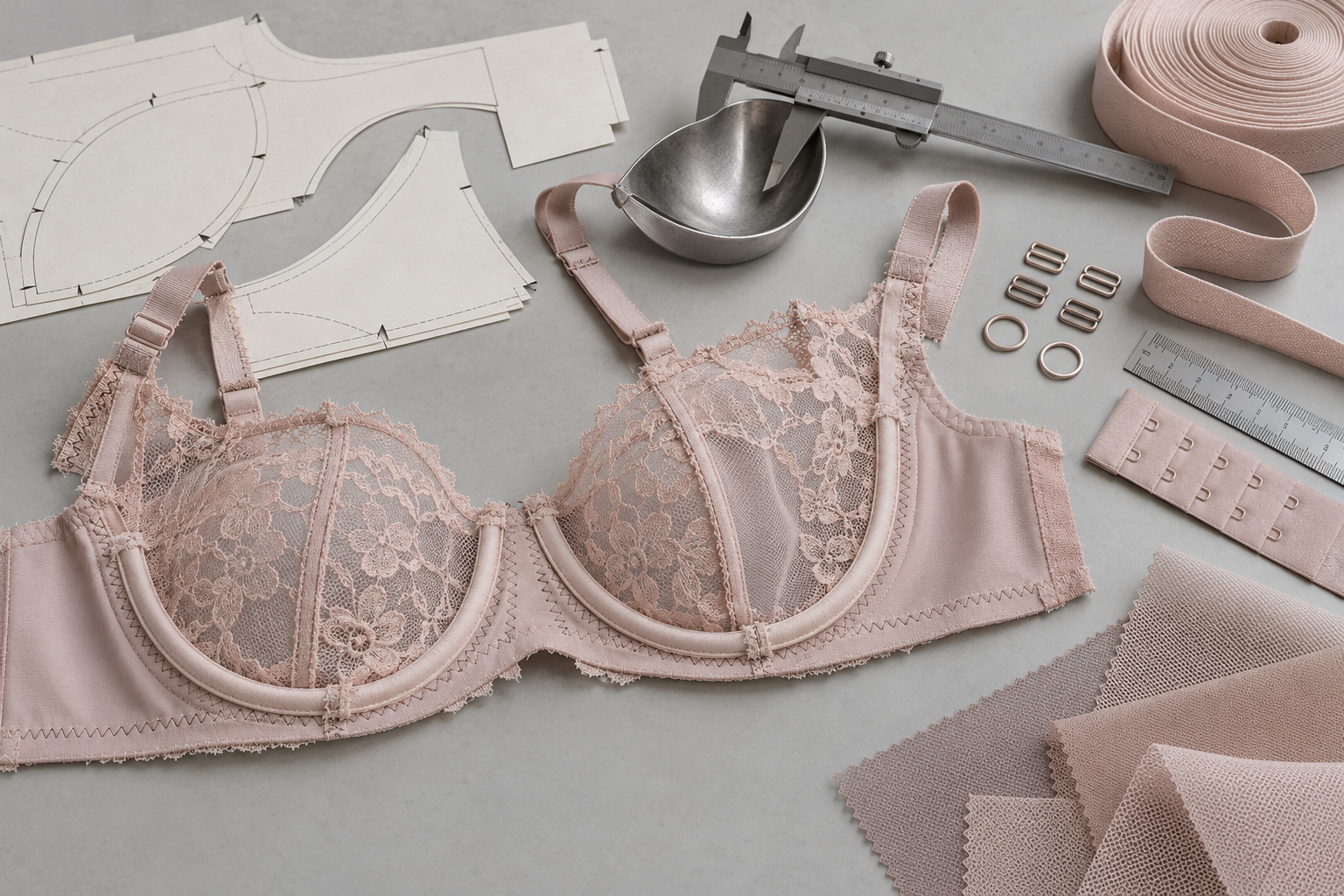
Epic Sourcing emphasizes that buyers must approve a physical pre-production sample on fit models before issuing a cutting authorization. In bra and intimates manufacturing, fit is an applied mechanical discipline. Cup depth, wire arch spread, cradle anchorage, wing modulus under elongation, strap placement, and leg-opening elastic recovery interact dynamically with fabric tension. A digital 3D rendering or flat sketch cannot reveal whether an underwire gore will lift away from the sternum or if wing mesh will roll under tension. While Epic Sourcing identifies fit failure as the primary driver of intimate apparel returns, it does not publish an empirical return percentage; consequently, no speculative return rate is asserted here.
A complete technical development dossier for European procurement should specify:
- Master style identification with the primary fit size (e.g., EU 75B or UK 34B) and documented grading rules across cup and band matrices.
- A comprehensive Bill of Materials (BOM) listing base fabric fiber ratios, raw fabric weight (GSM), linear elastic widths, elongation percentages, modulus curves, and metal or nylon findings.
- Mechanical construction parameters: seam classifications (e.g., ISO 4915 stitch types), stitches per inch (SPI), wire-casing channel tape attachment, and ultrasonic bonding or molded cup lamination tolerances.
- The designated European delivery market: EU, EEA, UK, or a single national jurisdiction.
- Gated approval governance: authorized buyer sign-offs and rules establishing whether grade modifications mandate a revised physical prototype or an administrative waiver.
These checklist criteria provide objective baselines to verify whether a bidding factory possesses the requisite engineering capacity for a buyer's specific product line.
Tech Pack Depth and Design-for-Manufacturing Reviews
A comprehensive technical pack is the foundation of intimate apparel prototyping. Sourcing documentation from Ladymate indicates that structured tech packs prevent cross-border miscommunication and minimize development rounds during OEM and ODM projects. The publication notes that manufacturers with over 20 years of operating experience routinely conduct technical design-for-manufacturing (DFM) reviews, during which pattern technicians analyze seam integrity, stitch tension, and elastomeric fabric recovery prior to pattern cutting (Ladymate).
Data point evaluation: "Over 20 years" expresses duration in years. Scope: Ladymate's qualitative description of experienced intimate apparel facilities; it is neither an industry-wide census nor a description of Velora Intimates' trading history. As-of context: Ladymate's guide lacks a formal publication date, requiring buyers to verify current supplier capabilities independently. Decades of factory existence do not guarantee that the technician assigned to a new tech pack will physically test modulus curves rather than rely on visual inspection.
A professional DFM review delivers actionable adjustments before initial sampling. European procurement teams should mandate written supplier feedback across four core criteria:
- Fabric recovery analysis: Evaluating whether specified microfibers, mesh, and elastics maintain adequate recovery after 100% stretch cycles, or if pattern dimensions must be adjusted to prevent band sagging.
- Seam engineering: Confirming whether specified flatlock, 3-step zig-zag, or bonded seams will create bulk under unlined lace cups or fail during cyclic tension at the wing-to-cradle junction.
- Hardware integration: Verifying that wire channel opening allowances, hook-and-eye tape widths, and ring/slider diameters match specified metal gauges rather than generic visual references.
- Tooling and machinery requirements: Identifying operations requiring dedicated machinery (such as automated foam-cup molding presses, ultrasonic seam welding, or multi-needle casing machines) versus lines using generic flatbed sewing tables.
The strategic trade-off of detailed OEM development is scheduling overhead. Epic Sourcing connects buyer-owned OEM patterns to increased sampling iterations and higher minimum order quantities without publishing fixed unit counts. Buyers should avoid estimating arbitrary piece count penalties; instead, secure binding supplier quotations detailing included sample rounds and minimum order volumes.
Original Design Manufacturing (ODM), where the factory designs the garment blocks, follows a separate commercial framework outside the scope of this briefing. If a contract manufacturer shifts a buyer's tech pack onto an existing factory master block, that transfer represents a modification of design control and fit ownership, not a faster OEM turnaround.
Sampling Days, MOQ, and Lead Time Benchmarks
A technical manufacturing guide by Chuangrong Apparel provides three explicit operational benchmarks for custom intimates production: custom prototype sampling typically requires 7 to 15 days with integrated fit testing; typical custom minimum order quantities (MOQs) are described as up to 3,000 units; and bulk production lead times span 30 to 40 days. The source also states that dedicated research and development units oversee pattern interpretation, material sourcing, prototype cutting, and commercial production handoff (Chuangrong Apparel).
These metrics must be evaluated strictly within their documented scope:
- Sampling turnaround: 7 to 15 days. Unit: Days. Scope: Chuangrong Apparel's typical internal window for custom lingerie prototype development and fit adjustments; not an industry average across Europe or a Velora Intimates performance metric. The source does not distinguish calendar days from working days or specify publication dates.
- Order minimums: Up to 3,000 units. Unit: Finished garment units. Scope: Published as a "typical custom MOQ" ceiling/range on that site. The phrase "up to" does not differentiate minimum baseline piece thresholds from maximum program capacities, nor does it specify allocations per colorway or cup-band size. Buyers must secure itemized minimums per style, colorway, and size break in the commercial quote.
- Bulk manufacturing lead time: 30 to 40 days. Unit: Days. Scope: The stated manufacturing duration from that supplier. The documentation does not define the starting trigger (e.g., initial deposit, lab-dip sign-off, raw material warehouse delivery, or pre-production sample approval) or the final milestone (ex-factory handover versus port departure).
Example timeline calculation (planning assumption to verify in supplier quotations): Assuming two sequential fit sample rounds at the upper limit of the stated sampling benchmark (15 days + 15 days = 30 days), combined with the stated 30-day lower bulk lead time, total elapsed production duration reaches 60 days. Combining two 15-day sampling rounds with the 40-day upper bulk lead time yields 70 days. Assumptions: Raw materials and findings are stocked in-house, lab-dip approvals do not delay cutting, lab testing does not sit on the critical path, and bulk lead time begins immediately upon secondary sample approval. If custom laces must be dyed to match (lab dips taking 10 to 14 days), this model becomes invalid.
Alternative timeline calculation (planning assumption to verify): A single prototype round executed at the 7-day lower benchmark, paired with a 30-day bulk run, yields a 37-day turnaround under identical in-stock material assumptions. The resulting 33-day variance between 37 and 70 days illustrates why broad estimates cannot support merchandising commitments until commercial quotes define exact sampling iterations and trigger milestones. Epic Sourcing's observation that OEM development requires added sampling rounds makes the longer estimate more realistic for novel technical styles.
Key manufacturing factors influencing these ranges include:
- Greige goods versus custom dyeing: A quoted 7-day prototype window that requires custom lab-dip dyeing cannot proceed until greige lace and microfibers clear color approval.
- Fit sampling versus graded size sets: Cutting a single core size (e.g., EU 75B) requires substantially fewer technician hours than grading and cutting across a full size run (65A through 85F).
- Hardware tooling: Introducing proprietary underwire shapes or molded spacer-foam cups introduces hard tooling lead times that standard 7-to-15-day sample windows do not incorporate.
- Regulatory testing for European delivery: Independent chemical and physical performance testing takes place outside production lines and must be scheduled independently from standard 30-to-40-day bulk lead times.
Chuangrong Apparel's reference to an internal R&D center represents an internal organizational description. The procurement verification task is auditing which personnel manage grade tables, seam mechanics, and quality loops, and which steps are subcontracted.
Lingerie Product Development Capability for Europe: Jurisdictional Compliance
Europe represents the primary delivery destination for programs evaluated under this framework. Development programs frequently encounter customs and regulatory bottlenecks when suppliers apply uniform "European compliance" claims across jurisdictions with divergent statutory mandates. Regulatory obligations differ across the European Union (EU), the European Economic Area (EEA), the United Kingdom (UK), and distinct member nations regarding chemical thresholds, environmental disclosures, and mandatory textile labeling. The third-party guides cited here do not provide legal compliance templates, and this briefing does not provide legal counsel. Nothing herein implies that Velora Intimates or the cited third-party manufacturers possess active third-party certifications.
Procurement teams must integrate specific administrative and technical safeguards into their development contracts:
- Explicit market naming: Specify whether the shipment destination is the EU, EEA, UK, or a single national jurisdiction across all tech packs and RFQ documents.
- Regulatory document schedules: Mandate that suppliers list exact test reports, fiber declarations, and care label layouts included in the unit price, indexed by target market.
- Rejection of generic certifications: Reject assertions of "European conformity" unless accompanied by verified lab documentation identifying specific regulations (e.g., EU REACH Annex XVII restricted substances vs. UK REACH equivalents).
- Traceability of manufacturing origin: The literature examines production networks associated with China. Record all assembly plants and secondary subcontractors (dyeing, bonding, printing, molding). Manufacturing origin documents traceability but does not demonstrate conformity with European market entry rules.
National regulations within the EU and EEA enforce distinct operational constraints. For example, France enforces consumer waste sorting and environmental labeling under the AGEC law (Decree 2022-748), requiring precise trim sorting instructions and traceability disclosures that do not apply in Germany or the UK. Similarly, fiber composition labeling must appear in the official language of each destination country under EU Regulation No 1007/2011. A multi-language care label represents a distinct development output compared to a single-language domestic run.
Decision Framework for Lingerie OEM Approvals
Evaluate prospective manufacturing partners using documented performance criteria rather than marketing brochures. Each task below represents a buyer verification requirement; cited data points provide comparative context and do not represent Velora Intimates operating baselines.
| Procurement Stage | Technical Parameter to Freeze | Published Benchmark (External Context) | Buyer Verification Milestone |
|---|---|---|---|
| OEM Scope Boundary | Buyer tech pack, pattern cut files, and formal factory change-request logs | Epic Sourcing: OEM provides full design ownership with longer lead times and higher MOQs | Approve written DFM change requests; prohibit unapproved component substitutions |
| Tech Pack Audit | Seam classification, elastomeric recovery, and hardware dimensional callouts | Ladymate: Tech packs reduce sample iterations; experienced plants (20+ years) review seams and recovery | Require a style-specific DFM review sign-off by a named pattern maker before cutting |
| Prototyping Timeline | Prototype turnaround days per round, included iterations, working vs. calendar days | Chuangrong Apparel: 7 to 15 days typical custom sampling with fit adjustments | Confirm raw materials and findings are physically in-house before starting the sample clock |
| Minimum Order Volume | Total program pieces, minimum units per colorway, minimum units per cup/band size | Chuangrong Apparel: Stated typical custom MOQ up to 3,000 units | Require the supplier to define piece minimums per style, color, and size breakdown |
| Bulk Lead Time | Formal trigger date (deposit/sample sign-off) to ex-factory handover date | Chuangrong Apparel: Stated lead time 30 to 40 days | Modeled spans of 37 to 70 days remain estimates until locked in a formal purchase contract |
| Mechanical Fit Validation | Physical prototype garment, graded measurement sheet, and calibrated fit form | Epic Sourcing: Physical fit sign-off required; fit issues drive intimates returns | Reject photo-only approvals; validate wire anchorage and stretch modulus on live fit models |
| European Jurisdiction | Regulatory documentation for EU, EEA, UK, or national markets | Regional compliance diverges across European markets; not uniform | Withhold sample sign-off if test packages and label language translations are unconfirmed |
| Facility Traceability | Primary cut-and-sew site plus dyeing, bonding, molding, and packing subcontractors | Manufacturing origins cited in literature do not confer European market access | Map the supply chain down to dyeing and molding sites to verify chemical compliance |
Methodology and Data Limitations
Methodology: All numerical data points in this report are transcribed directly from the cited third-party manufacturing publications or are explicitly identified as mechanical calculations derived from those inputs. Units, scope constraints, and qualitative contexts are preserved alongside each metric. No search volume, commercial cost-per-click, organic difficulty, or traffic projections are included, as no provider-backed keyword demand metrics exist for this technical topic. This briefing incorporates no factory inspection records, wear trials, or customer performance metrics from Velora Intimates.
Limitations and verification requirements: The 7-to-15-day prototype window, 30-to-40-day production timeline, and 3,000-unit ceiling represent operational statements from a single manufacturer's publication. They do not represent industry-wide statistical surveys and cannot be attributed to Velora Intimates. The "over 20 years" benchmark in Ladymate's guide reflects qualitative editorial text rather than an accredited audit. Epic Sourcing does not quantify specific MOQ premiums or return rates attributable to fit failures. The cited sources omit formal publication dates, pricing schedules, and contractual conditions. Buyers must obtain active, binding quotations from prospective suppliers rather than relying on external literature. Reference to public standards reflects mandatory market rules; it does not indicate that any named entity holds third-party certification.
RFQ Checklist
- Ask the supplier to confirm in writing that the program will run under an OEM commercial framework, detailing all pattern files, grading rules, and BOM components required before prototype cutting.
- Require the manufacturer to provide a formal design-for-manufacturing (DFM) assessment covering seam types, fabric recovery, and findings dimensions prior to cutting the initial sample.
- Specify the maximum allowable days for each prototype round, stating whether timeframes represent calendar or working days, and confirm the total number of sampling iterations covered in the development fee.
- Ask the supplier to define minimum order quantities (MOQs) broken down by style, colorway, and size cup/band breakdown, confirming whether prototype pieces offset bulk minimums.
- Require the manufacturer to define bulk lead times in days, identifying the exact starting milestone (e.g., pre-production approval, fabric arrival) and final handover point (ex-factory vs. FOB port).
- Specify the exact European delivery destination (EU, EEA, UK, or individual country) and require an itemized list of all regulatory test reports and label translations included in the quote.
- Require the manufacturer to disclose the primary assembly factory and all tier-2 subcontractors for cup molding, lace dyeing, fabric bonding, and finishing.
- Ask the supplier to supply a physical fit prototype, calibrated measurement spec sheet, and certified material swatches for written buyer sign-off before raw material cutting begins.
- Specify that external benchmarks (including 7 to 15 sampling days, 30 to 40 bulk lead days, or up to 3,000 units) serve solely as discussion baselines until verified in the supplier's commercial quote.
Post-Approval Governance: Securing Bulk Execution
A signed purchase order must reference the precise engineering specifications established during prototyping: unique style identifiers, approved sample revision numbers, graded measurement tolerance charts, material item codes, total piece counts by size, Incoterms, and designated European market jurisdictions. Mid-production adjustments to wire gauge, wing elastic modulus, or cup laminate foam density invalidate pre-production sign-offs and require an isolated development review. As Epic Sourcing notes, fit failures represent the primary driver of intimate apparel returns, making specification stability essential to commercial viability.
Compare vendor quotations by evaluating omitted operational parameters rather than promotional language. A 30-day lead time quote that omits raw material quality control, European regulatory testing, and care-label validation represents a higher delivery risk than a 50-day schedule that accounts for all stage gates. Low minimum order volumes paired with inadequate DFM oversight will lead to redundant sampling iterations and shipping delays. Until a binding commercial quotation defines project timelines, volume tiers, and regulatory deliverables, external benchmarks should serve as audit criteria. Rigorous lingerie OEM product development capability is confirmed when a supplier meets every line item on the buyer's technical specification.
Discuss Your Requirements
Review our manufacturing capabilities, then share your specifications for a supplier-fit review.