Lace Bra Set OEM Product Development Capability for Europe Sourcing
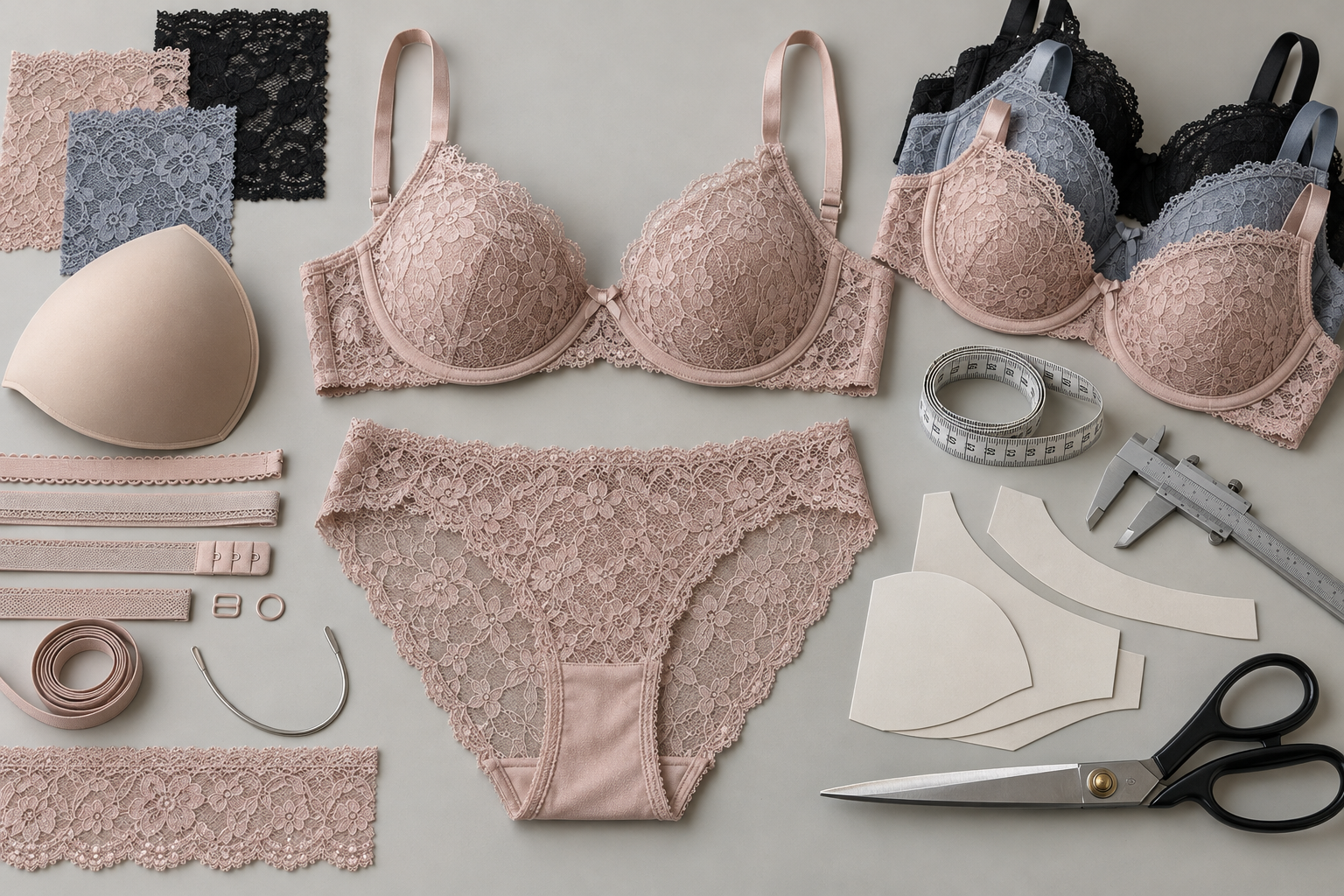
For European intimate apparel buyers, assessing lace bra set OEM product development capability is an operational risk control exercise. OEM development requires a supplier to translate buyer-owned technical assets into a wearable, commercially balanced bra and matching panty before bulk fabric cutting begins. A 2026 private-label lingerie manufacturing guide emphasizes that OEM production relies directly on buyer-provided tech packs and patterns, granting full design control but demanding longer development schedules, additional sample iterations, and higher production minimums compared to off-the-shelf ODM arrangements (Epic Sourcing, 2026 guide). Procurement teams in Europe must evaluate these operational trade-offs rather than assuming uniform development timelines across factories.
This analysis is prepared for Velora Intimates by Vincent Xi, Editorial Author (Vincent Xi). In accordance with editorial policy, no first-person experience claim is approved or implied; this evaluation synthesizes published documentation from manufacturer disclosures and industry procurement references. It does not represent a proprietary Velora factory audit, laboratory test, or client production log. Supplier and manufacturing-origin references illustrate stated production engineering practices and do not constitute an invitation to non-European sales markets, nor do they imply that unified compliance standards govern the EU, EEA, UK, or individual country retail channels.
Assessing Product Development Capability for Europe: Tech Packs to Pre-Production
Within technical intimate apparel sourcing, product development capability represents the repeatable engineering pathway connecting initial design packages to sealed pre-production samples. Public disclosures from export lingerie manufacturers reveal distinct intake methodologies that European procurement managers should benchmark.
One Shantou manufacturing overview outlines an intake process starting from client reference photos, physical reference garments, or dimensional size charts, proceeding through initial sample construction, structural fit reviews, pattern corrections, multi-size grading, pre-production (PP) validation, and bulk cutting (Bramingle). Conversely, a specialist bra manufacturer highlights intake from vector tech packs, 2D CAD pattern data, or physical reference garments, quoting an initial counter-sample timeframe of 7 to 10 days, while claiming that custom development and quality inspections remain fully in-house without third-party outsourcing (UnderwearGM). The 2026 private-label guide contextualizes this dynamic: when the brand furnishes proprietary patterns, design sovereignty remains protected, but the brand must absorb prolonged sampling calendars and elevated production minimums (Epic Sourcing, 2026 guide).
These statements reflect individual supplier claims and guide benchmarks, not standardized cross-industry guarantees. A brand evaluating lace bra set manufacturing proposals should require bidders to document a standardized stage-gate schedule:
- Accepted intake formats and explicit confirmation of pattern digitization responsibilities.
- First counter-sample turnaround, dimensional evaluation logging, and technical revision ownership.
- Contractual revision caps per development fee before supplemental engineering surcharges apply.
- Intermediate size-set grading reviews preceding final pre-production sample sign-off.
- Synchronized sign-off gates ensuring the matching brief coordinates with the bra in lace tension, shade matching, and trim lotting.
The commercial trade-off centers on pattern ownership versus time-to-market. Proprietary OEM blocks preserve brand-specific European fit profiles across seasonal drops but require disciplined technical coordination. ODM paths shorten initial sampling when buyers adopt a factory's stock underwire curves and lace inventory, but compromise proprietary sizing geometry. Factory assertions of in-house capability require explicit verification regarding whether lace knitting, yarn dyeing, foam cup molding, and ring-and-slide hardware coating are handled on-site or subcontracted.
Sampling cycles, set MOQs, and calendar trade-offs
Procurement managers should evaluate published manufacturing figures as baseline points of comparison, replacing them with legally binding supplier quotations.
- Counter-sample turnaround: UnderwearGM publicizes a counter-sample turnaround of 7 to 10 days when starting from an established tech pack, CAD draft, or physical prototype. Unit: calendar days. Scope: single counter-sample construction within that facility, excluding international air courier transit, lab dip approvals, or full size-grading sets. As-of context: public manufacturer website content; source excerpt does not state an original publication date (UnderwearGM).
- Initial physical sample development window: The 2026 private-label guide indicates that physical prototype development typically requires 2 to 3 weeks prior to bulk approval. Unit: weeks. Scope: sample development window described for private-label lingerie programs, distinct from shipping or commercial production windows. As-of context: published 2026 procurement guide (Epic Sourcing, 2026 guide).
- Matching-set minimum order quantity (MOQ): The 2026 private-label guide notes a standard MOQ range of 500 to 1,000 for matching lingerie sets. Unit: the source presents numerical figures without clarifying whether units represent combined two-piece sets or distinct individual garments. Scope: general private-label matching sets. As-of context: published 2026 guide (Epic Sourcing, 2026 guide). Buyers must verify whether 500 to 1,000 applies to total sets, individual SKUs, or single-colorway distributions.
- Lace library depth: UnderwearGM states that custom lace engineering is supported through an upstream mill network and advertises access to hundreds of open lace patterns to accelerate early-stage sampling. Unit: discrete lace patterns. Scope: aggregate mill library options claimed by the vendor, not proprietary or protected designs. As-of context: published website text, excerpt undated (UnderwearGM).
- Aggregate facility output: Bramingle cites 15 years of operational history and a monthly throughput of 400k. Unit: monthly output figure lacks a stated unit denominator (individual bras, briefs, or complete sets). Scope: supplier corporate marketing claim. As-of context: supplier homepage content; excerpt does not cite third-party audit verification (Bramingle). Gross sewing capacity does not correlate with sample-room pattern drafting speed or multi-size grading precision.
- Example calculation (assumption to verify in the supplier quote, not a contracted schedule): If a vendor quotes 7 to 10 days for an initial counter sample and a complex lace underwire design requires three sequential prototyping rounds, sample construction alone consumes 21 to 30 days. This baseline excludes overseas courier transit to a European inspection hub (typically 4 to 7 business days per cycle), internal fitting sessions, lab-dip approval, and pre-production signing. Stacking the 2-to-3-week development estimate from the 2026 guide on top of this model is valid only if the vendor confirms that raw material lab dips and pattern drafting operate along independent parallel paths.
Key development trade-offs to monitor:
- Accelerated initial counter samples do not guarantee rapid full size-set delivery; multi-size grading must be scheduled independently.
- Open-market stock lace removes textile mill weaving delays, whereas custom jacquard lace patterns require independent mold and yarn preparation lead times.
- High OEM minimums protect customized brand fit blocks but demand higher working capital if initial European market testing targets lower volumes.
- Waiving the pre-production sample stage to recover delayed sample calendars creates substantial cut-and-sew defect risks across lace scalloping and underwire channeling.
Buyer decision matrix for OEM lace bra set development
| Procurement Parameter | Specification Requirement | Source Benchmark & Scope | Contractual Verification Step |
|---|---|---|---|
| Sourcing Route (OEM vs. ODM) | Define pattern, grade rule, and nesting ownership; confirm buyer tech-pack control | 2026 guide: OEM requires buyer tech pack/patterns, involving longer development, more sample rounds, and higher MOQ (Epic Sourcing, 2026 guide) | Require vendor to sign an intellectual property and pattern ownership schedule prior to development fee disbursement |
| Technical Intake Baseline | Provide vector tech packs, 2D CAD files, or physical reference samples with prioritized tolerance hierarchies | UnderwearGM cites tech packs, CAD, or samples (UnderwearGM); Bramingle accepts photos, garments, and size charts (Bramingle) | Specify the primary controlling document and require the pattern master to log discrepancies in writing before cutting |
| Counter-Sample Lead Time | Require separate lead-time line items for bra construction, brief construction, and shipping | UnderwearGM advertises 7 to 10 days for counter samples from technical assets; undated excerpt (UnderwearGM) | Separate bench sample fabrication from courier transit in the development milestone agreement |
| Prototyping Stages to Bulk | Mandate fit revisions, multi-size set validation, and a sealed pre-production sample gate | 2026 guide indicates physical samples require 2 to 3 weeks before bulk; Bramingle lists fit reviews, size sets, and PP gates | Require signed technical sign-off on the pre-production set before bulk fabric and lace yardage are released for cutting |
| Matching-Set Order Minimum | Specify unit terms (packaged sets vs. independent garments), cup/band matrices, and size curves | 2026 guide lists typical matching-lingerie-set MOQ at 500 to 1,000 without unit clarification (Epic Sourcing, 2026 guide) | Require quote to specify minimums by style, colorway, and cup-band size increment before sample commencement |
| Lace Sourcing Model | State whether lace uses open mill stock or custom pattern development; define shade-matching criteria | UnderwearGM claims access to hundreds of lace designs through mill networks alongside custom lace options (UnderwearGM) | Contract minimum dye lots, shade tolerance (Delta E), and repeat length stability across replenishment runs |
| Vendor Production Scale | Separate sample room prototyping allocation from mass cut-and-sew throughput | Bramingle claims 15 years experience and 400k monthly output without unit specification (Bramingle) | Audit sample-room technician headcounts independently from main floor sewing lines |
Matching-set coordination and lace sourcing controls
A lace bra set must function as an integrated commercial unit. A program fails if the bra cup satisfies projection standards while the brief exhibits uncalibrated lace tension, asymmetric scallop placement, or mismatched dye lots. European brands should require a unified technical file containing shared raw material lot numbers, elastomeric recovery tolerances, and common quality rejection thresholds.
UnderwearGM notes that custom lace can be developed across multiple suppliers and that hundreds of stock designs are accessible to compress schedules (UnderwearGM). Sourcing from an active library supports a 7-to-10-day counter sample, but bespoke lace development introduces separate loom setup, sample beam warping, and pattern repeat proofs. While the vendor publicizes self-contained development and quality auditing, buyers must confirm which exact operations occur on-site; lace knitting and elastomeric dyeing often involve regional specialists outside the cut-and-sew plant.
Bramingle lists lace across its supported fabrications, differentiating sewn cut-and-sew from seamless processes, and structures sample development through revisions, size sets, and final PP validation (Bramingle). Multi-size sets are critical for lace lingerie: cup arc lengths, cradle depth, center-gore stability, wing tension, and brief rise grade at different ratios. Improper grade rules distort lace scallop alignment along deep-cup margins or brief leg openings. The 2026 guide's direction to approve physical samples prior to bulk cutting establishes the final operational barrier against cut-and-sew alignment errors (Epic Sourcing, 2026 guide).
A quoted 500 to 1,000 matching-set MOQ does not guarantee that every cup construction or lace configuration is commercially feasible at the lower threshold. Elaborate multi-panel lace layouts, varied colorways, or extended plus-size matrices inflate minimum yardage requirements at the dye house. Conversely, standard core size curves utilizing high-inventory running lace can hit the lower MOQ boundary. Commercial terms must be validated against actual bill-of-materials consumption.
Cut-and-sew versus seamless engineering must be locked before preliminary prototyping. Switching from cut-and-sew underwire lace cups to engineered seamless circular-knit bodies invalidates grading rules, edge-finishing elastic selections, and brief gusset bonding. The tech pack must state construction methods explicitly and obligate the supplier to disclose any external subcontractors.
Sourcing specifications across Europe: EU, EEA, and UK compliance rules
A factory's internal development tracking sheet does not constitute an import compliance dossier. The manufacturer descriptions and private-label guides referenced here address sample milestones, lace sourcing networks, and production minimums. They do not substantiate European Union conformity, European Economic Area placement rights, United Kingdom regulatory filings, or national retailer standards. No independent certification is claimed or implied for Velora Intimates or the cited manufacturers.
While Europe is the primary sales destination, regulatory frameworks are not uniform across the continent. A technical file compiled for an EU member state does not inherently satisfy UK regulatory placement statutes, and EEA trade mechanisms entail specific compliance parameters. Individual commercial accounts in specific European countries frequently enforce private restricted substance lists (RSL), textile labeling language localizations, fiber composition breakdown rules, or packaging waste obligations beyond baseline continental directives. Because the referenced sources do not provide regulatory compliance proofs, buyers must establish these requirements directly.
Technical product development workflows must incorporate destination-specific protocols:
- Delineate primary destination markets in the RFQ as EU, EEA, UK, or specific nation states, avoiding generalized continental designations.
- Require the supplier to provide raw material chemical test declarations, fiber composition verifications, and bills of materials alongside the physical pre-production sample.
- Evaluate chemical and material compliance documentation independently from dimensional fit approvals; a sample can achieve precise cup projection while failing chemical trace limits.
- Recognize that manufacturing cluster density—such as vertical supply integration in Shantou cited in the 2026 guide—illustrates component proximity, not pre-cleared compliance with European destination laws (Epic Sourcing, 2026 guide).
Commercial buyer standards must be integrated directly into tech packs rather than assumed to be standard factory cut-and-sew protocol.
RFQ Checklist
- Ask the supplier to confirm in writing the technical intake format (tech pack, 2D CAD, physical reference garment, or size chart) and to document every milestone through fit revisions, size sets, pre-production (PP) sealing, and bulk production.
- Require the manufacturer to quote counter-sample fabrication lead times and iterative revision windows in clear calendar days, separated from international courier transit to European review offices.
- Specify the controlling garment construction (cut-and-sew versus seamless), lace category (running open stock versus proprietary custom pattern), target color standard (such as digital spectral data), and shared raw material dye-lot tracking between bra and brief.
- Require the manufacturer to define set MOQ terms explicitly, distinguishing two-piece packaged sets from independent unit minimums and detailing colorway and size-run minimum order constraints.
- Ask the supplier to state pattern, block, and lace design ownership in writing, including explicit restrictions regarding whether the factory or mill may reuse custom lace tooling or graded blocks for third parties.
- Specify pre-production (PP) acceptance criteria, detailing dimensional measurement tolerances, fit-comment sign-off procedures, lace symmetry standards, and the authorized buyer representative responsible for written bulk release.
- Require the manufacturer to itemize technical documentation it will furnish for designated EU, EEA, UK, or specific country destinations, avoiding generalized compliance assumptions.
- Ask the supplier to identify any subcontracted manufacturing process—including lace warp knitting, yarn dyeing, foam cup molding, and metal hardware enameling—even when sewing operations are represented as fully in-house.
- Specify revision thresholds and sample alteration fees in the quotation currency, separating costs stemming from buyer-driven specification edits from supplier-driven construction corrections.
Methodology, sources, and limitations
How data was derived: Numerical metrics, lead-time statements, and stage descriptions in this report are compiled from three publicly accessible online industry sources and do not reflect internal Velora Intimates manufacturing trials. Counter-sample turnaround ranges, lace library scale claims, internal manufacturing assertions, and self-reported operational history and monthly capacity derive from supplier website materials (UnderwearGM; Bramingle). The OEM versus ODM operational analysis, physical sample development timelines, matching-set MOQ ranges, and industrial cluster context derive from the published private-label manufacturing guide (Epic Sourcing, 2026 guide). The 21-to-30-day development schedule is an illustrative example calculation derived by multiplying a stated 7-to-10-day counter-sample window across three sequential prototyping cycles. This analysis contains no search volume, cost-per-click, keyword difficulty, traffic, or search engine ranking metrics, as none exist for this specific controlled editorial scope.
What to verify before contracting: Original publication and revision dates are absent from the cited factory website excerpts; stated 7-to-10-day sample cycles, lace library counts, 15-year histories, and 400k capacity figures may be historical or subject to variation. Output units in the Bramingle excerpt and matching-set MOQ units in the Epic Sourcing guide are not explicitly defined. None of the referenced sources constitutes an open-market commercial tender, a legally binding contract, a laboratory test certificate, or an accredited quality audit. Factory marketing claims represent unverified self-descriptions. International courier transit to European review hubs can match or exceed garment construction timelines, and specialty lace mill production can introduce substantial delays. European regional and national regulatory compliance must be verified independently with accredited test laboratories. A supplier incapable of confirming stage gates, MOQ unit metrics, intellectual property ownership, and pre-production sign-off protocols cannot demonstrate adequate product development capability to justify commercial production release.
Discuss Your Requirements
Review our manufacturing capabilities, then share your specifications for a supplier-fit review.