Lace Bra Set OEM Material Options for United States Buyers
By Vincent Xi, Editorial Author Vincent Xi author profile
Author scope: The cited profile supports Vincent Xi's name, Editorial Author role, and profile URL. It does not support a first-hand factory, sourcing, testing, or customer-outcome claim, and none is made here.
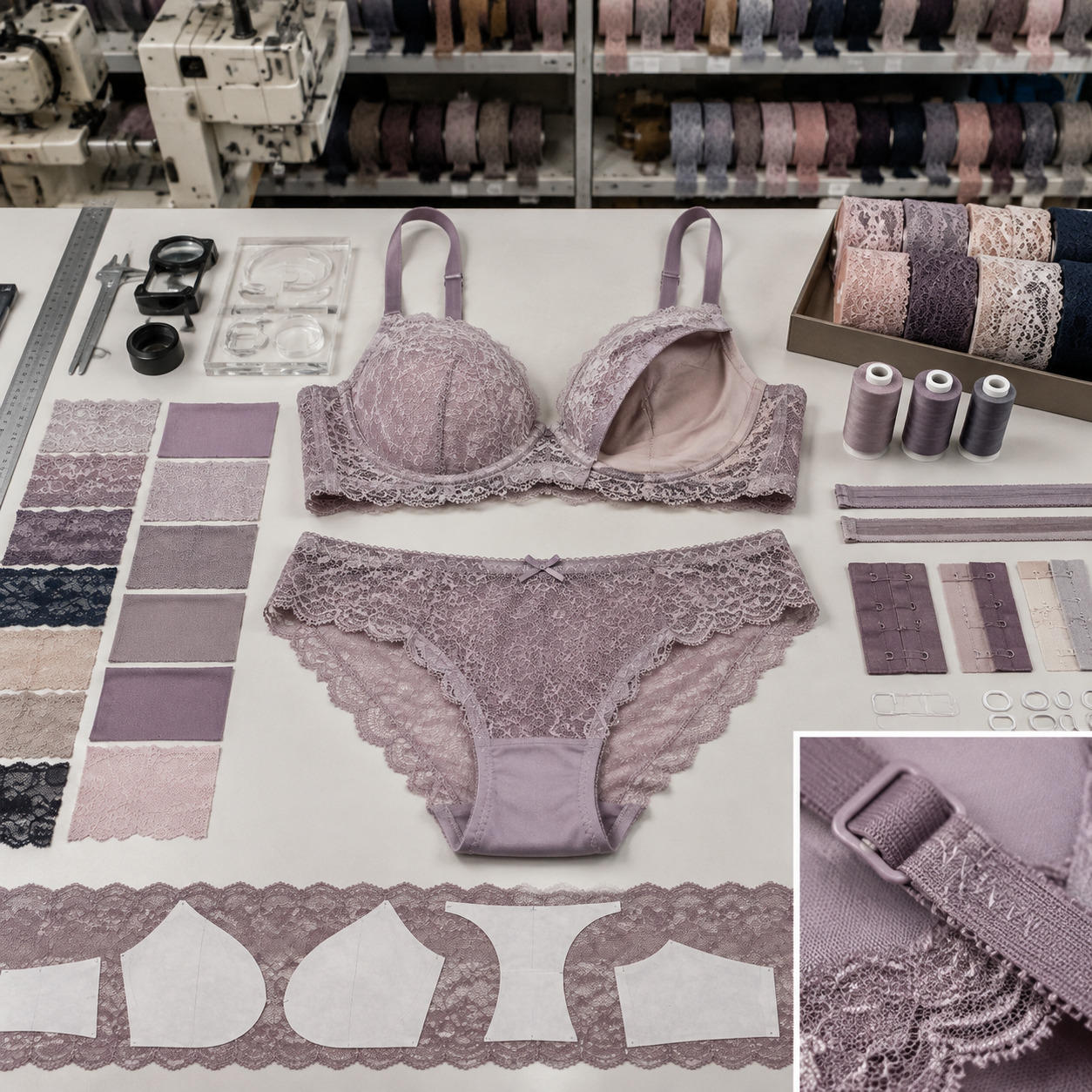
For United States B2B buyers, the decision on lace bra set OEM material options should compare controlled bill-of-materials alternatives for the same manufacturing RFQ. Hold the design, size range and ratio, color scope, lining, trim package, packaging basis, named United States delivery point, and requested ship-ready date constant. Then require the supplier to identify exactly what changes with each material option.
A fiber name alone is not an approval specification. The decision file should connect the proposed material code and color to an identified swatch, production-intent sample, bill of materials, measurement record, quote, supporting documents, landed-cost bridge, and delivery calendar. Any proposed substitution should return through that same approval path.
The central buying question is not which lace has the lowest nominal price. It is which documented material option produces an acceptable finished set at a verifiable cost and on a supportable calendar.
Lace bra set OEM material options for United States RFQs
The supplier-authored commercial lace sourcing reference discusses polyester, nylon, and cotton-blend yarn families in a B2B sourcing and manufacturing context. It supports a candidate-material vocabulary, but it does not prove the performance, availability, price, or suitability of any material proposed in an RFQ.
The supplier-authored Chingva sourcing page places materials and components within broader OEM development, manufacturing, and quality-control topics. That context supports linking material selection to samples, component records, evaluation results, quotes, and production controls. It is not evidence for a particular component, facility capability, or delivery commitment.
| Material option | Fields to fix in the RFQ | Evidence to request | Hold the option when |
|---|---|---|---|
| Polyester-based outer lace | Component composition by mass, construction, nominal width, usable width, mass per area, motif repeat, scallop depth, edge configuration, stretch direction, finish, and shade reference | Identified swatch, supplier material code, proposed bulk source, color reference, lot-control method, measurement methods, and buyer-agreed evaluation results | The evidence covers a different code, color, width, construction, finish, lot, or source |
| Nylon-based outer lace | Component composition by mass, location of any stretch yarn, construction, usable width, motif direction, edge treatment, intended layer role, and care basis | Identified swatch, composition record, documented extension-and-recovery method, dimensional-change result, and shade-control procedure | A result lacks a method, unit, specimen identity, color scope, or link to the proposed bulk source |
| Cotton-blend outer lace | Percentage of each fiber by mass, component scope, usable width, mass per area, edge geometry, finish, intended layer role, and care basis | Composition record for the identified component, swatch, dimensional-change result, shade record, and proposed lot controls | The blend statement cannot be tied to the component used in the production-intent sample |
| Outer lace with a separate lining or cup layer | Separate composition, construction, thickness, mass per area, opacity criterion, stretch direction, support role, contact surface, attachment method, and care response for each layer | Layered production-intent sample, separate component identifiers, construction record, evaluation results, and source-matched documents | The sample contains an unquoted layer or the quote omits its consumption, attachment operation, or booking dependency |
| Elastic, hardware, thread, and closure package | Component-level width or dimensions, composition or substrate, finish, color reference, functional criterion where relevant, attachment method, and substitution rule | Identified component samples, bill-of-materials references, inspection criteria, source records, and current scope-matched documents | Components are hidden inside a generic trim allowance without identities, quantities, or change controls |
Do not assign softness, support, strength, durability, recovery, or colorfastness from fiber family alone. When a property matters to the intended construction, define the evaluation method, conditions, result unit, and acceptance criterion, then apply them to the identified production-intent material.
How to specify comparable material options
Establish an identity chain
Every option should have a traceable identity across the RFQ and approval file. Request:
- Supplier material code and color code.
- Proposed bulk source and the rule for changing that source.
- Fiber composition by mass for the identified component.
- Construction, including backing, integrated stretch yarn, coating, bonding treatment, or applied finish.
- Swatch, sample, bill-of-materials, quote, and report revisions that reference the same material identity.
- Lot or source reference for the production-intent sample and proposed bulk material.
A photograph or generic composition statement cannot establish usable width, edge geometry, motif placement, finish, hand, or lot identity. Require a physical swatch or production-intent cutting labeled in the approval file with the same code, color, source, and revision used in the quote.
Control geometry and usable yield
Nominal fabric price becomes useful only after the supplier shows how the material converts into the approved finished set. For each outer-lace option, request:
- Nominal roll width and usable cutting width, reported separately in agreed units.
- Mass per area, measurement method, and sample-conditioning basis.
- Motif repeat, scallop depth, edge configuration, and permitted placement direction.
- Consumption by size ratio and marker revision.
- Cutting allowance, unusable-edge treatment, motif-placement loss, and defect treatment.
- Treatment and ownership of excess or unusable material.
The same design and size ratio should be used when comparing options. If usable width, motif orientation, or edge geometry changes, require a revised marker and cost allocation before accepting the new price.
Define evaluation methods before comparing results
For properties such as extension, recovery, dimensional change, shade consistency, opacity, or care response, the RFQ should state the method and acceptance basis. A usable result record identifies the specimen, material code, color, direction, conditioning, procedure, applied load or extension where relevant, dwell and recovery conditions where relevant, result unit, date, and decision status.
A supplier result should not be transferred to another material, color, finish, layer, or source without evidence that the reported scope covers the proposed option.
Separate lining, cup, and trim decisions
Treat lining, cup fabric, mesh, jersey, foam, backing, elastic, thread, closure tape, rings, sliders, stabilizers, and finishes as separate bill-of-materials entries. For each relevant component, request its composition or substrate, construction, dimensions, color and finish reference, intended function, attachment method, source identity, consumption, cost, booking dependency, and approved-substitute rule.
For coated or metal hardware, request the declared substrate and finish together with documents applicable to the actual component and intended contact. For plastic hardware, request material identification when it affects the buyer's product file, labeling, care, or packaging review. A general quality statement does not document the quoted component package.
Changes to yarn, fiber percentage, backing, width, motif, softener, coating, bonding treatment, dye lot, lining, elastic, thread, hardware substrate, or hardware finish should require written buyer review of the revised sample, evidence, cost, and calendar effects.
United States material options: labeling and evidence controls
Use official United States sources as legal-review starting points rather than relying on a supplier-authored label template. The FTC's official textile-labeling guide addresses fiber-content, country-of-origin, and manufacturer or dealer identity disclosures under the textile-labeling framework. Care instructions should be reviewed against the official FTC Care Labeling Rule page and its applicability to the actual finished product. Neither source proves that a supplier's proposed label is compliant.
For each material option, provide the buyer's responsible United States compliance reviewer or counsel with:
- Component-level composition records tied to the approved lace, lining, cup layer, and other relevant textile components.
- The proposed finished-product fiber statement and its documented calculation basis.
- Care instructions tied to the approved construction and the applicable care evaluation.
- Manufacturing-origin inputs for review of the proposed origin statement.
- Material and component identities linked to the production-intent sample and proposed bulk sources.
- Proposed label placement, attachment method, artwork revision, approval owner, and approval date.
- Supporting documents showing the relevant holder, facility, material, color, sample, method, issue status, and validity scope.
Do not transfer the composition printed on an outer-lace swatch directly to the finished-set label. Reconcile the proposed declaration with the approved bill of materials and current United States requirements, including the applicable treatment of components, ornamentation, and trim.
The supplier-authored Sino Finetex sourcing article discusses alignment to United States or custom size charts. For this material-options RFQ, that source supports only the need to hold the buyer-approved size chart and grading basis constant while material alternatives are compared. It does not prove that a proposed pattern or sample meets the buyer's measurements. Attach the approved size chart, grade rules, points of measure, tolerances, and construction revision, then request measured production-intent sample results.
If a supplier names a standard, certification, or laboratory report, request the current document and verify the requirement, holder, scope, sample identity, method, issue or expiry status, color, facility, and production-source relevance. Describe a supplier's internal procedure as company practice, not as a requirement of a named standard. Do not imply certification without a current document that matches the proposed material and scope.
Material-option cost for United States delivery
Buyer-created comparison example
Every exact figure below is a buyer-created example assumption for a hypothetical quote comparison dated 15 February 2025. The example scope is 1,000 finished sets of a single style and single colorway for a named United States delivery point. The figures are not drawn from the cited sources, are not supplier quotes or market benchmarks, and must be verified in the dated supplier quote, approved bill of materials, measured marker record, and current logistics inputs before purchase-order release.
| Example input | Buyer-created calculation | Source, scope, date, and verification |
|---|---|---|
| Proposed outer-lace composition | 85% nylon by mass and 15% elastane by mass of the outer-lace component | Buyer-created assumption for the hypothetical comparison dated 15 February 2025, scoped only to the proposed outer-lace component. Verify against a composition record tied to the quoted material code, color, and bulk source before label review |
| Order scope and outer-lace usage | 1,000 finished sets x 2.00 usable meters of outer lace per finished set = 2,000 usable meters of outer lace | Buyer-created quantity and consumption assumptions dated 15 February 2025, scoped to the stated style, colorway, size ratio, and United States delivery comparison. Verify against the supplier's measured marker or cutting record |
| Cutting allowance | 8% of 2,000 usable meters = 160 usable meters, producing an example planning requirement of 2,160 usable meters of outer lace | Buyer-created allowance and calculation dated 15 February 2025, scoped only to the example outer lace. Verify after approval of usable width, motif placement, edge alignment, size ratio, marker, and defect treatment |
| Outer-lace input cost | USD 4.25 per usable meter x 2,160 usable meters = USD 9,180, equal to USD 9.18 of outer lace per finished set across 1,000 finished sets | Buyer-created cost assumption dated 15 February 2025, scoped only to the example outer-lace allocation. Verify quote currency, validity, unit basis, finish, color charge, material minimum, payment basis, and exclusions in the supplier quote |
The example allocation is not a finished-set price or landed cost. The comparison must separately account for lining, elastic, hardware, thread, labels, packaging, assembly, inland movement, freight, insurance, customs charges, brokerage, inspection, and other supplier- or buyer-incurred amounts applicable to the approved option.
Build the landed-cost bridge around the approved material
Compare every option using the same construction, order scope, packaging basis, trade term, named place, and United States delivery point. Keep supplier charges, logistics estimates, and buyer-incurred charges separate, with a source date, validity period, currency, and responsible owner for each input.
| Control | Supplier return | Buyer decision check |
|---|---|---|
| Quote identity | Material code, bill-of-materials revision, sample identity, currency, unit basis, quote date, validity, payment terms, trade term, and named place | Confirm that every option covers the same design, quantity, size ratio, color scope, component scope, packaging, and delivery basis |
| Material yield | Nominal width, usable width, consumption by size ratio, marker revision, motif-placement rule, edge loss, defect treatment, and cutting allowance | Compare material cost per approved finished set rather than price per nominal fabric unit |
| Dependent materials and operations | Separate costs for lining, cup layers, elastic, hardware, thread, finishes, attachment operations, labels, and packaging | Identify whether a lower outer-lace price introduces another material, operation, or minimum |
| Minimums and charges | Material minimum, color minimum, component minimum, development fee, sample fee, custom-finish charge, and unused-material treatment | Record unavoidable order-level costs and ownership of excess material |
| Freight inputs | Packing method, carton dimensions, net and gross weight, carton count, inland movement, freight basis, insurance treatment, and named United States delivery point | Obtain a dated logistics calculation for the approved material and packaging configuration |
| Border-cost inputs | Proposed customs classification, declared-origin inputs, dutiable-value basis, and all excluded duty, tax, brokerage, or other charges | Validate the proposed classification and current tariff treatment against the approved product facts and the official United States Harmonized Tariff Schedule with the buyer's responsible customs adviser |
The landed-cost bridge should start with the quoted finished-set price and show each addition or exclusion through the named United States delivery point. Do not treat a supplier-proposed classification or an undated tariff or freight input as final. Recalculate whenever composition, usable width, consumption, lining, hardware, packaging, origin input, classification, trade term, delivery point, or freight basis changes.
Delivery and change control for material options
Material availability and approval dependencies belong in the delivery comparison. Request calendar dates and named owners rather than descriptions such as fast production or short lead time. The supplier response should show:
- Swatch dispatch and expected receipt dates.
- Color-reference or shade-approval deadline.
- Material reservation and booking deadline.
- Production-intent sample completion and buyer-approval dates.
- Bulk lace, lining, elastic, hardware, label, and packaging arrival dates.
- Cutting start, assembly completion, inspection release, and ship-ready dates.
- Transit basis and estimated delivery date for the named United States point.
- Dependencies controlled by the buyer, supplier, material source, component source, inspector, customs process, or carrier.
- Calendar effect of a rejected shade, failed evaluation, late artwork, missing document, or requested substitution.
Keep material approval, bulk completion, inspection release, ship-ready status, and estimated arrival as separate milestones. If a supplier proposes a change in yarn, composition, backing, width, motif, dye lot, finish, lining, elastic, hardware, thread, or source, require a revised swatch, evidence package, cost bridge, and delivery calendar before approval.
Practical RFQ checklist for United States material options
Use this checklist separately for every quoted material option. A checked item should point to an identified document, sample, calculation, date, or approval owner in the RFQ file.
- [ ] State the United States sales market, intended product use, named delivery point, order quantity and unit, and requested ship-ready date.
- [ ] Fix the design revision, size chart, grade rules, size ratio, color scope, lining and trim package, packaging basis, trade-term comparison basis, and delivery assumptions.
- [ ] Define component composition by mass, construction, nominal and usable width, mass per area, motif and edge geometry, stretch direction, finish, shade reference, source identity, and substitution rule.
- [ ] Require an identified swatch and production-intent sample linked to the same material code, color, source, bill-of-materials revision, and quote revision.
- [ ] Request method-based evaluation records with specimen identity, conditions, result unit, date, scope, acceptance criterion, and decision status.
- [ ] Request finished-product fiber, care, manufacturing-origin, label-placement, attachment, and artwork inputs for review by the buyer's responsible United States compliance reviewer or counsel.
- [ ] Require a comparable quote showing material and component costs, minimums, charges, currency, validity, payment terms, trade term, named place, packing basis, and exclusions.
- [ ] Build a dated landed-cost bridge through the named United States delivery point using current packing, freight, insurance, customs, brokerage, and other applicable inputs.
- [ ] Request dated material-booking, sample-approval, bulk-arrival, cutting, assembly, inspection-release, ship-ready, transit, and estimated-delivery milestones with owners and dependencies.
- [ ] Require written buyer approval before any change to yarn, composition, backing, width, motif, dye lot, finish, lining, elastic, hardware, thread, component source, or material source.
- [ ] Reconcile the swatch, production-intent sample, bill of materials, measurement record, supporting documents, label inputs, quote, landed-cost bridge, and calendar to the same proposed construction.
- [ ] Record approved identities, retained references, acceptance criteria, document revisions, exception decisions, change-control owner, and supplier acknowledgment before purchase-order release.
Do not check an item when evidence covers another code, color, construction, source, facility, holder, sample, method, or validity period. Hold release when the quote uses unstated yield assumptions, the label relies on unconfirmed product facts, landed-cost inputs are undated, delivery omits material dependencies, or the supplier retains an uncontrolled substitution right.
Methodology, source context, and limitations
Methodology: Each source was assigned a limited evidentiary use. Supplier-authored pages were used only to identify candidate material terminology or workflow questions. Official United States pages were used as review starting points for labeling, care, and tariff controls. Those contexts were converted into buyer-controlled specification fields, evidence requests, comparison calculations, and release conditions. No cited source was used to set a material-performance threshold, supplier capability, price, minimum order, lead time, customs classification, tariff rate, or certification status.
| Source context | Supported use | Limitation |
|---|---|---|
| Vincent Xi author profile | Author name, Editorial Author role, and profile URL | Does not support a first-hand factory, sourcing, testing, or customer-outcome claim |
| Commercial lace sourcing reference | Supplier-authored context for polyester, nylon, and cotton-blend candidate lanes and related sourcing questions | Does not prove suitability, availability, performance, price, or production capability for a proposed material |
| Chingva sourcing page | Supplier-authored workflow context connecting materials and components with OEM development, manufacturing, and quality-control topics | Does not document a specific component, evaluation result, facility scope, or delivery commitment |
| Sino Finetex sourcing article | Supplier-authored context for requesting alignment to a United States or custom size chart | Does not prove that a proposed pattern or sample meets the buyer's measurements |
| FTC textile-labeling guide | Official United States starting point for fiber-content, origin, and manufacturer or dealer identity review | Applicability, exceptions, wording, placement, and current legal interpretation require review for the actual finished product |
| FTC Care Labeling Rule page | Official United States starting point for care-label review | Does not establish the correct care instruction for an untested or unidentified construction |
| United States Harmonized Tariff Schedule | Official schedule lookup for current classification and tariff review | Does not determine classification or landed cost without approved product facts, origin facts, the applicable date, and responsible customs review |
Limitations and what to verify: The supplier-authored sources are not independent proof for a particular lace bra set, material, factory, price, minimum, evaluation result, certification, delivery promise, or customer outcome. The cited pages do not establish current inventory or manufacturing capability. Verify composition, construction, usable width, mass per area, motif dimensions, extension and recovery, dimensional change, shade result, material source, sample identity, report scope, label fields, customs treatment, landed-cost inputs, and calendar dates with the responsible supplier and the buyer's current United States compliance, customs, and logistics sources. Do not approve a claimed standard or certification without a current document covering the relevant requirement, holder, facility, material, color, sample, method, source, and validity period.
Discuss Your Requirements
Review our manufacturing capabilities, then share your specifications for a supplier-fit review.