Lace Bra Set OEM Digital Integration Readiness for Canada
Editorial byline: Vincent Xi, Editorial Author, Velora Intimates. Profile: https://velora-intimates.com/authors/vincent-xi/
For apparel brands and retail importers in Canada, evaluating lace bra set OEM digital integration readiness is a technical file assessment rather than an evaluation of marketing claims. Sourcing teams preparing manufacturing contracts in Canada must verify whether an original equipment manufacturer (OEM) can open native digital tech packs, maintain multi-component bill of materials (BOM) synchronization across grading scales, and execute pre-sample computer-aided design (CAD) checks on lace placement and elasticity. This analysis synthesizes public technical documentation from intimates product lifecycle management (PLM) providers and lingerie 3D CAD developers. It serves procurement professionals structuring request-for-quotation (RFQ) packages and does not reflect a factory audit or proprietary production data from Velora Intimates.
What digital integration readiness means in lace bra set manufacturing
Digital integration readiness in coordinated lace intimates production is defined by four technical handoffs between the brand's product development team and the factory floor.
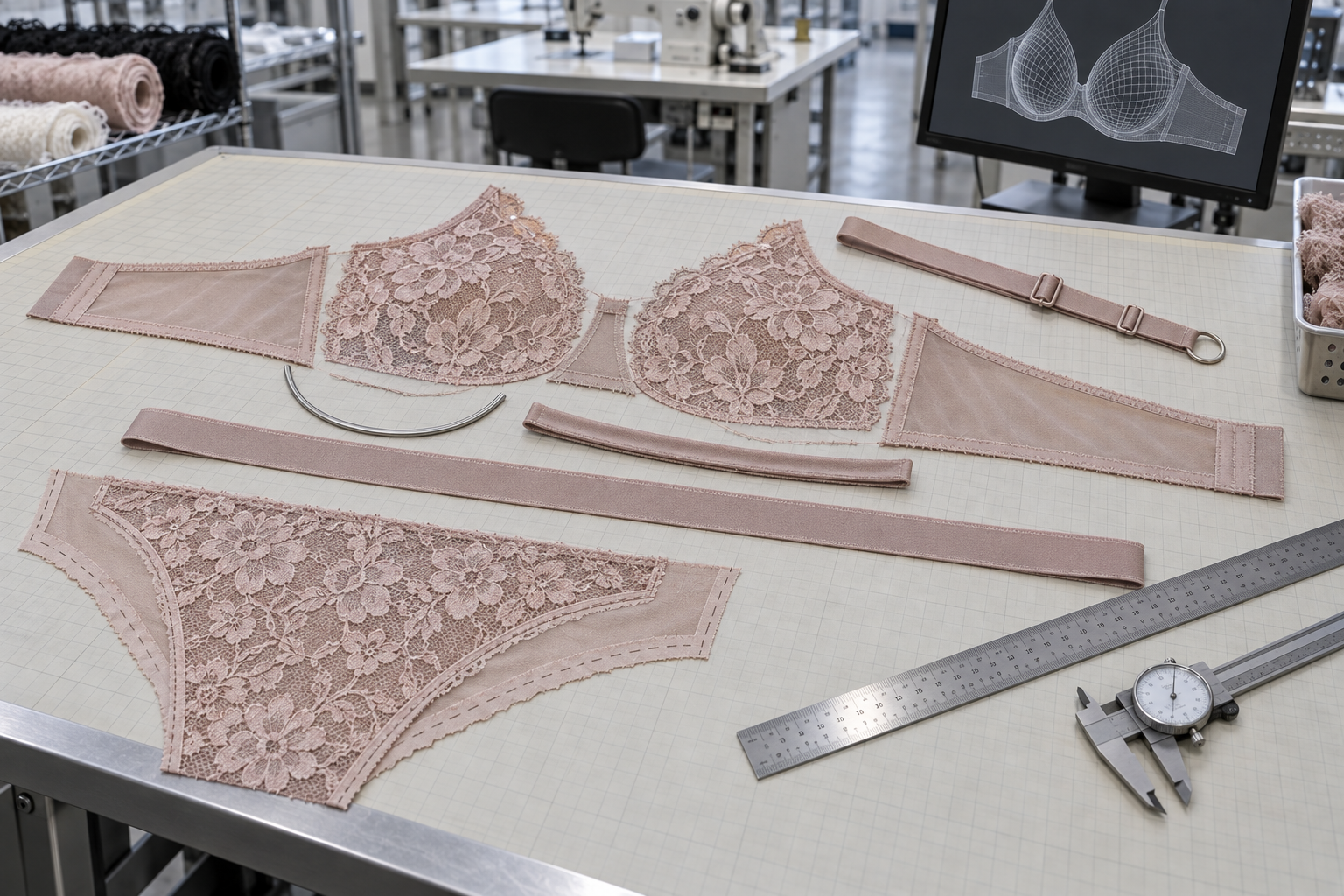
First, the OEM must ingest 2D patterns, grading rules, and lace artwork into its active CAD environment. As documented by Style3D, lingerie 3D applications simulate lace motif positioning, underwire behavior, and strap tension prior to physical sample cutting. However, suppliers can only resolve lace-layout conflicts and sewing construction constraints digitally if their in-house CAD configuration actively supports multi-layer simulation.
Second, the BOM must update dynamically across styles. According to DESL, a standard bra BOM comprises 20+ individual components, including lace, cup foam, underwire channeling, and hardware sourced from separate upstream vendors. In a fully integrated PLM environment, any component substitution automatically updates across all graded sizes and coordinating colorways.
Third, color approvals must synchronize across disparate substrates. The DESL analysis highlights that digital color standardization aligns dye formulations across differing materials—such as polyamide lace, polyester-wrapped wire channeling, and elastane straps—reducing redundant physical lab-dip rounds.
Fourth, shop-floor cutting and sewing data must reconcile against the purchase order. Textile School lists CAD, enterprise resource planning (ERP), digital twins, Internet of Things (IoT) monitoring, and distributed ledger tracking as manufacturing tools deployed to manage cutting precision, assembly consistency, and material scrap. These tools represent operational categories that require verification on a per-factory basis.
Three data points, with scope
- Component complexity benchmark: DESL documents that an intimates bra BOM includes 20+ parts from distinct material suppliers. Unit: individual component lines per single bra style. Scope: intimates complexity analysis published by DESL (industry overview article, publication date not specified). This metric serves as a structural baseline. If an OEM quotation lists significantly fewer lines, the buyer must verify whether wire channeling, strap adjusters, hook-and-eye tape, or structural interlinings were omitted from the quote.
- Pre-cut simulation parameters: Style3D defines three core simulation topics in 3D lingerie software: lace placement, underwire curve tension, and strap elasticity. Unit: 3 functional simulation parameters. Scope: published software capability overview (vendor documentation, publication date not specified). This figure reflects commercial software capability rather than an empirical production pass rate. Buyers must establish whether a quoting factory performs all three checks or relies entirely on physical prototype fitting.
- Size-colorway revision impact (illustrative model): Consider an example production run of a lace bra set specified across 6 cup/band sizes and 2 seasonal colorways, totaling 12 distinct size-colorway stock keeping units (SKUs) (calculated as 6 sizes × 2 colorways). If a mill substitutes a retired lace pattern and the OEM uses static spreadsheets instead of a version-controlled PLM system, up to 11 records beyond the base sample size risk retaining stale lace specifications. Unit: 12 SKU records in an illustrative calculation. Scope: example calculation for quotation verification, not an industry-wide average or Velora Intimates internal statistic.
No commercial search traffic, keyword ranking, or cost-per-click metrics are stated or estimated for this topic.
CAD and 3D checks before physical lace cutting
Turning digital assets into production approvals requires strict acceptance criteria. In its lingerie software review, Style3D notes that virtual prototyping simulates lace placement, underwire channeling, and elastic recovery before physical fabric cutting. Furthermore, integrated PLM connections allow 3D assets to populate tech-pack BOM fields with lace article codes and ecological testing references, while factories leverage digital assets to catch assembly conflicts where CAD capability permits.
Lace motif alignment. File verification must confirm that scalloped edges align with neckline curvatures, that stretch-lace motifs sit clear of cup seam allowances, and that internal cup linings do not reveal raw edges. Renders disconnected from physical lace article numbers cannot ensure pattern repeatability.
Underwire tension and strap dynamics. Virtual simulation indicates whether a selected underwire arc matches the cradle geometry and whether strap elasticity corresponds to calculated cup support. Virtual stress modeling does not replace physical fit testing on live models, as software does not measure long-term tactile comfort or wash-induced recovery loss. RFQ terms must specify physical prototype sign-off for primary fit approval.
Sewing clash detection. The Style3D documentation emphasizes that factory execution depends on CAD software capabilities. Canadian buyers should mandate a written log of pre-cut checks, identifying whether seam bulk at the strap-to-wing apex or lace gathering along the wire casing was verified digitally or deferred to the sewing line.
Material compliance data fields. A digital tech-pack field containing an OEKO-TEX reference is a database attribute, not proof of certified compliance. This analysis does not evaluate active supplier certificates and does not claim that Velora Intimates or any quoting manufacturer possesses third-party certifications. When Canadian buyers require restricted-substance or ecological assurances, they must inspect independent testing certificates showing valid scope and expiration dates directly from the fabric mill.
Operational trade-offs. Performing multi-layer 3D pre-checks can reduce physical prototype iterations by locking pattern dimensions early. However, onboarding proprietary brand files into an incompatible factory CAD system creates file translation delays. Procurement teams must compare quoted calendar lead times against actual prototype cycles.
BOM synchronization and graded consumption for multi-component sets
Managing a two-piece coordinated lace bra and brief set increases operational complexity. The DESL analysis highlights that bra sets contain 20+ components per bra, requiring version-controlled PLM systems to reflect component substitutions across every size and colorway. Live systems also manage digital color approval across disparate substrates and calculate size-dependent consumption for matched sets.
Coordinated set consumption rules. A bra and brief set typically shares an identical stretch lace and elastic trim family, but consumption curves diverge across the grade scale. Larger cup sizes require wider elastics and higher lace yields, while matching briefs follow distinct hip-grade increments. A supplier's digital integration is validated when its system automatically outputs separate, graded consumption yields for both pieces while binding them to the same master lace article number.
Cross-substrate color coordination. Dye absorption varies significantly between open-knit polyamide lace, elastane wing mesh, polyester sewing thread, and coated metal hardware. DESL indicates that digital spectral color management aligns dyeing across substrates, compressing sample approval cycles. Because public technical literature does not publish standard cycle reduction percentages, buyers must establish baseline lab-dip cycles directly within the supplier quote.
Engineering change control. Digital versioning is functional only if technical changes generate unique revision identifiers. If an OEM switches a lace trim due to yarn shortages, the change must push through a frozen BOM revision visible to both the brand and factory floor before bulk cutting begins.
Quotation comparison model. Using the earlier illustrative baseline of 12 size-colorway records (6 sizes × 2 colorways, assumption for verification), buyers should evaluate bids by isolating base digital pattern preparation fees from individual physical prototype charges. Quotations that blend freight into unit prices obscure cost transparency. Canadian procurement teams should mandate ex-works pricing alongside designated Incoterms, applying their own freight forwarding and customs clearing models.
Technical infrastructure evaluation for OEM files
Textile School identifies CAD systems, ERP platforms, digital twins, IoT factory dashboards, and distributed ledger tracking as tools deployed across bra manufacturing to track cutting accuracy, balance assembly lines, and reduce material waste. These represent broad industrial categories; the reference provides no specific waste percentages, software benchmarks, or factory performance audits.
Procurement teams should convert generic software listings into functional verification tests:
CAD interoperability. The OEM must prove it can import brand DXF or native lingerie 3D files and generate graded pattern pieces without manual redrafting.
PLM data exports. The factory should output a unified data package linking lace article numbers, size-dependent yields, and lab-dip approvals, aligning with the live tech-pack framework outlined by DESL.
ERP yield reconciliation. The factory must demonstrate that cut-room fabric disbursements reconcile against theoretical BOM consumption at designated milestones, such as batch completion.
Advanced tracking and algorithmic references. Textile School notes emerging supply chain visibility tools, including distributed tracking and automated scheduling workflows, without quantifying model accuracy or tracing parameters. Buyers should treat claims of digital twins or distributed ledgers as unverified unless the OEM identifies the exact database keys linking a roll of lace to a finished carton. In the absence of documented tracking mechanisms, advanced digital claims should not influence vendor selection.
Implementation trade-offs. Demanding complex enterprise software integration from an OEM can lengthen onboarding schedules and add administrative overhead. For an initial seasonal order, ensuring reliable CAD file transfer and live BOM revision control is far more critical than requiring theoretical distributed ledgers.
Decision table for Canada lace bra set manufacturing bids
Evaluate competing factory proposals against technical evidence on a single test style. This table provides structural acceptance criteria rather than a commercial scoring algorithm.
| Buyer Verification Item | Quoted Parameter to Compare | Approving Technical Evidence | Risk if Evidence is Missing |
|---|---|---|---|
| Tech-pack ingestion | CAD/PLM file compatibility (DXF, native 3D) | Sample file import report with revision ID | Manual digitizing alters pattern curves |
| Lace motif placement | Pre-cut digital checking vs. manual cut check | 3D render linked to exact lace article code | Scallops misalign across cup seams |
| Wire and strap physics | Simulation scope (wire channel, strap modulus) | Written protocol confirming in-scope checks | Fit defects caught only after bulk assembly |
| BOM completeness | Part count compared to 20+ part benchmark | Complete export listing all elastics, trims, and foam | Missing components trigger mid-run surcharges |
| Revision control | Dynamic change propagation across SKUs | Live BOM sample showing two sizes updated simultaneously | Stale lace or trim specified on secondary sizes |
| Graded consumption | Yield variation across coordinating set | Size-graded material matrix for bra and brief | Cutting yields fail to cover required units |
| Cross-substrate dyeing | Lab-dip management across lace, foam, and elastic | Spectral color reports and quoted lab-dip cycles | Color mismatch between cups and elastics |
| Physical sample terms | Prototypes required post-digital approval | Itemized quote showing sample counts and setup fees | Hidden fees emerge after digital sign-off |
| Cutting yield audit | Scrap and usage reconciliation via ERP | Exported cutting ledger sample with lot IDs | Unreconciled lace scrap inflates reorder costs |
| Lot traceability | Component batch tracking to finished goods | Database schema linking fabric roll to carton | Recalls require quarantine of entire orders |
| Certification validity | Separation of database tags from legal certificates | Independent PDF certificates with current validity | Reference fields mistaken for valid compliance |
| Commercial pricing structure | Breakdown of digital setup vs. unit manufacturing | Ex-works unit pricing with clear Incoterms | Inability to evaluate true Canadian landed costs |
Pre-order verification checks for Canada intimates buyers
Style code harmonization. Ensure the purchase order, digital tech pack, physical sample tag, and commercial invoice reference identical style and colorway numbers. If the coordinating brief carries an independent SKU, document explicitly whether the lace trim and dye approvals are shared.
Engineering change freeze dates. Contractually establish a calendar cut-off date after which no lace, underwire, or elastic substitutions are permitted without written brand authorization. Every modification must trigger a newly incremented BOM revision ID.
Scope of virtual approvals. Maintain contractual clarity that CAD or 3D visual approvals govern aesthetic placement and geometry only. Final sizing, comfort, and structural recovery must remain contingent on physical sealed samples.
Documentation alignment for Canadian import. The technical sources cited here do not establish Canadian customs regulations, Competition Bureau textile labeling requirements, bilingual packaging laws, or CBSA tariff classifications. Procurement teams must independently require the vendor to provide complete shipping documentation—including commercial invoices, packing lists, and certified bills of lading—to substantiate customs entry under Canadian import procedures.
Verification of software claims. Require the supplier to validate any digital manufacturing claim by submitting real production files from an active style rather than relying on promotional brochures.
How the data in this briefing was derived
This analysis is authored by Vincent Xi, Editorial Author at Velora Intimates (profile: https://velora-intimates.com/authors/vincent-xi/). The author holds the professional title of Editorial Author. No unverified professional credentials, factory inspection histories, enterprise consulting relationships, or proprietary trial results are claimed.
Methodology. The framework was developed by analyzing public technical literature covering intimates software and lingerie manufacturing, mapping documented digital capabilities to commercial OEM procurement requirements. Style3D technical articles provided documentation on 3D lingerie modeling, including lace placement, wire tension, strap elasticity, and tech-pack BOM integration. DESL publications supplied data regarding the 20+ component intimates BOM, automated revision propagation, cross-substrate color coordination, and graded consumption rules for matching sets. Textile School literature established current terminology around CAD, ERP, and factory monitoring systems. Where industrial metrics are omitted from published research, this guide outlines an illustrative calculation (6 sizes × 2 colorways = 12 SKUs) for buyers to calibrate during quotation reviews. No proprietary internal production data or third-party search demand analytics were used.
Limitations. The referenced sources outline software features and high-level manufacturing concepts; they do not document the operational capabilities, pricing schedules, defect rates, or compliance standing of Velora Intimates or any specific OEM. The source materials do not provide publication dates for the 20+ component metric or the three simulation parameters. They do not quantify exact sample lead-time reductions, fabric waste savings, or color-matching accuracy. Mention of external standards (such as OEKO-TEX data fields in PLM systems) denotes software schema design rather than active regulatory certification. Buyers must independently verify CAD file handoffs, BOM accuracy, prototype allotments, and compliance certificates directly with their manufacturing partners, and verify customs, tariff, and labeling requirements with their qualified trade advisors.
RFQ Checklist
- Ask the supplier to confirm in writing which specific CAD or 3D simulation checks will be executed on the lace bra set prior to cutting physical prototypes, detailing coverage for lace motif placement, underwire channel curve, and strap elastic tension.
- Require the manufacturer to provide an exported multi-component bill of materials showing at least two graded sizes and both colorways, confirming that a lace substitution automatically updates all corresponding records across the coordinating set.
- Specify the exact quantity of physical approval samples included in the quotation across each size and colorway, requiring the supplier to price digital engineering setup fees separately from prototype garment charges.
- Ask the supplier to detail its quoted lab-dip and strike-off cycle count across all distinct substrates—including stretch lace, cup foam, and elastic trims—and identify the revision record generated when a dye lot is modified.
- Require the manufacturer to outline its post-cutting production data reporting process, specifying the file format, delivery frequency, and exact data fields used to reconcile bulk lace consumption against the approved BOM.
- Specify a binding revision-freeze calendar date after which raw material substitutions cannot occur without written brand consent, requiring a newly incremented tech-pack revision ID before bulk production commences.
- Ask the supplier to state ex-works manufacturing prices alongside designated Incoterms and dispatch facility locations, allowing the Canadian importer to apply independent freight, duty, and clearance calculations.
- Require the manufacturer to furnish current third-party laboratory test reports and ecological certificates as separate PDF documents, confirming that PLM data fields are not substituted for authentic compliance filings.
- Specify required CAD interchange formats for initial tech-pack submission, and ask the supplier to return a validated trial import record with an assigned revision ID prior to purchase order confirmation.
Discuss Your Requirements
Review our manufacturing capabilities, then share your specifications for a supplier-fit review.