Intimates OEM Digital Integration Readiness for United States Manufacturing Buyers
Vincent Xi, Editorial Author · https://velora-intimates.com/authors/vincent-xi/
United States procurement teams should treat intimates OEM digital integration readiness as a pass/fail RFQ gate, not a brochure claim. Before a development purchase order for intimates manufacturing, require evidence of 3D virtual prototyping for stretch bras and knits, structured tech-pack ingest into cutting and sewing systems, production-status fields that can feed an ERP, and lot-level material data that can generate FTC fiber-content and country-of-origin strings. Those controls determine how many physical samples enter the United States, how fit comments close, whether purchase-order dates stay usable for freight booking, and whether labels match the BOM used for costing and CBP entry.
A vendor publication on intimates virtual prototyping describes material-waste reduction of up to 48 percent by simulating elastic fabrics and construction before fabric is cut (Browzwear). That 48 percent figure is a vendor-associated upper bound, not an OEM quote: unit is percent of material waste as that page describes it (confirm marker waste versus purchased fabric); scope is intimates virtual prototyping and the fabric types on that page; as-of context is the cited page’s own publication or last-update date, which the buyer must record from the live URL. Digital twins still have to match the lace, foam, and elastane that will be sewn, and collaboration tools still have to meet the brand’s information-security policy.
This assessment synthesizes the publicly cited industry publications listed with the figures below. It does not claim unpublished factory visits, laboratory tests, named customer results, or first-hand production experience.
What intimates OEM digital integration readiness requires
For intimates manufacturing, the OEM must show that a style can move from digital design through approved production on shared files, with couriered samples as a controlled exception rather than the primary loop. For a United States RFQ, treat the following as must-have evidence:
- Acceptance of 3D files and digital twins for stretch intimates (bras, briefs, shapewear, sleep), including elastane blends, narrow elastics, molded cups, underwires, and lace placement.
- A collaboration environment with versioned comments on fit, construction, and color.
- Mapping of the buyer’s PLM attributes into cutting, sewing, and QC systems without re-keying graded specs and BOM lines.
- Daily or better production and quality status that can feed an ERP or a read-only portal (cadence is a buyer specification to confirm in the quote, not a published industry average).
- Lot-level fiber, mill, and origin data that can later populate label copy, customs fields, and a digital product record.
Price the trade-off; do not assume a saving. Digital onboarding or software-related fees may appear as development line items. Analog routing can look cheaper on the first sample invoice and then add revision rounds, air freight, and opaque work-in-progress. Put both paths on the same comparison sheet rather than treating a digital workflow as an automatic reduction in total landed cost.
3D virtual prototyping workflow and collaboration tools
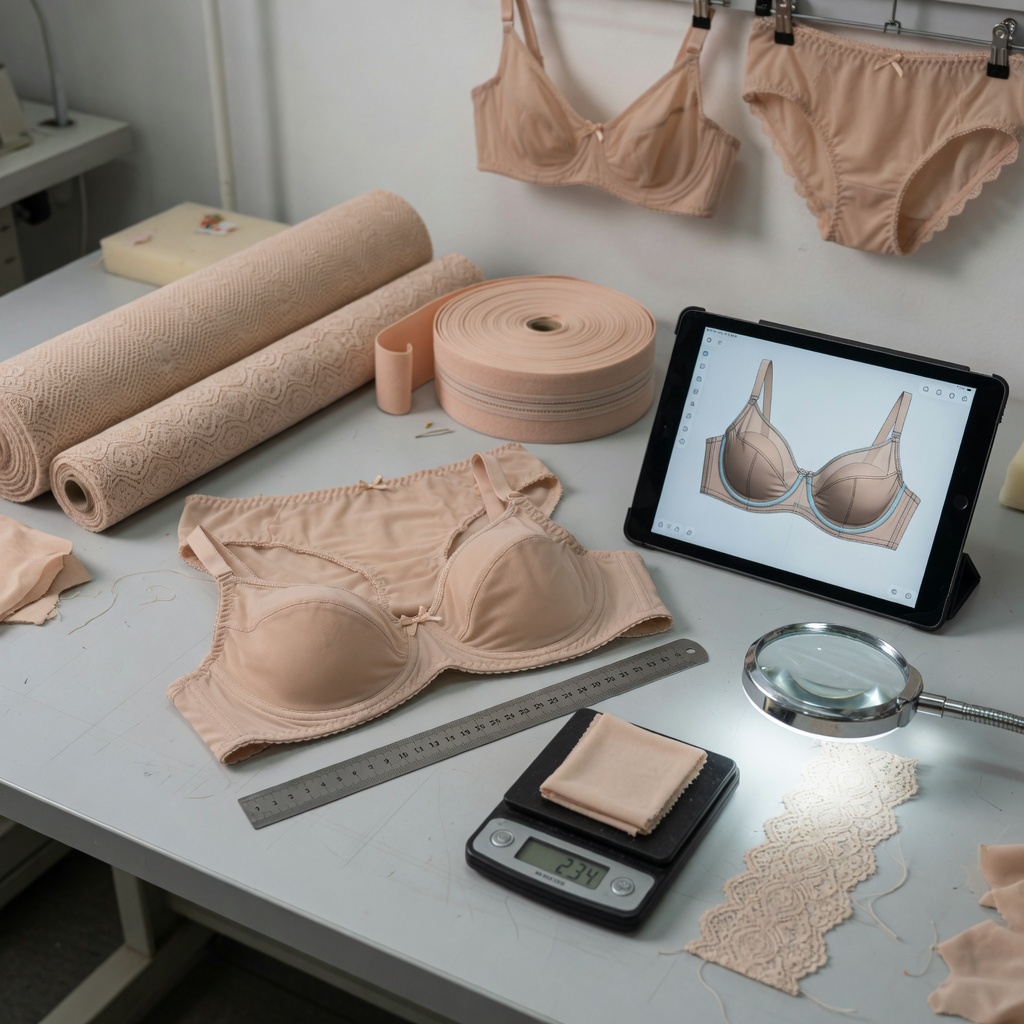
Intimates create specific digital-twin problems: high-stretch elastane blends, narrow elastics, molded cups, underwires, lace placement, and fit across cup and band sizes. Virtual prototyping software is described as simulating drape, stretch, and seam construction so early fit reviews can happen on screen. The same intimates-focused vendor overview states that this approach accelerates design-to-production cycles and enables brand–supplier collaboration (for example via Stylezone, as named on that page) (Browzwear). Those statements belong to the cited page; they are not measurements from a named OEM program.
Measurable trade-offs for a United States buyer:
- Physical sample reduction versus tactile validation. Digital reviews can save courier time and fabric, but lace scallop quality, foam compression set, and hook-and-eye durability still usually need at least one physical gold-seal round before bulk. Treat the remaining sample count as an RFQ field (samples per style, with the date of the last comparable program).
- File-format lock-in. Ask which 3D formats the OEM natively supports and whether the brand must buy matching licenses.
- Skill on both sides. A factory that can generate an accurate digital twin is useful only if the brand’s technical designer can comment inside the same environment.
RFQ action: require a live walk-through of one intimates style (a bra with foam and a matching brief) showing how comments are versioned. Do not paste vendor waste-reduction percentages into a cost model until the OEM documents a comparable program with unit, fabric types, and as-of period.
PLM, ERP, and digital tech-pack integration in OEM manufacturing
Once a style is approved, the tech pack should not remain a static PDF. The OEM should ingest measurements, graded specs, BOM, construction notes, and 3D references into its production system and push status back. Industry trend pieces describe underwear OEMs adopting 3D body scanning, AI-assisted patterning, and more automated knitting and assembly (China JMC). Those factory-floor tools help the buyer only when they connect to commercial systems the brand can audit. A trade-page description of category trends is not evidence that a specific quoting factory has a live interface.
Specify in the RFQ:
- Which PLM platforms or generic data formats (CSV, XML, JSON, or vendor API) the OEM has actually used, with software names rather than a claim that any system can be connected.
- Update cadence for cutting complete, sewing WIP, inline QC fail rate, and finished-goods cartonization.
- Whether the buyer can have read-only portal or API access rather than weekly email summaries.
Portal or API access can improve landed-cost forecasting because delays surface before they become air-freight emergencies, but it introduces cybersecurity questionnaires, SSO requirements, and possible per-user fees. United States companies with vendor-risk programs should include their information-security addendum in the same RFQ package.
Traceability data and Digital Product Passport preparation
European Union Digital Product Passport rules are described as taking effect from 2027 and requiring QR-coded digital identities that cover composition, origin, and recyclability for in-scope products (China JMC; Fobsourcify). That timeline is an EU market requirement as those trade pages describe it, not a United States regulation. It still matters to US-based brands because many intimates OEMs run mixed order books, and the same lot-level fiber, mill, and dye-lot data improves US recall readiness, responsible-sourcing questionnaires, and customs documentation. The primary sales market for this RFQ is the United States; DPP field capture is a factory-maturity and data-export test unless the buyer’s own compliance team requires it for other destinations.
Do not treat a marketing statement that a factory is DPP-ready as proof of a current, third-party-audited passport system. Ask for:
- Data fields already captured (fiber percentages by weight, mill name, country of yarn and fabric, recycled-content claims if any).
- Whether those fields can be exported in a structured file the buyer’s compliance team can store.
- Whether blockchain or other passport tools mentioned in trade articles are in production use or only piloted.
The cited sources describe 2027 as a start year and mention QR codes and circularity; they do not provide the final legal text or confirm any named OEM’s live implementation. A standard’s future requirement is not the same as this (or any) company’s current practice. For a purely United States program, do not convert DPP language into a US legal gate.
Landed-cost, labeling, and delivery specifications for United States intimates manufacturing
Digital workflows change the cost model United States buyers actually pay only when sample counts, calendar time, and data errors are priced as line items. Fewer physical samples can reduce international air freight and brokerage on development. Faster approvals can shorten the production calendar. Digital onboarding time and possible software seats are real costs that belong on the comparison spreadsheet. None of those deltas replaces a quoted FOB, a named Incoterm, and a buyer-owned duty and inland-freight model.
Labeling for the United States market remains physical at the garment: fiber content, RN number or company identity, country of origin, and care instructions under FTC textile-labeling rules, plus CBP country-of-origin marking. Those are regulatory requirements for goods sold in the United States; they are not a claim that any quoting OEM is certified, audited, or currently generating error-free copy. An OEM that generates those strings from the same BOM used for costing reduces the classic error of a body fabric labeled at the wrong elastane percentage. Request a sample label-data export for one style as part of the RFQ. Example of the error to prevent (assumption to test, not a measured factory defect rate): a body specified at 12 percent elastane by weight that is labeled as 8 percent elastane.
Delivery and Incoterms: state whether the OEM’s portal shows ex-factory readiness, booked vessel or flight, and carton-level packing list. United States inland delivery (port to DC) is usually the buyer’s or a 3PL’s responsibility; digital ASN quality determines whether that last mile is usable. Require carton ASNs to carry SKU, size run, and country of origin consistent with the sewn-in label.
Example calculation (to verify in the supplier quote, not a quoted factory price and not a dated survey): if a conventional intimates development path uses six physical samples at an assumed 180–350 US dollars each landed in the United States including express freight and duties, eliminating two sample rounds saves 360–700 US dollars per style plus one to three weeks on the calendar. Confirm actual sample prices in USD, duty rates for the specific HTS heading, and freight in the OEM’s formal quotation. Do not use these dollar figures as a market index.
Buyer decision table for scoring OEM digital capabilities
Score each row as fail (no evidence), conditional (trial required), or pass (file plus live test). Do not award a development PO on a verbal claim that the factory is digital.
| Capability | Specification to put in the RFQ | How the buyer verifies | Primary trade-off | United States note |
|---|---|---|---|---|
| 3D virtual prototyping for stretch intimates | Native support for the brand’s 3D format; digital twin of at least one bra and one brief including elastic and lace | Live screen-share of an existing style plus file-exchange test | Lower fabric waste vs possible miss on hand-feel | Can reduce air-freight samples entering the US |
| Collaboration / sample comments | Named platform or equivalent; version history; buyer-stated comment turnaround target (example: 24–48 hours, to confirm in the quote) | Trial login or recorded workflow | Speed vs extra software licenses | Aligns with US time-zone overlap if OEM staffs a US-hours desk |
| PLM tech-pack ingest | List of accepted fields and file types; graded spec handling | Mapping document for one live style | Setup time vs fewer transcription errors | Supports accurate FTC fiber % on labels |
| ERP / production tracking | Portal or API; fields for PO, WIP stage, QC photos, ship date | Time-boxed trial feed or sandbox (example: 14 days, buyer-specified) | Visibility vs cybersecurity review | Improves duty and inland-freight accruals |
| Material traceability | Lot-level fiber, mill, origin export | Sample data file for one BOM | Admin load vs recall and claim support | Useful for CBP and customer questionnaires even without non-US sales |
| DPP / circularity data (if relevant) | Composition, origin, recyclability fields exportable | Written statement of current vs planned 2027 capability as those trade pages describe it | Future-proofing vs cost of data capture | Optional for purely domestic US programs; still a factory-maturity signal |
Every row is a yes/no-plus-evidence item the buyer can score before approving a development PO or bulk order.
Practical RFQ checklist for intimates manufacturing
Use this list as an RFQ attachment. Each item is written so a United States buyer can specify, compare quotes, verify in a call or trial, approve a development path, or place a bulk order.
- State the exact 3D file formats and fabric-simulation requirements for bras (foam, underwire, stretch) and knits (briefs, tanks).
- Require a timed demonstration of virtual prototyping and comment round-trip on one intimates style, with the recording or login remaining available for the evaluation committee.
- Ask the OEM to declare the number of physical samples they expect after digital approval, with units (samples per style) and the date of the last comparable program they will use as reference.
- Request the material-waste or marker-efficiency metric they claim, including unit (percent), scope (fabric type, intimates category), and as-of period; compare against the 48 percent figure published in virtual-prototyping literature as an external benchmark only (Browzwear).
- List the PLM or generic tech-pack fields the OEM can ingest without re-keying (measurements, BOM, construction, 3D link, colorway).
- Specify production-status fields and maximum latency (buyer example to confirm in the quote: WIP stage updated at least once per 24 hours during cutting and sewing).
- Require a data-security summary: hosting location, encryption, user roles, and whether a US-based brand can use SSO.
- Demand a structured export of fiber content by component, mill origin, and country of manufacturing for one sample style, formatted for FTC label copy and CBP entry.
- Ask whether the OEM already captures the data elements described for 2027 EU Digital Product Passports (composition, origin, recyclability) and whether those fields can be delivered even if the current order is for the United States only (China JMC; Fobsourcify).
- Separate the quotation into digital-development fees, physical-sample fees (FOB and estimated US-landed), bulk FOBs, and any portal/API subscription so landed-cost models stay transparent. Quote in USD.
- State Incoterms, target ex-factory date from digital approval, named US port of discharge if ocean or air is in scope, and whether carton ASNs include SKU, size run, and country of origin consistent with the label.
- Include a clause that first-bulk production cannot start until the digital twin, physical gold-seal sample, and label data file are all signed by the buyer’s technical and compliance owners.
- Request contact hours overlap with United States East or West Coast business days for digital collaboration, or a documented follow-the-sun protocol.
- Require the OEM to identify the software names actually used on the floor so IT and technical design can assess lock-in.
- Require the OEM to state who owns HTS classification, who files entry, and which fields on the commercial invoice and packing list are generated from the same BOM as the FTC label.
How the figures in this article were derived and what remains to verify
Source context 1: Browzwear’s intimates virtual-prototyping article describes faster cycles, Stylezone collaboration, and material-waste reduction up to 48 percent (Browzwear). Source context 2: a manufacturing-trends article on the future of intimates cites 3D scanning, AI-assisted patterning, automation, and EU Digital Product Passports from 2027 (China JMC). Source context 3: a China intimates sourcing overview similarly notes virtual sampling, digitally integrated factories, and 2027 passport rules with QR identities (Fobsourcify). Manufacturing origin mentioned in those pages is a supply-base reference, not a sales-market target.
Methodology: claims were taken from the three publicly linked trade and vendor publications supplied for this editorial. No original time-and-motion study, factory audit, or laboratory test was performed. Percentages and years are reproduced as stated on those pages. Dollar sample-cost ranges, sample counts, comment-turnaround hours, trial-feed durations, and the 12 percent versus 8 percent elastane labeling example are explicit example calculations or buyer-specified RFQ assumptions for modeling only.
Concrete data points used in the body:
- Up to 48 percent material-waste reduction — unit: percent; scope: intimates virtual prototyping as described by Browzwear; as-of: the cited page’s own publication or last-update date (record it from the live URL before using the figure); source: Browzwear URL above.
- Calendar year 2027 as a described start year for EU Digital Product Passport rules — unit: calendar year; scope: in-scope products as those trade pages describe EU DPP composition, origin, recyclability, and QR identity requirements; as-of: the description on the two cited trade pages, not the final legal text; sources: China JMC and Fobsourcify URLs above.
- Example landed sample-cost model of six physical samples at an assumed 180–350 US dollars each (eliminating two rounds modeled as 360–700 US dollars per style plus one to three weeks) — unit: US dollars per sample and per style, plus calendar weeks; scope: conventional intimates development path landed in the United States including express freight and duties; as-of: editorial modeling assumption with no survey date; source: labeled example calculation to verify in the supplier quote, not a factory price list.
Limitations and verification duties: the 48 percent waste figure is an upper-bound vendor-associated claim; the cited page does not, in the form used here, provide the study date, sample size, or fabric list. The 2027 DPP year is a regulatory timeline for the EU as described by those trade pages, not a United States mandate and not a substitute for the legal text. Sourcing-guide language about digitally integrated factories is promotional in tone and must be tested with file-exchange trials. FTC textile-labeling rules and CBP origin-marking rules are named as United States market requirements; this text does not document that any OEM currently meets them on live orders. Vincent Xi’s role is Editorial Author; this text does not document personal factory inspections or named customer results. United States buyers should obtain current OEM software lists, security white papers, sample-cost breakdowns in USD, HTS classifications, Incoterms, and a live data-feed test before awarding an intimates manufacturing contract.
Discuss Your Requirements
Review our manufacturing capabilities, then share your specifications for a supplier-fit review.