Garter Set OEM Production Scalability Planning for Canada
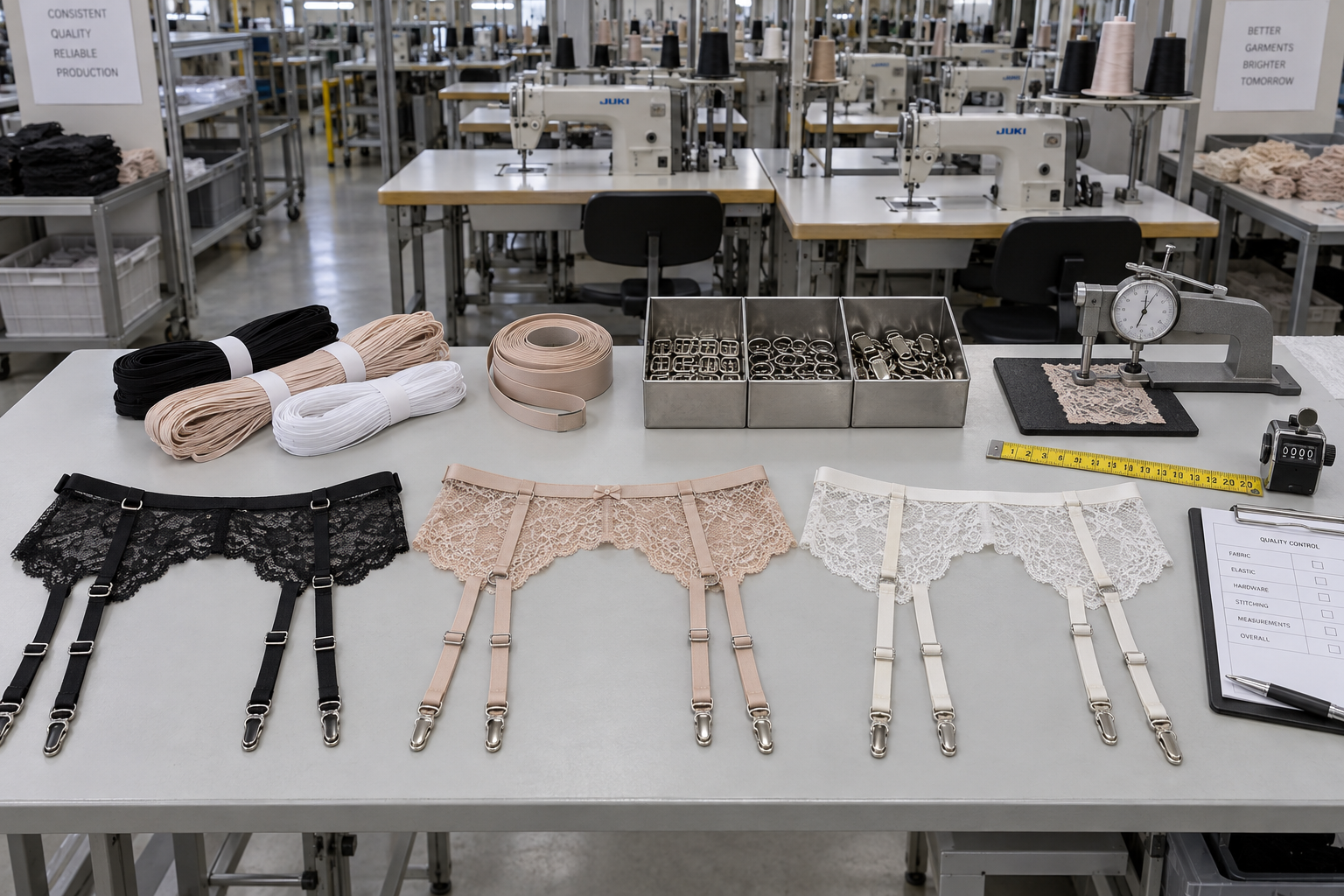
Garter Set OEM Production Scalability Planning for Canadian Buyers
Vincent Xi, Editorial Author https://velora-intimates.com/authors/vincent-xi/
For intimate apparel brands in Canada, garter set OEM production scalability planning is a capacity-commitment process that must be verified before signing bulk purchase orders. A factory can reliably scale a garter set order only when available standard minutes—calculated with an empirical operational buffer—exceed the total standard allowed minutes required by the garment design, and when every fabric, elastic, hardware, and trim component is aligned on an active critical path. Quantity commitments without verified line minutes do not guarantee capacity. Canadian procurement teams should require manufacturers to present audited line minutes, style complexity breakdowns, material readiness dates, and a time-and-action schedule mapped to the contracted delivery window before authorizing production volume.
This article does not document an on-site factory inspection, timed sewing study, proprietary testing protocol, quality certification, or client outcome on behalf of Velora Intimates. Planning ratios and operational frameworks cited below originate from published garment manufacturing authorities or serve as baseline calculation models to be replaced with verified supplier quotes. No first-person factory production experience is claimed.
Production Scalability Planning for Garter Set Lines in Canada
Production scalability planning defines the maximum output volume an approved garter set style can achieve without creating bottleneck operations or exceeding assigned line capacity. In this manufacturing context, successful scale-up requires translating an approved sample into a controlled operational sequence that the facility can cut, sew, inspect, and pack within commercial tolerances.
Canadian procurement specialists must lock three structural variables before evaluating production quotes:
- Demand in Standard Minutes: Style quantity multiplied by the standard allowed minutes (SAM) per unit. This must encompass detailed handling times for adjustable elastic straps, slider and ring threading, hook-and-eye attachments, and lace-edge joins, verified through an engineering time study rather than historical category averages.
- Available Standard Minutes: Factory capacity derived using the established industry formula: machines × operators × working hours × efficiency, balanced against demand in standard minutes so that production schedules reflect achievable line output (Coats Digital).
- Critical Path Routing: Operational sequencing where style complexity, machinery allocation, and labor efficiency are matched with component delivery dates to generate achievable daily floor targets (IBOS).
Scaling failures occur when buyers increase order volumes without verifying these inputs. Adding units to a commercial invoice does not generate machine hours. Seasonal color additions create changeover losses that standard replenishment runs do not encounter. Buyers in Canada can protect supply predictability by confirming that all volume expansions fit buffered line allocations and component delivery schedules.
Convert Garter Set Orders into Standard Minutes
Reliable manufacturing capacity calculations depend on standard allowed minutes rather than aggregate piece counts. Coats Digital specifies available production minutes as the product of machines, active operators, shift hours, and measured operator efficiency, against which order demand is measured in standard minutes (Coats Digital). Industry data indicates that apparel manufacturers commonly plan line allocations at 80% to 90% of theoretical capacity to absorb operational friction. The unit of measure is percent of theoretical capacity; the operational scope reflects garment manufacturing facilities under the conditions cited by Coats Digital; the context is an undated source publication; and the metrics represent general sector practices rather than Velora Intimates operations.
Procurement teams should treat this 80% to 90% range as an audit question during vendor quoting to establish the actual efficiency targets applied to intricate intimates:
- Example Baseline Assumptions (to verify against factory quote): One designated assembly line, 18 operators present, 8 working hours per shift, 60 minutes per hour, and an operating line efficiency of 70%.
- Example Available Output: 18 operators × 8 hours × 60 minutes × 0.70 efficiency = 6,048 standard minutes per line per day.
- Example Garment Demand (to verify against sample time study): An approved 4-strap lace garter set engineered at 12.0 standard allowed minutes per unit.
- Example Production Load (2,000 units): 2,000 units × 12.0 SAM = 24,000 total required standard minutes.
- Example Sewing Line-Days Required: 24,000 required minutes ÷ 6,048 available minutes/day = approximately 3.97 line-days (excluding pilot cut and final packing buffers).
Planning at 100% theoretical capacity leaves zero margin for operator absenteeism, machine downtime, or component feed delays (Coats Digital). A garter set featuring multiple narrow elastic attachments, delicate stretch mesh, and metal hardware requires more handling minutes than standard waistbands. IBOS identifies style complexity as an essential modifier alongside operator skill and line configuration (IBOS). Any technical modification introduced between pre-production approval and bulk cutting requires a recalculation of line-day commitments.
Load Garter Set Manufacturing Only After the Critical Path Is Real
IBOS outlines a structured operational sequence for garment manufacturing: style review and order volume analysis, capacity and machinery validation, fabric and trim readiness verification, critical path development, line loading, and daily tracking of output, work-in-process (WIP), and rework rates (IBOS).
For garter set manufacturing, material staging represents the most frequent cause of production delay. A complete set relies on multiple independent supply streams: stretch mesh or lace base fabric, picot elastic, plush strapping, coated metal sliders, rings, garter clips, hook-and-eye tape, and packaging materials. A sewing line staffed with 18 operators cannot commence efficient assembly if sliders or elastic trims are delayed. The time-and-action calendar must confirm receipt dates for every bill of materials (BOM) item prior to line allocation.
Tracking daily output against work-in-process and rework units ensures operational control during the manufacturing run (IBOS). When completed units lag daily projections, work-in-process builds up at manual assembly stations—such as strap threading or clip attachment—or defective joins require rework. Buyers should monitor initial production runs to ensure that scrap and rework do not exhaust planned line buffers before releasing replenishment batches.
Neither minimum order quantities (MOQs) nor base lead times are mandated by universal industry standards. Commercial terms depend on production line configurations, raw material lead times, and verified assembly minutes. A shorter quoted delivery schedule is only reliable if material arrival dates leave sufficient net line-days to complete sewing and quality inspection.
Separate Core Replenishment from Seasonal Capsules
Production literature demonstrates the operational benefit of separating production floors into dual lines: dedicated continuous-flow lines for consistent core inventory and agile modular cells for complex seasonal capsules. This system preserves line momentum on high-volume runs while allowing rapid machine resets on small-batch capsules under uniform quality controls, as documented across a 400-line manufacturing cluster in Shantou (Ladymate).
The 400-line metric represents total regional production lines cited in Ladymate's industrial review; the unit is production lines; the date context is an undated industrial report; and the scope is regional cluster capacity rather than facility assets dedicated to Velora Intimates. It serves as an example of structured industrial capacity segregation.
Canadian brands can apply this separation strategy to their own procurement programs:
- Core Continuity Styles: Basic nude and black garter belts with established specifications should be scheduled on dedicated continuous-flow lines to maintain stable line efficiencies.
- Seasonal Capsule Styles: Short-run multi-strap or novelty lace garter sets requiring frequent machine readjustments should be routed to modular cells, with line plans calculated toward the conservative 80% planning ceiling to absorb changeover downtime (Coats Digital).
- Unified Quality Control: Both continuous lines and flexible cells must adhere to identical seam strength, strap tension, and hardware retention tolerances (Ladymate).
Dual-line organization reflects factory production scheduling methodology rather than an accredited quality certification. Buyers must establish technical quality criteria within purchase contracts rather than presuming third-party certification.
Compare Scale-Up Routes Before the Purchase Order
Use this decision framework to evaluate manufacturing capacity before issuing commercial commitments. Replace example figures with values from technical factory audits.
| Decision Focus | Operational Comparison | Required Vendor Evidence | Impact on Scalability |
|---|---|---|---|
| Available Capacity | Theoretical 100% capacity vs. 80–90% buffered planning (Coats Digital benchmark) | Mathematical breakdown (machines × operators × shift hours × efficiency) with stated capacity buffer | Prevents unachievable delivery windows caused by downtime or absenteeism |
| Design Complexity | Simple elastic waist garter vs. multi-strap lace set with companion brief | Engineering SAM breakdown for approved pre-production sample (e.g., 12.0 SAM baseline) | Determines total required standard minutes and line-day commitments |
| Line Allocation | Single shared assembly line vs. separate continuous core line and modular capsule cell (Ladymate model) | Assigned line designation, operator headcount, and cell configuration | Eliminates changeover delays on core replenishment runs |
| Material Readiness | Scheduling assembly based on labor availability vs. verified receipt of all BOM materials (IBOS model) | Time-and-action calendar showing locked delivery dates for fabric, elastic, and hardware | Prevents line stoppages and unbalanced work-in-process buildup |
| In-Line Monitoring | Final inspection counts vs. daily tracking of output, WIP, and rework (IBOS control) | Daily floor reporting of completed units, staged WIP, and seam rework counts | Identifies assembly bottlenecks before production buffers are exhausted |
| Order Authorization | Speculative volume release vs. commitment tied to verified standard minutes | Formal quotation stating capacity dates, shift hours, and audited SAM calculations | Anchors delivery commitments to demonstrated manufacturing throughput |
RFQ Checklist
- Ask the supplier to quote available line minutes using the formula (machines × operators × shift hours × efficiency), including the specific capacity planning buffer applied to intimates.
- Require the manufacturer to provide an engineered standard allowed minute (SAM) breakdown for the approved garter set sample, itemizing times for strap stitching, slider attachment, and lace joins.
- Specify whether the purchase order represents a recurring core continuity style or a seasonal capsule run, and ask the supplier to confirm line assignment accordingly.
- Require the manufacturer to supply a time-and-action critical path verifying delivery and quality approval dates for all fabrics, elastics, rings, sliders, and clips prior to sewing start.
- Ask the supplier to detail in-line monitoring procedures for daily output, work-in-process levels, and rework tracking across high-precision assembly points.
- Specify total order volume alongside calculated total standard minutes, requiring the vendor to calculate net line-days before and after operational efficiency buffers.
- Require the manufacturer to confirm the ex-factory date only after material readiness dates and line-minute allocations are fully reconciled.
- Ask the supplier to structure pilot cutting, inline sampling, and bulk production as sequential milestones on the critical path to prevent premature full-scale loading.
How These Planning Figures Were Derived, and What to Verify
This analysis synthesizes three operational manufacturing sources. Coats Digital outlines standard garment capacity calculation formulas and the practice of booking production lines at 80% to 90% of theoretical capacity to account for operational variables. The unit of measurement is percent of theoretical capacity, derived from garment factory studies in an undated reference source. IBOS establishes the sequencing methodology: style complexity review, capacity verification, BOM readiness gating, critical path development, and real-time monitoring of daily output, WIP, and rework. Ladymate provides the dual-line scheduling model separating continuous flow lines from modular short-run cells, referencing regional cluster capacity of 400 lines across Shantou intimates operations. The unit is production lines, sourced from an undated sector study. These sources provide manufacturing methodology; they do not represent consumer search metrics, keyword performance, or commercial market estimates.
The calculation figures—6,048 standard minutes per line per day, 12.0 SAM per garment, 2,000 units per order, 24,000 total demand minutes, and approximately 3.97 line-days—are illustrative assumptions for buyers to verify against vendor-specific time studies, active line staffing, and plant efficiencies. Import duties, transpacific ocean freight, Canadian port handling, and bilingual labeling requirements under the Canada Textile Labelling Act must be quoted separately by supply chain partners, as they are outside the manufacturing datasets cited here.
Planning limits must be recognized: the 80% to 90% planning benchmark and regional line totals reflect published case references, not proprietary factory audits or operational guarantees for Velora Intimates. Dual-line scheduling and standard minute controls are operational practices, not accredited management certifications. Buyers must verify lead times, order minimums, unit pricing, and efficiency metrics on the supplier's formal quotation. Any design adjustment made to pre-production samples requires a revised standard minute calculation before bulk cutting begins.
Vincent Xi, Editorial Author, is the bylined author of this article (https://velora-intimates.com/authors/vincent-xi/). In accordance with verified author records, no personal factory ownership, on-site testing, or direct production outcomes are claimed.
Discuss Your Requirements
Review our manufacturing capabilities, then share your specifications for a supplier-fit review.