Corset OEM Material Options for United States Buyers
By Vincent Xi | Editorial Author
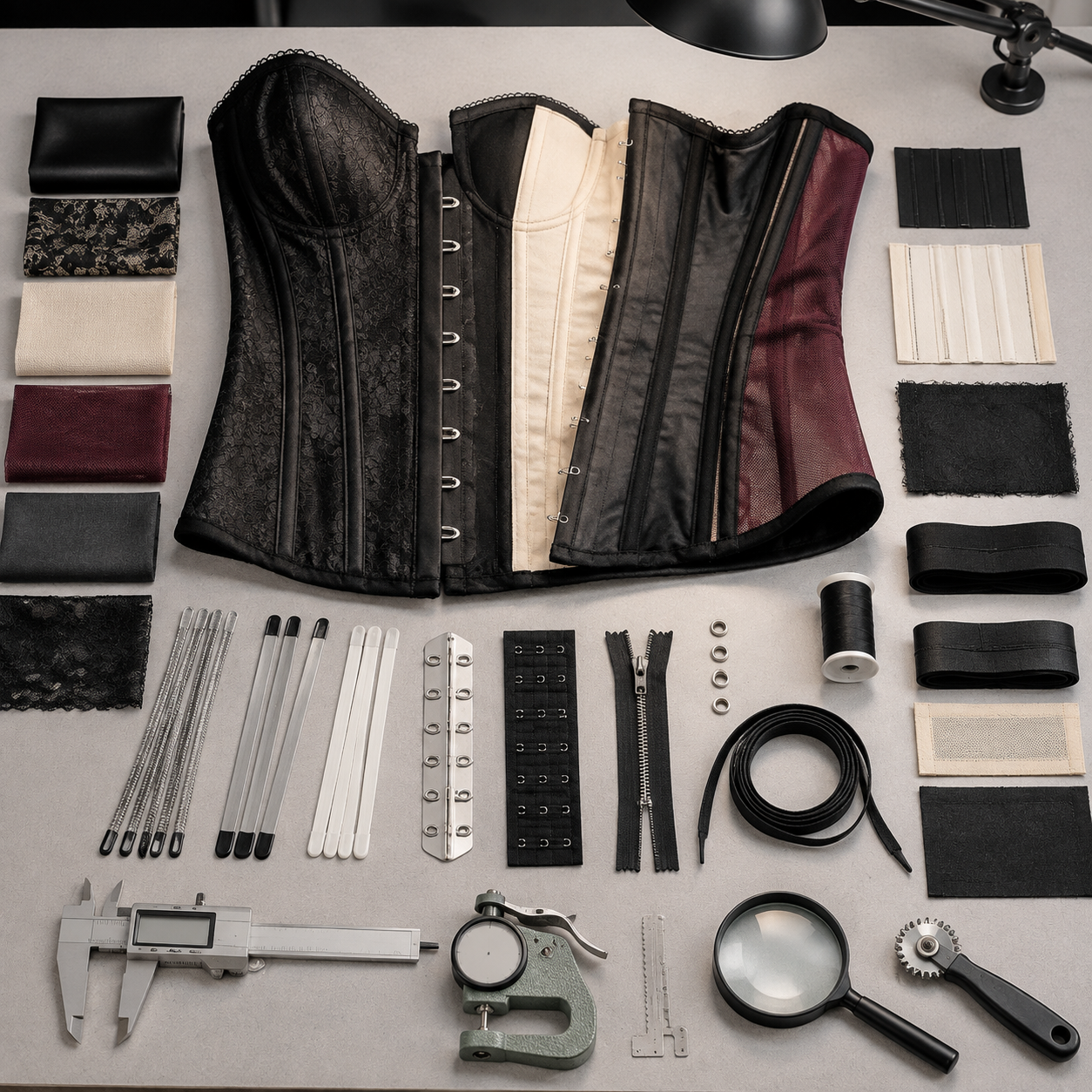
For United States buyers comparing corset OEM material options, the manufacturing RFQ should define the complete material architecture, not only the visible shell. A comparable corset bustier quote identifies the shell, stable layer, lining, stretch panels, overlays, reinforcement, thread, boning, closures, and edge finishes. It also states which substitutions are prohibited, what evidence must accompany a proposed change, and who may approve it.
Treat satin, brocade, mesh, coutil-type fabrics, lace, and boning as option categories rather than finished specifications. Each selected component needs a controlled code, composition, construction, dimensions, finish, color, intended function, test scope, and approval specimen.
A commercial corset-sourcing article discusses mesh, brocade, silk, cotton coutil, and boning as sourcing categories. It can inform an initial shortlist, but it does not establish buyer-specific specifications, performance limits, or supplier capability (WholesaleNext).
Material options for corset bustier manufacturing
The following are buyer-defined RFQ controls. They are not claims about a particular supplier, factory, or finished product.
| Material decision | Quote-ready definition | Evidence before approval |
|---|---|---|
| Appearance shell, including satin or brocade options | Component code, generic fiber composition, construction, mass per unit area, usable width, color reference, finish, direction, care route, panel locations, and structural role, if any | Dated specification, physical swatch, color approval, seam trial, care-test specimen, and production-intent article or lot reference |
| Stable woven layer, including coutil-type or twill options | Component code, composition, weave, mass per unit area, usable width, grain direction, dimensional-change requirement, relevant seam or strength property, panel map, and preshrinking status | Specification for the proposed article, applicable test results, layered panel trial, measured approval sample, and bulk-lot identity |
| Stretch panel, including power-mesh options | Component code, composition, construction, usable width, stretch direction, elongation condition, applied force or target extension, dwell condition, recovery interval, heat sensitivity, color, and panel locations | Direction-marked swatch, dated elongation and recovery results, seam trial, fit sample, and color-lot approval |
| Lining, including tricot, jersey, or woven options | Component code, composition, construction, stretch direction, skin-contact scope, dimensional-change and colorfastness requirements, seam compatibility, color, and care route | Lined panel sample, applicable reports, care-test specimen, and production-intent swatch |
| Lace or embroidered overlay | Ground and embroidery composition, motif repeat, placement, usable width, cutting direction, edge treatment, lot-matching rule, permitted defects, and proposed fiber-label treatment | Approved swatch or strike-off, placement map, cutting trial, shade review, sealed sample, and documented label review |
| Boning, including spiral steel, flat steel, or polymer options | Component code, base material, coating, profile, end finish, flex direction, channel assignment, orientation, care exposure, tolerance, and deformation decision rule | Component specification, dimensional inspection, channel trial, protected-end review, post-care comparison, and production-intent sample |
| Busk, hook-and-eye tape, zipper, eyelets, or lacing | Base material, coating or plating, dimensions, color, edge finish, attachment method, operating criterion, reinforcement, skin-contact status, and care exposure | Hardware card, material declaration, attachment trial, operation result, relevant care or corrosion evidence, and approved sample |
| Thread, binding, channel tape, fusible, or reinforcement | Composition, commercial size reference, color, stitch or bonding conditions, placement, compatibility requirements, prohibited substitutions, and approval authority | Controlled trim card, seam or bonding trial, care-test specimen, final bill of materials, and written exception record |
A generic material name cannot control a purchase order. Assign every component a unique bill-of-materials code linked to its proposed source, construction, dimensions, finish, color, evidence, approved sample, and revision status.
A change in mill, component supplier, fiber composition, construction, finish, coating, color process, or material code should trigger a substitution request. Before purchase or cutting, require the replacement specification, physical swatch, comparison evidence, affected tests, labeling effect, cost effect, delivery effect, and written buyer disposition.
Turn material options into quote-ready specifications
An acceptance field should identify the property, unit, specimen scope, conditioning or care procedure, method, tolerance, and decision rule. Stretch requirements also need a direction, applied force or controlled extension, dwell condition, recovery interval, and residual-extension rule. An assembled-panel requirement should identify every included layer, seam, channel, and reinforcement.
| Property | Define in the RFQ | Require in the evidence |
|---|---|---|
| Fiber composition | Generic fiber names, percentages, and the component or label scope to which they apply | Supplier declaration and supporting documentation appropriate to the buyer's label-review process |
| Mass, width, and thickness | Unit, conditioning, usable-edge rule, test pressure where relevant, tolerance, and method | Dated result tied to the component code, construction, color, and proposed article or lot |
| Elongation and recovery | Direction, force or controlled extension, dwell condition, recovery interval, result unit, and residual-extension limit | Direction-marked specimens and dated results for the proposed material |
| Dimensional change | Fabric direction, complete care procedure, conditioning, result unit, and acceptance rule | Pre-care and post-care measurements with specimen identity, method, and deviations |
| Seam performance | Layer stack, seam construction, stitch and thread scope, loading direction, result unit, and failure mode | Layered seam report or controlled trial using production-intent materials |
| Boning profile | Width, thickness, coating, end treatment, channel assignment, orientation, and tolerance | Component drawing, measured sample, and inspection record |
| Closure operation | Attachment construction, operating procedure, conditioning or care exposure, failure definition, and acceptance rule | Production-intent attachment trial with recorded results and failure observations |
The entries below are buyer-authored example assumptions. They are formatting examples, not recommended thresholds, source-derived benchmarks, or supplier-performance claims.
| RFQ field | Buyer-authored example assumption | Scope, date, source, and verification control |
|---|---|---|
| Stable-layer mass | 250 g/m2 nominal with a tolerance of +/- 5% | Example assumption for one coded stable woven article and specified color, as of the style's RFQ issue date. No cited source supplies this value. Verify it in the supplier's dated quote, material specification, named method, and bulk-lot inspection before release. |
| Boning profile | 6.0 mm wide by 0.8 mm thick | Example assumption for one boning code and its assigned channels, as of the style's RFQ issue date. No cited source supplies these values. Verify them in the supplier's dated quote, component drawing, tolerance statement, and measured approval sample before release. |
| Shell usable width | 145.0 cm minimum usable width after excluding defined unusable edges | Example assumption for one coded shell article and color, as of the style's RFQ issue date. No cited source supplies this value. Verify it in the supplier's dated quote, width definition, proposed material specification, and incoming-measurement procedure before release. |
| Composite dimensional change | 3.0% maximum in either fabric direction after 5 complete care cycles | Example assumption for the specified shell, stable layer, and lining composite under one buyer-approved care procedure, as of the sample-approval date. No cited source supplies these values. Verify them in the supplier's dated quote and a report naming the method, specimen, conditioning, care procedure, and production-intent material codes before release. |
Do not transfer these example values into a technical pack or purchase order as defaults. The buyer should set limits for the actual material system, pattern, intended use, applicable obligations, risk assessment, supplier evidence, and approved production-intent sample.
Approval evidence should identify the method and edition, test location, specimen conditioning, test date, component code, construction, color or lot, measured result, acceptance limit, and deviations. A pass statement without that scope does not show that the result covers the quoted material or assembled corset bustier.
United States material labeling and compliance controls
United States label review should start with the controlled bill of materials rather than a supplier's shorthand description. The Federal Trade Commission's textile-labeling guidance discusses fiber-content, country-of-origin, and responsible-business identification disclosures, along with applicability and exceptions for covered textile and wool products. The buyer should determine the correct treatment for the actual corset bustier using the current official guidance (FTC textile-labeling guidance).
The FTC's care-label guidance addresses care instructions for covered garments and the need for a reasonable basis for those instructions. Review the proposed care route against the complete production-intent assembly, including the shell, stable layer, lining, overlays, thread, coatings, boning, closures, and applied trims (FTC care-label guidance).
The Consumer Product Safety Commission's clothing guidance provides federal clothing-textile flammability context and business guidance on applicability. Confirm the scope for the actual garment and obtain evidence tied to its production-intent materials and construction (CPSC clothing guidance).
| Decision area | Source-backed basis | Buyer release control |
|---|---|---|
| Fiber, origin, and responsible-party labeling | FTC textile-labeling guidance for covered products | Reconcile the final label file to the approved bill of materials, manufacturing-origin facts, responsible-party decision, and documented applicability review |
| Care instructions | FTC care-label guidance | Approve wording only after reviewing the evidence for the complete production-intent assembly and intended care procedure |
| Clothing-textile flammability | CPSC clothing guidance | Record the applicability decision and retain evidence identifying the garment construction, material codes, test basis, date, and covered specimen or lot |
| Certification or compliance representation | The cited editorial sources establish no certification for a material, product, supplier, or production site | Require the current document, issuer, scope, validity, evidence basis, exclusions, and confirmation that it covers the quoted article and production location |
| Customs inputs | This article supplies no tariff classification, duty rate, or origin determination | Give a qualified customs reviewer the finished composition, construction, manufacturing-origin, value, and shipment facts for the actual import plan |
A supplier's internal screening test or a buyer's inspection protocol is a company practice. It does not replace an applicable legal requirement and does not, by itself, establish certification.
Do not release final labels from a questionnaire response, mill shorthand, or commercial invoice description alone. Reconcile the approved label file to the final bill of materials, documented origin analysis, care basis, and production sample. Any material substitution that changes those inputs should reopen label review.
Landed-cost controls for United States material decisions
Use the same cost boundary when comparing material options and supplier quotes. The following is a buyer worksheet structure, not a tariff, accounting, or supplier-performance claim:
Comparable landed unit cost = quoted garment cost + packaging + origin handling + international freight + insurance + duty and applicable import fees + brokerage + inspection + domestic delivery + financing or inventory cost
Require each quote to state:
- The style, color, size range, and quoted quantity covered by the garment price.
- The bill-of-materials revision used for costing and whether any component remains provisional.
- Material consumption units and the treatment of cutting waste, directional goods, motif placement, matching, and unusable width.
- Material and color minimums, reservation conditions, excess-material ownership, storage terms, and cancellation exposure.
- Separate charges for sampling, pattern work, tooling, testing, inspection, labels, packaging, and material development.
- Currency, unit basis, trade term, named place, payment assumptions, quote validity, and included or excluded logistics costs.
- Packed garment quantity, carton dimensions, net mass, gross mass, and packaging configuration used for freight planning.
- Surcharge triggers, required supporting evidence, and buyer approval authority for a price change.
Keep duty, import-fee, and freight estimates separate from the supplier's base garment price until the actual customs treatment, shipment mode, packed measurements, route, and planned import date have been reviewed. An uncited market average is not a substitute for a supplier quote, freight offer, or customs determination.
A commercial fabric-sourcing overview connects fabric decisions with cost, minimums, compliance, and lead-time considerations. It supports those RFQ control categories only; it does not provide a corset bustier price benchmark, minimum-order benchmark, delivery commitment, or proof of supplier capability (World Collective).
Delivery controls for the selected material options
Request a dated schedule that separates material approval, reservation or production, color approval, material testing, garment sampling, preproduction approval, bulk manufacturing, inspection, shipment handoff, and transit. Each quoted duration should use calendar days and identify its start event, responsible party, dependencies, and completion evidence.
For every material code, require the supplier to state whether the component is stock-supported, made to order, custom colored, reserved against payment, or dependent on another component source. The response should include the availability date, reservation expiry, minimum commitment, quote-validity condition, and schedule consequence of a late buyer approval.
A schedule described only as starting after approval is incomplete. The controlling event might be approval of a color standard, test report, label file, sealed sample, material payment, or another documented item. The purchase order should define how a failed test, unavailable lot, late approval, or substitution request affects the committed shipment date.
| Material schedule risk | Evidence to request | Purchase-order control |
|---|---|---|
| Quoted material is not reserved | Written availability and reservation conditions by component code | State when reservation must occur and how approved cancellation or expiry costs are handled |
| Custom color is on the critical path | Dated development schedule and approval dependencies | Define approval authority, response window, rejection record, and schedule-change process |
| Test evidence is pending | Test plan naming specimen identity, method, location, start event, and report due date | Make release conditional on acceptable evidence or documented buyer disposition |
| A substitute is proposed | Replacement specification, swatch, comparison evidence, cost effect, and delivery effect | Prohibit purchase and cutting until written change approval is recorded |
| Material will arrive in separate lots | Lot list, shade-control method, allocation plan, and incoming records | Define segregation, matching, traceability, and disposition before bulk cutting |
Material approval gates before purchase and cutting
Material review: Require coded swatches, component specifications, composition declarations, proposed care instructions, available reports, and a written deviation list. Record each item as approved, conditionally approved, rejected, or open.
Development sample: Review how the selected layers, seams, channels, bone ends, closures, reinforcement, lining, and edge finishes correspond to the current technical pack. Record accepted changes by revision rather than relying on informal messages.
Preproduction approval: Seal a sample made with production-intent materials. Link it to the final bill of materials, measurement chart, color references, label files, packaging specification, test plan, approved deviations, and material-lot status.
Bulk material control: Before cutting, verify component identity, source reference, color, lot, usable width, and other buyer-defined incoming properties. Segregate unapproved or rejected material and record its disposition.
Finished-garment control: Verify component placement, channel and closure construction, seam and stitch condition, bone-end protection, symmetry, labels, packing, measurements, and workmanship under the purchase order's inspection rules.
Approval of a swatch does not approve an unreviewed substitute or later lot. Approval of an individual component also does not establish the performance, care response, labeling status, or compliance of the assembled corset bustier.
RFQ release checklist for corset bustier manufacturing
- [ ] State the adult fashion use, fit intent, shaping target, wearing context, skin-contact areas, intended care route, and prohibited medical or protective claims.
- [ ] Attach the current technical drawing, panel map, construction details, measurement chart, and revision date.
- [ ] Identify the intended function of every shell, stable layer, stretch panel, lining, overlay, reinforcement, boning component, closure, and trim.
- [ ] Assign a controlled code to each material and hardware component.
- [ ] Define textile composition, construction, mass per unit area, usable width, finish, color reference, direction, panel location, and care route.
- [ ] Define boning and hardware base material, coating, profile, end finish, placement, attachment, tolerance, operation rule, and care exposure.
- [ ] State relevant test properties, methods, specimen scope, units, tolerances, and decision rules.
- [ ] Request composition and manufacturing-origin inputs suitable for the United States buyer's label and customs reviews.
- [ ] Require current supporting documents before accepting any certification or compliance representation.
- [ ] Prohibit changes to the material source, composition, construction, finish, color process, coating, or component code without written approval.
- [ ] Compare garment price, material minimums, development charges, testing, packaging, logistics inputs, and surcharge conditions on the same basis.
- [ ] Request material and garment schedules in calendar days with dated start events, dependencies, and reservation conditions.
- [ ] Define sample stages, approval authority, sealed-sample status, retest triggers, bulk inspection rules, and disposition authority.
- [ ] Make the purchase order reference the final technical pack, bill of materials, test plan, label files, packaging specification, approved deviations, and sealed sample.
Methodology, source context, and limitations
The editorial method grouped the corset bustier bill of materials by appearance, stable, stretch, lining, overlay, structural, closure, and assembly functions. Each function was then translated into fields that can be quoted, documented, tested, sampled, inspected, or placed behind a buyer approval gate. Regulatory statements were limited to the subjects described by the cited official guidance. Commercial sources were used only for sourcing context, not as independent performance evidence.
The numerical entries are explicitly labeled buyer-authored example assumptions. They were not derived from the cited sources and do not represent supplier results, market benchmarks, or recommended acceptance limits.
| Source | Use in this article | What the source does not establish here |
|---|---|---|
| Vincent Xi author profile | Vincent Xi's identity and Editorial Author role | Factory experience, laboratory work, product use, sourcing outcomes, certifications, or supplier capabilities |
| WholesaleNext corset-sourcing article | Commercial context for an initial corset material and boning shortlist | Independent test results, buyer-specific limits, or performance of the quoted style |
| World Collective fabric-sourcing article | Commercial context linking material selection with cost, minimums, compliance, and lead-time considerations | Price or minimum-order benchmarks, delivery commitments, or supplier capability |
| FTC textile-labeling guidance | Official United States guidance on textile-labeling applicability and disclosures | A completed applicability analysis or approved label for the buyer's garment |
| FTC care-label guidance | Official United States guidance concerning care instructions and their basis | Evidence that a proposed care route is suitable for the production-intent assembly |
| CPSC clothing guidance | Official United States clothing-textile flammability context | A style-specific scope decision, test result, certificate, or production-lot determination |
Author basis: The cited profile identifies Vincent Xi as Editorial Author. It does not document factory visits, laboratory testing, sourcing outcomes, product use, or customer results. Those claims are omitted, and no first-person experience claim is made.
No style-specific supplier quotation, factory audit, laboratory report, customs determination, certification, production schedule, material reservation, or production sample was supplied as evidence for this article. Before award, the United States buyer should verify material identity, specifications, methods, tolerances, assembled performance, label wording, regulatory applicability, customs treatment, document validity, supplier capacity, landed-cost inputs, and delivery commitments for the actual style and planned import date. Evidence for a different component code, construction, color, finish, supplier, production location, specimen, or lot should not be assumed to cover the quoted corset bustier.
Discuss Your Requirements
Review our manufacturing capabilities, then share your specifications for a supplier-fit review.