Corset OEM Digital Integration Readiness for European Corset Bustier Manufacturing
Written by Vincent Xi, Editorial Author, Velora Intimates. Author profile: https://velora-intimates.com/authors/vincent-xi/. This page attributes published OEM and industry descriptions only. It does not claim factory visits, laboratory tests, client engagements, awards, certifications, or first-person production experience.
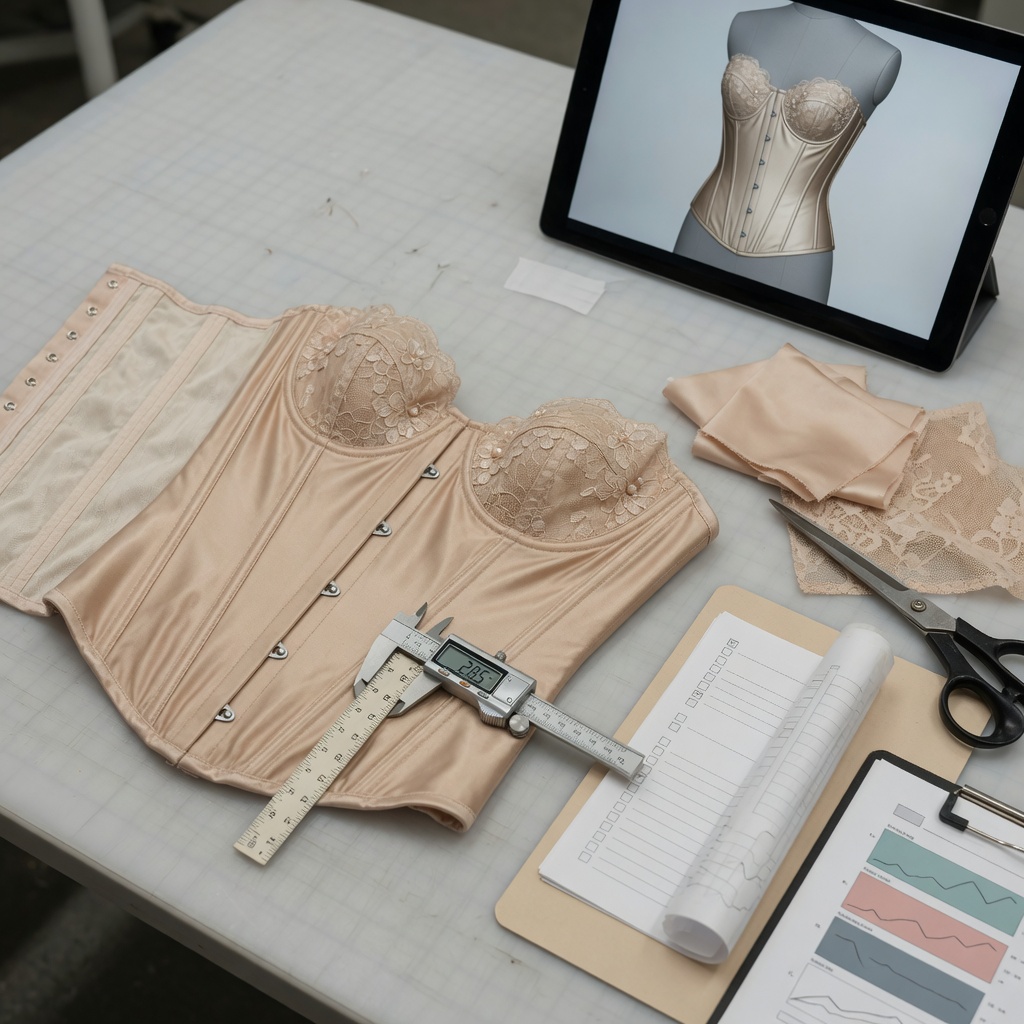
European buyers should treat corset OEM digital integration readiness as an award gate for corset bustier manufacturing, not as a brochure extra. Before bulk is approved, require four file-and-data proofs: (1) a named 3D CAD or digital pattern system plus a comparable-style file the buyer can open; (2) a structured digital tech pack covering pattern, 3D form, and a BOM for boning, busk, grommets and cup construction; (3) a data-flow diagram and a redacted cutting, sewing or inspection export the buyer’s ERP or PLM can parse; and (4) evidence of MES, IoT or coded end-line inspection on the line that would sew this order. A physical sample is not a substitute for those files.
Go if a comparable 3D file opens, the graded nest matches the stated EU, EEA or UK size matrix in the RFQ, a sample production file maps to the buyer’s fields, and a live or dated line demo shows coded defects such as channel twist, cup mismatch or hardware failure. No-go if markers are still drawn by hand, the OEM can only email unstructured spreadsheets with no test file, “Industry 4.0” is a future plan rather than a live point on this line, or a single data-protection clause is written for “Europe” as if GDPR (EU/EEA) and UK GDPR were the same. File-based sampling can cut failed-sample freight into a named EU, EEA or UK destination; it does not replace fit, hardware function or hand-feel. Price IT mapping, NDA discipline, and jurisdiction-specific privacy review in the quote before comparing cut-make rates.
What digital integration readiness covers in corset bustier manufacturing
For this product, readiness is not ownership of a CAD seat. It is the ability to hold a 3D engineered object as data: cup volume, underbust grip, boning channels that must not twist, layered power mesh and satin, and hardware that has to survive repeated fastening. A ready OEM can carry that definition from first pattern through cutting, sewing, inspection and, where the buyer requires it, structured compliance records. An OEM that is not ready may still sew samples, but each change (a new cup, a different bone count, a destination-specific size run) restarts physical trial-and-error.
Four layers have to connect. Authoring means 3D CAD or equivalent digital pattern-making that can output nested markers and a tech pack. Execution means cutting and sewing stations that consume those files rather than reinterpreting paper. Capture means inspection and production counts that are timestamped and coded, not only written on a ticket. Exchange means a defined way to send the buyer a tech pack, a 3D asset, and later a production or quality file that their PLM or ERP can parse.
Industry articles from OEM and factory sources describe combinations of 3D shaping, digital patterns, ERP-connected cutting and sewing data, Gemini CAD, IoT-plus-MES, and planned Industry 4.0 monitoring (S-SHAPER OEM corset description, Starwin on AI and digital design, Abhinandan Creation on real-time monitoring). Those pages are self-reported snapshots. They are starting points for RFQ questions, not certificates, not independent audits, and not Velora Intimates capabilities. Naming those publishers is a manufacturing-origin evidence reference only; it is not a sales-market invitation.
The trade-off is repeatability versus setup cost and data risk. A partner that can hold the product as data can iterate a corset bustier silhouette in file form before cutting fashion fabric and steel bones; require dated project evidence rather than assuming this will happen. The buyer pays in IT time (API or file-mapping work), tighter NDAs, and the discipline of one product definition. A lower cut-make price can be offset by extra calendar time and sample freight into the named European destination if each cup or waist-spring change restarts a physical round. Split the quote into digital-asset, physical-sample and bulk lines so that trade-off is visible.
3D CAD and digital pattern files for a structured corset bustier
Ask every shortlisted OEM which systems they use for pattern, grading and 3D, which file types they can send, and whether hardware and multi-layer construction exist inside the model or only as notes. One published OEM account of corset work describes advanced 3D shaping technology, tech packs that include size charts, fabric specs and stitching details, and 48-hour rapid prototyping from MOQs of 50 pieces as of the article dated 23 September 2025 (S-SHAPER). Another manufacturer-facing article describes AI-supported 3D design simulation of fabric behaviour on body shapes together with digital pattern systems, as of 30 October 2025 (Starwin). A third factory account names Gemini CAD for precise lingerie patterns (Abhinandan Creation).
Three concrete data points for the RFQ (not industry averages, not Velora Intimates claims):
- 48-hour prototyping — unit: hours; scope: S-SHAPER published OEM corset account only; as-of: 23 September 2025; source: the S-SHAPER article cited above. Treat as a self-reported figure to re-demonstrate, not as a market SLA.
- MOQ of 50 pieces — unit: pieces; scope and date: same published OEM corset account and date; source: same S-SHAPER article. Confirm whether the figure is sample MOQ, bulk MOQ, or mixed, and whether it applies to a structured corset bustier with busk and bones.
- Example assumption to verify in the supplier quote, not a published factory result: cutting physical sample rounds from four rounds to two rounds for a new corset bustier style — unit: physical sample rounds; scope: buyer-side planning assumption for one new style. Ask for dated project examples, including how many physical iterations were still required for fit and hardware.
Buyer-specified check duration (not a sourced OEM SLA): request a 15-minute screen-share of a comparable style, scheduled for the buyer’s European procurement and quality team. Label that 15-minute window as an RFQ test length, not as published evidence.
Treat published figures as prompts: request current software names and versions, a sample 3D file of a comparable bustier, and the measured fabric properties (stretch, recovery, bending) loaded into any simulation. The model must at least represent cup-to-body contact, channel paths, bone tips, and the difference between rigid satin and elastic panels. If the OEM cannot show a graded nest or a 3D form that includes the busk and bone tips, the virtual prototype will not reduce physical rounds.
Specify file formats the buyer’s team can open (example formats to state in the RFQ, not claimed as this site’s standard: DXF/AAMA or the OEM’s native file plus a 3D viewer file) and a locked PDF or structured tech pack so construction notes cannot drift. Digital grading must support the size set the buyer will sell in the named EU, EEA or UK destinations, including cup and band combinations for those retail charts. Do not assume one European size logic; country conventions and retailer charts differ. Require a graded marker for the actual size range in the RFQ, not a single sample size.
ERP and PLM exchange for cutting, sewing and inspection data
Once the pattern is digital, the next test is whether the factory floor treats it as a work order or as a picture. Published descriptions include automated cutting, sewing and quality data connecting to ERP systems, supporting fewer errors and faster B2B delivery (Starwin), and integration of IoT plus MES with ERP for real-time data (Abhinandan Creation). Ask for a data dictionary, not a slogan.
Minimum fields that matter for a corset bustier work order include style and colourway IDs, size, cut bundle or RFID identity, fabric lot, bone and hardware lots, planned versus actual stitch or operation counts, and coded defects (for example channel twist, cup asymmetry, hardware misalignment). Request a redacted sample export (CSV, XML or JSON) from a recent similar style. Ask whether the interface is a daily file drop, an API, or only a dashboard screenshot. Latency is a specification: daily batch can be enough for some PLM updates; it is not event-level monitoring.
If lot and BOM fields sit in the work order the factory actually uses, a mismatched bone length or mixed fabric lot is easier to catch before a shipment to a named EU, EEA or UK destination is completed. That is only true if cutting consumes the digital nest rather than a paper copy. The same connection creates a larger attack surface and more personal-data questions if operator IDs or customer body measurements travel with the file. In the EU and EEA, GDPR applies to personal data in scope; the UK applies UK GDPR. Those regimes are not interchangeable. Production telemetry is often commercial confidential information even when it is not personal data. Specify roles, retention, encryption in transit, subprocessors, and whether the OEM will sign the buyer’s data-processing terms for the correct jurisdiction. Do not assume an EU processor clause covers a UK-only flow or the reverse. If personal data would leave the EU/EEA or UK, ask counsel about transfer tools before sending body-scan or fit-session files.
If the buyer already runs a PLM, list the objects that must round-trip: BOM, construction, size spec, and later actuals. If the OEM can only email unstructured spreadsheets, score data exchange as manual. Re-keying of colour, size and hardware fields is a defect risk on multi-part intimates.
MES, IoT and coded inspection versus Industry 4.0 plans
The same factory account that names Gemini CAD also describes plans for Industry 4.0 upgrades for production and quality monitoring and digital end-line inspection tools (Abhinandan Creation). Treat “plans” as a different score from “live on the line that will sew this order.” Ask which processes are instrumented today: spreading and cutting, sewing machines, fusing, end-line measurement, or packing. High-value signals for this construction are channel alignment, cup pair matching, bone insertion completeness, and hardware function, not only unit counts.
IoT and MES can surface stoppages and defect spikes while the lot is still in the factory, which is more useful for a European launch calendar than a delayed spreadsheet QC report after goods have shipped. Ask how conflicting counts from ERP, MES and the shop floor are resolved, and who may override a fail. Use the 15-minute screen-share already specified as the live-data test, and add one week of historical defect codes for that cell, redacted as needed. The one-week extract is a buyer-specified evidence window, not a published OEM metric.
Do not confuse a large showroom dashboard with digital integration readiness. The test is whether the buyer can receive an event (for example “bundle 14, size 75C, defect: channel twist”) in a system they control, tied to the same SKU as the digital tech pack. If the OEM offers only a monthly PDF, score it as reporting, not live monitoring.
Scoring digital integration readiness for European corset bustier manufacturing
Use the table to score each OEM on the same scale (0 = not offered, 1 = brochure only, 2 = demo on a similar style, 3 = live on the line that will produce this order, with sample files). The 0–3 scale is an editorial RFQ rubric, not a sourced industry index and not a search or ranking metric. Weight CAD and data exchange higher if the goal is fewer sample rounds into a named EU, EEA or UK destination; weight MES/IoT higher if the goal is in-season visibility for European retail windows. Score only what will be used on this corset bustier programme. A factory that cannot export a bone-level BOM is not ready for a structured bustier even if other programmes run well.
Award path: total weighted score at or above the buyer’s threshold, plus a paid pilot that passes file quality, data-export and physical-fit gates. Hold bulk: any critical row scored 0–1 (CAD file, graded nest for the named size set, parseable production file, or jurisdiction-correct data terms).
| Capability | What to specify in the RFQ | Evidence to request | Measurable trade-off | Europe-specific note |
|---|---|---|---|---|
| 3D CAD / virtual prototype | Named system, file types, fabric property inputs, hardware in model | Sample 3D file of a comparable bustier; graded nest | Fewer physical rounds vs asset-build time and licence limits | Confirm grading for the actual EU/EEA/UK size set, not a single sample size |
| Digital tech pack | Size chart, fabric, stitch, bone/hardware BOM, construction | Editable or structured pack plus locked PDF | Single source of truth vs extra admin | Align measurement points with the buyer’s European retail spec |
| Cutting data to ERP/PLM | Bundle ID, fabric lot, marker version, consumption | Sample cut-order export | Less fabric waste vs IT mapping cost | Lot traceability supports chemical and fibre questions; EU/EEA rules and UK rules can differ |
| Sewing / IoT events | Operation complete, machine ID, exception codes | Live or historical event sample | Faster reaction vs noisy data | Operator IDs may be personal data (GDPR in the EU/EEA; UK GDPR in the UK) |
| Inspection / MES | Coded defects, measurements, pass-fail, photos if used | End-line file plus defect taxonomy | Catch channel/cup issues before ship vs false fails | Measurement method must match the buyer’s incoming QC at the named destination |
| Data interface | API, SFTP, or defined file; latency; ownership | Interface spec and one successful test file | Automation vs security review | Processor terms: do not assume EU clauses cover UK-only flows |
| File IP and revision control | Who owns nests, 3D assets and markers after payment; ECO IDs | Written IP clause plus a revision-naming example | Re-use of digital assets vs lock-in | State governing law the buyer will accept for contracts serving EU, EEA or UK delivery |
| Compliance data capture | Fibre, substances, process records in structured form | Field list the OEM can already export | Future-proofing vs extra data work | Ask counsel about current EU Digital Product Passport status versus UK; do not assume one timeline or that EEA duties match the EU automatically |
| Pilot / bulk gate | One colourway, limited sizes, digital pack plus one physical fit sample | Written acceptance criteria before first bulk PO | Calendar time vs avoided failed bulk | Inspection location and Incoterms for the named EU, EEA or UK destination |
RFQ checklist for European buyers
Copy these items into the RFQ. Each item is there to specify, compare, verify, approve or order.
- Name the CAD, 3D, spreading/cutting and MES/ERP systems in current production use (version and year of last upgrade), not a future roadmap only.
- Attach a digital tech pack template the OEM must complete for the corset bustier: size chart, measurement points, fabric specs, stitch types, bone lengths and types, busk, grommets, cup construction, and packing.
- Require one 3D virtual prototype (or equivalent viewer file) of a comparable structured style plus a statement of which fabric mechanical tests were used in the simulation.
- State the size range and cup/band matrix for the named EU, EEA or UK retail destinations; require a graded marker screenshot or file for that range. Do not accept a single sample size as proof of grading.
- Specify the production-data fields and the transfer method (API, SFTP, format, frequency). Require a redacted sample file from a recent similar style.
- Require a one-page data-flow diagram from pattern release through cutting, sewing, inspection and despatch, showing where the buyer’s PLM/ERP sits and whether any process is subcontracted.
- Ask which IoT or MES points are live today on the line that will sew this order, and request a 15-minute screen-share of live or recent data in a window the buyer’s European team can attend (buyer-specified test length).
- List defect codes the OEM already uses for channel twist, cup mismatch, hardware function and fabric flaws; require mapping to the buyer’s codes.
- State data-protection terms separately: GDPR for EU/EEA personal data, UK GDPR for UK personal data, retention, subprocessors, encryption, and transfer tools if files leave that jurisdiction. Do not use a single “Europe” clause.
- Ask whether fibre, chemical and process data can be exported in structured form to support the buyer’s compliance files; treat labelling, chemical rules (for example EU REACH versus UK REACH; confirm EEA application with counsel) and any digital-passport duties as jurisdiction-specific. This article does not treat those regimes as factory certifications.
- Request dated examples (style, year, number of physical sample rounds still required) for any claim of faster prototyping, including the 48-hour and 50-piece figures if the OEM cites similar performance, and verify against a pilot.
- Define the pilot: one colourway, limited sizes, digital pack plus one physical fit sample, with written acceptance criteria for file quality, measurement tolerances between virtual and physical, and data export before bulk is approved.
- Split the quote: digital prototype and file-mapping hours, physical sample, bulk cut-make, and any MES/API setup. State Incoterms and inspection location for the named European destination.
- State ownership and licence terms for graded nests, 3D assets, markers and tech packs after payment, plus revision/ECO rules so cutting must consume the approved version only.
- Require the OEM to confirm that brochure claims from any 2025 article will be re-demonstrated on current equipment before order, and state whether the buyer will audit systems remotely or on site before the first bulk PO.
Limitations, methodology and what to verify
Methodology: The digital-tool examples in this article are taken from three publicly available manufacturer or industry articles that describe 3D shaping and rapid prototyping, AI-supported 3D simulation and ERP-connected shop-floor data, and Gemini CAD plus IoT/MES and planned Industry 4.0 inspection (S-SHAPER, Starwin, Abhinandan Creation). No independent laboratory test, factory audit or customer file was used. Numbers (48-hour prototyping; MOQ of 50 pieces) are quoted with the unit, the publishing factory’s stated scope, and the article dates given above. The four-to-two sample-round figure is labelled as an example assumption to verify in the supplier quote. The 15-minute live view, one-week defect extract, and 0–3 score scale are buyer-side RFQ controls, not published OEM performance data.
Limitations: Self-reported capabilities can lag or lead actual shop-floor practice. Software licences, API access, and operator skill vary by line and by season. A 3D file that looks correct may still fail on stretch, bone insertion or cup symmetry. GDPR in the EU and EEA is not identical in application to UK GDPR; labelling, chemical rules and any future digital-passport duties also split by jurisdiction and should not be written as one “Europe” rule. This article does not state that any named OEM is certified to a particular standard, and it does not assign those capabilities to Velora Intimates. Buyers must verify current systems with a live demo, a sample data file, and a paid pilot on the actual corset bustier construction.
What to verify before order: current software versions; who in the factory owns the digital product definition; whether cutting actually consumes the nested file; whether inspection codes reach the buyer’s system without re-typing; data-processing terms for the correct jurisdiction (EU/EEA versus UK); IP and revision control on the digital assets; and whether the first bulk PO is gated on a signed digital-and-physical sample approval. If any of those proofs cannot be produced, score digital integration readiness as low and keep extra physical sample rounds and incoming inspection in the plan for European delivery.
Discuss Your Requirements
Review our manufacturing capabilities, then share your specifications for a supplier-fit review.
Sources
- OEM Corset Supplier for Lingerie Startups: How to Launch Your Brand with the Right Manufacturing Partner
- How AI and Digital Design Are Transforming the Lingerie Industry | B2B Custom Lingerie Manufacturer Insights
- Integrating real-time monitoring and lean to enhance lingerie manufacturing: Sarthak Kubadia, MD, Abhinandan Creation