Bodystocking OEM Product Development Capability: Australia RFQ Decisions
By Vincent Xi, Editorial Author.
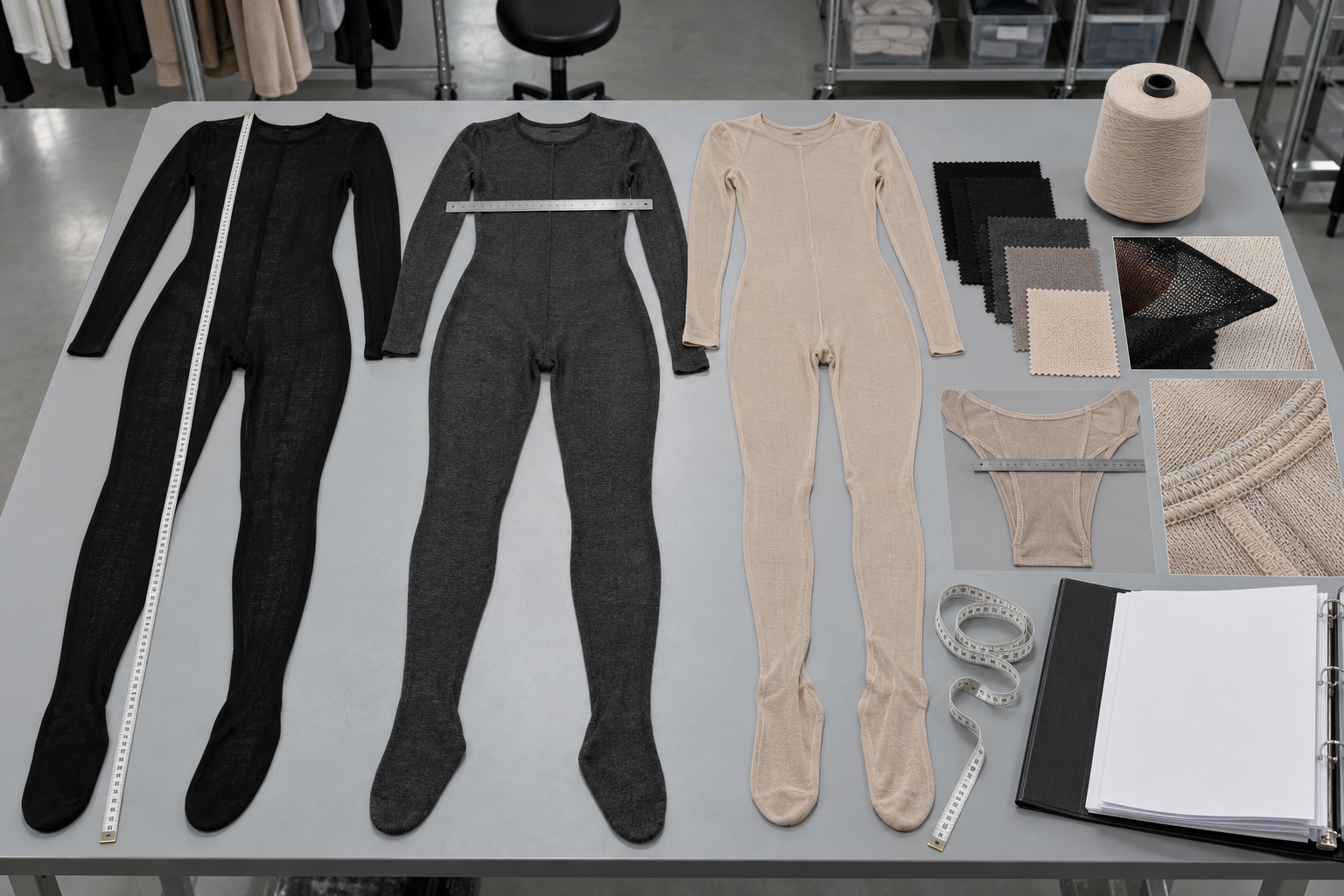
For Australia-based B2B buyers, bodystocking OEM product development capability is a quote-verification question, not a label to accept at face value. The supplied page excerpts give adjacent-scope claims for seamless bodysuits, sexy lingerie, and sexy bodysuits/jumpsuits, but they do not document a bodystocking-specific program or an Australia shipment. That gap does not establish a lack of capability; it sets the RFQ requirement: the bidder must define product scope, tech-pack inputs, sample operations, minimum order quantity, inspection release, and Australia handover terms in writing. Use the published figures below as prompts to verify, not as a substitute for a current bodystocking quote.
Bodystocking OEM product development capability: the Australia RFQ gate
Answer first: Shortlist a bidder only when the written response makes these items comparable:
- Product scope: Identify the exact construction, yarn or fabric, openings if any, size run, grading, trims, and branding included in the offer.
- Development record: State the tech-pack fields received, supplier assumptions, sample version, fit-comment process, clock-start event, and included dispatch.
- Commercial gate: State the minimum order quantity basis, sample price, development or setup charges, sample-cost credit, and quote validity.
- Quality gate: State inspection points, measurement conditions, acceptance criteria, records, release authority, and the action if the approved specification is not met.
- Australia handover: Separate sample dispatch, production, inspection release, handover, and freight or transit to Australia.
An adjacent-category page can frame an RFQ question, but the quote must identify which claims apply to the bodystocking itself.
Published manufacturing evidence for adjacent product scopes
The following source contexts are prompts only. Their product scopes are not interchangeable, and no adjacent-page figure proves a bodystocking-specific program.
- The Shaper Factory seamless-bodysuit OEM guide states that its sample-development stage, covering pattern, knitting, and fit adjustments, takes 10–14 days. The supplied excerpt shows no publication date, so this is an undated page claim for the seamless-bodysuit scope. The same excerpt lists sketches, fabric or yarn specifications, compression zoning, grading, and construction details as tech-pack inputs; use those fields as a source-specific prompt, not a universal bodystocking requirement.
- The Jinfeng Apparel sexy-jumpsuit manufacturer page states sample development of 5–10 days and refers to 7 pattern makers for its sexy-bodysuit and jumpsuit scope. No publication date is visible in the supplied excerpt; both figures are undated page claims for that scope and do not establish a bodystocking sample calendar.
- The Shaper Factory guide states that custom OEM starts at a minimum of 1,000 pieces and that bulk production takes 25–30 days for its seamless-bodysuit scope. The supplied excerpt is undated. These figures do not establish MOQ or production timing for a bodystocking order or transit to Australia.
- The XS Lingerie sexy-lingerie category page states an MOQ of 300–500 pieces, depending on complexity, for its sexy-lingerie OEM/ODM category, including teddies and bodysuits. It also states that sample costs are deducted from qualifying bulk orders and describes customization of fabrics, trims, colors, and branding. No publication date is visible in the supplied excerpt; these are undated category-page claims to verify for the quoted bodystocking scope.
- The Jinfeng Apparel page states an MOQ of 200 pieces and monthly capacity of 300,000 pieces for its sexy-bodysuit and jumpsuit scope and mentions inline quality control. Its supplied excerpt has no publication date. These are undated page claims, not a reserved Australia allocation or an acceptance criterion.
Example calculation—not a measured schedule: If the undated Shaper Factory seamless-bodysuit claims of 10–14 sample-development days and 25–30 bulk-production days were consecutive, the arithmetic span would be 35–44 days. This is an example calculation and assumption to verify in the supplier quote; it excludes additional fit rounds, material wait, sample dispatch, inspection release, and transit to Australia.
| RFQ decision | What the supplied evidence does not establish | Buyer requirement |
|---|---|---|
| Sample calendar | The pages cover different product scopes and do not show included fit rounds or clock-start events. | Require a bodystocking-specific calendar with included operations, exclusions, and the event that starts the clock. |
| MOQ basis | The MOQ statements do not define whether the basis is per style, color, size, or program. | Require the bidder to state the MOQ basis and any development or setup charge. |
| Capacity | A published capacity statement is not an allocation or an open-capacity promise for the Australia order. | Require a program-specific production slot and start condition in writing. |
| Quality | Quality-control wording does not state a certificate, test method, measurement condition, or acceptance rule. | Require inspection points, pass criteria, records, and the fail path. |
| Sample-cost treatment | The deduction statement does not show the qualifying quantity, expiry, or outcome if bulk is not placed. | Require the deduction threshold, expiry, and commercial outcome in the quote. |
This is not a supplier ranking. A shorter sample window, lower MOQ, or larger published capacity is not automatically better if the quoted operations, product scope, or approval conditions differ.
Bodystocking specification and approval gates for Australia buyers
The source material should be translated into a product-specific RFQ, not copied as a generic capability claim. The Shaper Factory list applies to its seamless-bodysuit scope; Jinfeng Apparel’s supplied excerpt mentions tech-pack support without listing fields; XS Lingerie describes customization of fabrics, trims, colors, and branding without establishing a complete bodystocking tech pack.
Translate the product scope into buyer-owned fields:
- Materials: State the yarn or fabric proposal, buyer-supplied material requirements, and approved substitution process.
- Construction: Define openings or gusset details if present, construction features, and the approved reference.
- Fit: State the size run, grading, measurement and tolerance sheet, and sample version.
- Appearance and finish: Define color, opacity or appearance expectations, trims, branding, packaging, and label-file responsibility.
- Development record: List tech-pack inputs, assumptions, sample operations, fit comments, clock-start event, included dispatch, and exclusions.
Tech-pack acceptance. Require the supplier to list every assumption, identify buyer-provided inputs, and obtain written approval for any proposed material, construction, grading, or branding change.
Prototype approval. Approve a named sample version against the agreed measurements, construction details, appearance, and fit comments. Bulk production should be checked against that approved reference.
Bulk release. Put inspection points, measurement conditions, defect disposition, rework or reinspection, and shipment-release authority in the purchase order.
Commercial close. If sample-cost credit is offered, require the quote to state the qualifying order condition, expiry, and outcome if the bulk order is cancelled or not placed.
Australia handover for a bodystocking RFQ
The supplied excerpts do not state Australia-specific labeling, compliance, freight, or transit requirements, and they do not evidence an Australia-bound shipment. Keep those points as verification fields rather than filling them with assumptions from a generic supplier page.
Require the commercial offer to separate sample dispatch, production, inspection release, handover, and transit to Australia. Ask the buyer’s forwarder and compliance adviser which destination requirements apply to the actual yarn or fabric, construction, packaging, and labels. The sources do not set those terms.
If a bidder names a standard, certificate, test method, or label claim, request a current document showing its scope and validity. A supplier’s own quality-control or inline-quality-control wording is a practice statement, not proof of certification, a passed test, or an agreed acceptance rule.
RFQ Checklist
Use this list to force a current Australia quote into a comparable format.
- Ask the supplier to define the bodystocking construction, yarn or fabric proposal, openings, size run, grading, branding, packaging, and label fields covered by the quote.
- Require the manufacturer to map every tech-pack input to buyer-provided, supplier-proposed, or approval-required status, and to flag assumptions before sampling.
- Specify sample operations, fit comments, sample versions, clock-start event, included dispatch, excluded waiting time, and the quoted unit for all timing statements.
- Ask the supplier to state MOQ in pieces and whether it applies per style, color, size, or program, using the quoted bodystocking scope rather than an adjacent-category page.
- Require the manufacturer to separate production days, inspection release, handover, and freight or transit to Australia in the commercial offer.
- Ask the supplier to separate sample cost, unit price, development or program charges, packaging, payment milestones, and quote validity.
- Specify inspection points, measurement conditions, defect disposition, rework or reinspection, and shipment-release authority in the purchase order.
- Ask the supplier to define sample-cost treatment, any bulk-order deduction, qualifying quantity, expiry, and outcome if bulk is not placed.
- Require the manufacturer to provide a current document for any claimed certification, test method, or label or compliance claim, showing scope and validity; do not accept marketing wording alone.
- Specify confidentiality, pattern or design ownership, and any Australia exclusivity in the contract; treat a general privacy statement as insufficient unless the terms are written.
- Require the manufacturer to identify the approved prototype as the measurement master and state which measurements are relaxed or extended, if that is part of the product specification.
Methodology and limitations
Methodology. The edit uses the linked statements from the Shaper Factory, XS Lingerie, and Jinfeng Apparel pages as separate evidence contexts. It transcribes only claims stated in the supplied excerpts, keeps each figure with its unit, cited product scope, and undated-page status, and maps those statements to buyer verification questions. The schedule arithmetic above is explicitly an example based on a consecutive-stage assumption; it is not a measured schedule or supplier commitment.
Limitations. The supplied evidence does not document a bodystocking-specific program, an Australia-bound shipment, prices, named customers, wear-test results, acceptance criteria, certificates, or test methods. Published timing, MOQ, capacity, customization, and quality-control statements may change; verify current terms and supporting records in the supplier quotation before approving a sample or releasing an order.
Author basis. The Vincent Xi author profile identifies Vincent Xi as Editorial Author. It does not provide a basis for first-hand production, testing, factory-visit, or customer-outcome claims, so none is made here.
Discuss Your Requirements
Review our manufacturing capabilities, then share your specifications for a supplier-fit review.