Babydoll Lingerie Sourcing: Sustainability Sourcing Criteria for Europe
By Vincent Xi — Editorial Author
Direct answer: Babydoll lingerie sourcing for Europe should use these core sustainability sourcing criteria: component-specific material claims; traceable fibre or content calculations; identified wet-processing and assembly sites; dated, in-scope evidence; destination-specific chemical and product-law review; lot-linked QC; and shipment-release documents. Approve only a quotation that ties each claim to the relevant component, site, source rule, sample or production lot, purchase order and destination route. Compare price, minimum order, lead time and verification costs separately for each sustainability option; hold unsupported, expired, out-of-scope or substituted claims.
Route the intended destination before comparing quotations. Keep EU Member States; Iceland, Liechtenstein and Norway as non-EU EEA destinations; Great Britain, comprising England, Scotland and Wales; Northern Ireland; and destination-country checks on separate review lines. The cited ECHA and UK Health and Safety Executive sources support distinct chemical-law routes for the EEA and Great Britain. They do not establish one compliance route for all of Europe.
Unless expressly attributed to a cited law or standard, the controls below are buyer-defined RFQ practices. They are not represented as requirements imposed by GOTS, GRS, OEKO-TEX®, EU law, EEA law or UK law.
Sustainability sourcing criteria for babydoll lingerie procurement in Europe
Use the following gates to decide whether a quotation is ready for comparison, requires clarification or must remain on hold.
| Decision gate | Required supplier return | Approve when | Hold when |
|---|---|---|---|
| Destination route | Destination country, applicable official sources, responsible economic operators to be verified and release-document route | The legal and document route is identified for the actual destination | A general Europe-compliant or REACH-compliant statement replaces destination-specific review |
| Claim definition | Exact proposed wording, claimed component or finished-product scope, calculation basis, scheme or buyer rule, version and source clause | The claim has a defined meaning and can be checked against an identified rule | Terms such as sustainable, eco or certified are supplied without scope, calculation or source |
| Component and site traceability | Bill of materials, composition, component mass, material supplier, relevant processor, assembly site, lot and approved substitute | Claimed materials and responsible sites reconcile with the quoted garment | A claimed lace, mesh, lining, elastic, trim, label or packaging item is missing or linked to an unidentified site |
| Chemical evidence | Applicable legal route, buyer restricted-substances requirements, test matrix, sample identity, method and acceptance decision | The evidence matches the destination, component, colour and relevant lot | A certificate or report is used outside its stated product, component, colour, site or sample scope |
| Wet-processing evidence | Named facility, process, reporting period, operational boundary, utility data, denominator and wastewater route | Data represents the facility and process responsible for the quoted material | Group-level or sewing-site data is substituted for an unidentified dyeing or finishing facility |
| Sample and QC control | Approved BOM revision, sample identity, dimensions, tolerances, methods, material swatches and lot-linked reports | The sustainability option remains traceable through sample and bulk approval | A material, process, site or subcontractor change is not reconciled with the approved specification and evidence |
| Commercial and release terms | Separate price, minimum order, lead time, verification costs, quotation validity and final document list for each option | Verified and unverified options can be compared on the same order and destination assumptions | Different evidence levels are combined into an undifferentiated quotation line |
Require each supplier response to be marked confirmed, deviation, not available or not applicable, with a reason where relevant. A blank field or broad assurance should not be treated as confirmation.
Source-supported thresholds and evidence boundaries
The data points below define limited source questions. They do not establish supplier capability, finished-product compliance, certification status or an overall sustainability score.
| Evidence question | Source-supported point | RFQ use and boundary |
|---|---|---|
| Organic-fibre claim | For evidence citing GOTS Version 7.0, released in March 2023, the cited GOTS material gives a minimum of 95% certified organic fibres in the qualifying fibre composition for the label grade organic and a minimum of 70% certified organic fibres in the qualifying fibre composition for the label grade made with organic materials | Verify the current version, eligible inputs, calculation method, accessory treatment, claim wording, certificate holder and covered sites. These percentages do not prove that every component, process or shipment is covered |
| Recycled-content claim | For evidence citing GRS Version 4.0, effective 1 July 2017, the cited Textile Exchange source gives a minimum of 20% recycled material by product content for entry into GRS product-certification scope and a minimum of 50% recycled content by product content for product-specific GRS labelling under that version | Verify the current standard and claims policy. Neither threshold alone proves order-level chain of custody, chemical compliance, product performance or facility impact |
| Harmful-substance evidence | OEKO-TEX® STANDARD 100 addresses harmful-substance testing for the article or component covered by the certificate | Check the current dated certificate, holder, covered products and component scope. Do not use it as evidence of organic content, recycled content, chain of custody or facility-wide environmental performance |
| EU textile-regulation scope | Under Regulation (EU) No 1007/2011, adopted in 2011 for EU textile-fibre naming and related labelling scope, a product containing at least 80% textile fibres by weight of that product is treated as a textile product for the regulation | This is an EU legal-scope threshold, not a sustainability threshold. Confirm the garment composition and current consolidated text for the EU destination |
| EU general product-safety timing | Regulation (EU) 2023/988 has applied from 13 December 2024 to consumer products within its EU legal scope | Use the cited regulation for the EU product-safety route. Do not transfer this application date automatically to Great Britain or a non-EU EEA destination |
| EU azo-colourant restriction | Under Annex XVII, Entry 43 of Regulation (EC) No 1907/2006, adopted in December 2006 for the EU REACH framework, specified azo colourants are restricted where listed aromatic amines can be released above 30 milligrams per kilogram of the covered textile article or dyed part that may have direct and prolonged skin or oral-cavity contact | Apply the limit only to the substances, articles, contact conditions and legal scope defined by the entry. It is not a universal chemical limit for every component or analyte |
| EEA REACH route | The ECHA REACH overview provides the cited regulator context for REACH in the EU and non-EU EEA destinations | Verify the destination and current requirements. Do not use this source as evidence of Great Britain requirements |
| Great Britain REACH route | The UK Health and Safety Executive UK REACH guidance addresses UK REACH for Great Britain | Use it for England, Scotland and Wales. Its Great Britain scope is not sufficient by itself to determine the Northern Ireland route |
| EU ecodesign framework | Regulation (EU) 2024/1781, dated 13 June 2024 for the EU Ecodesign for Sustainable Products framework, establishes that framework | Do not infer a babydoll-specific Digital Product Passport deadline, mandatory data field or supplier duty from the framework regulation alone. Verify whether an applicable product-specific measure has been adopted and is in force |
For each proposed claim, create a register containing:
- Exact external and purchase-order wording.
- Component-level or finished-product scope.
- Source title, version, clause and calculation basis.
- Certificate holder, covered sites, processes and materials where certification is proposed.
- Issue, expiry and relevant activity dates.
- Material lot, garment lot and purchase-order identifiers.
- Destination route and release owner.
- Conditions requiring renewed review, including substitution or production transfer.
The source defines the rule being tested. Supplier-specific evidence must separately show whether the quoted component, holder, site, process and order fit that rule.
Component schedule for the babydoll lingerie RFQ
Complete one line for every component present in the quoted design. Do not assume that evidence for the main fabric covers trims, labels or packaging.
| Component group | Examples to include where present | Required return |
|---|---|---|
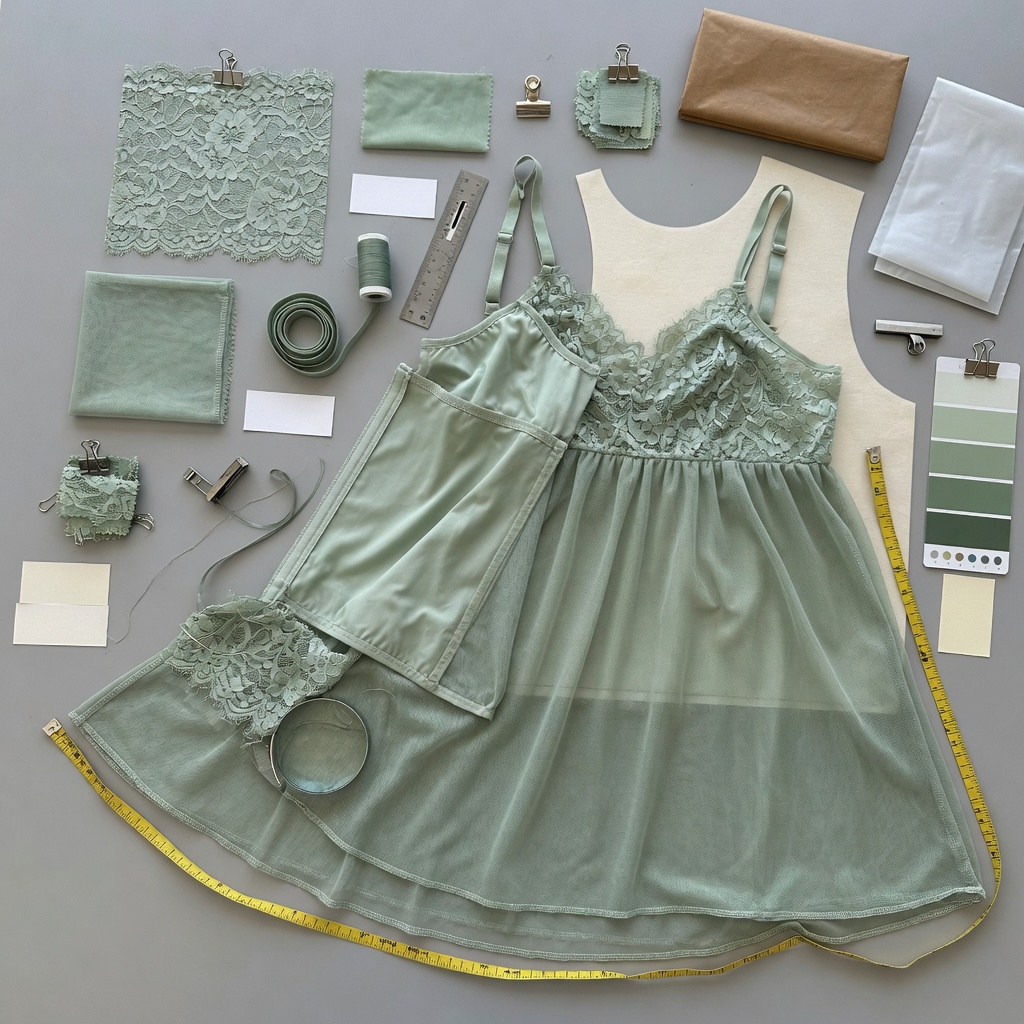
| Main textile components | Outer lace, skirt mesh and bodice lining | Generic fibre or material name, composition, mass in grams per finished garment, supplier, mill, wet processor, assembly site, claimed attribute and lot reference |
| Fit and attachment components | Elastic, adjustable straps and reinforcement pieces | Composition, dimensions, supplier, material identity, recovery or fit checks selected by the buyer, chemical-evidence scope and approved substitute |
| Construction and hardware | Sewing thread, rings, sliders, hooks or decorative hardware | Material identity, coating or finish where relevant, supplier, skin-contact position, evidence scope and lot linkage |
| Product information and packing | Care-label substrate, brand-label substrate and item-level packaging | Material composition, mass in grams per packed garment, proposed wording, evidence for any content claim and transit-validation plan |
Every component line should also identify whether the proposed sustainability attribute applies to that component alone or contributes to a finished-product calculation.
Illustrative component-content screen
The following figures are example assumptions for RFQ screening only and must be verified in the supplier quotation. They are not a product specification, certification decision or approved external claim:
- Assumed finished-garment mass: 180 grams per illustrative garment.
- Assumed mesh contribution: 90 grams per illustrative garment at 100% assumed eligible content, contributing 90 grams of assumed eligible content.
- Assumed lace contribution: 30 grams per illustrative garment at 50% assumed eligible content, contributing 15 grams of assumed eligible content.
- Assumed remaining components: 60 grams per illustrative garment at 0% assumed eligible content, contributing 0 grams of assumed eligible content.
- Illustrative internal result: 105 grams of assumed eligible content divided by 180 grams of assumed finished-garment mass, equal to 58.3% of the assumed denominator.
The applicable scheme rules must determine the actual denominator, exclusions, accessory treatment, rounding, chain-of-custody evidence and permitted wording. The example must not be converted into a product claim without that verification.
RFQ return schedule: evidence, cost and lead time
The buyer should issue the technical-pack revision, intended claim, destination, order assumptions and required evidence standard. The supplier should return verified and unverified options separately.
| RFQ block | Buyer supplies | Supplier returns |
|---|---|---|
| Style and destination | Style code, technical-pack revision, colourways, size range and intended European destinations | Quoted revision, production country, exact destination assumptions, shipping route and responsible economic operators to be verified |
| Component and claim option | Required component schedule and intended wording | Completed component schedule, exact claim, claimed percentage where applicable, calculation basis, source rule, version and limitations |
| Certification scope | Required scheme and claim type | Certificate holder’s legal name, site address, certification body, covered processes, material or product scope, issue date, expiry date, relevant activity date and database-verification route where available |
| Chain evidence | Required custody depth and purchase-order linkage | Relevant intermediaries, invoices, lot references and scheme-recognised transaction records where the selected scheme requires or recognises them |
| Chemical route | Applicable official sources, buyer restricted-substances list, buyer manufacturing restricted-substances list and test policy | Declaration and test matrix identifying component, colour, sample or production lot, method, laboratory, analytes, reporting limits, timing and acceptance decision |
| Wet processing | Required dyeing, printing, washing, coating or finishing disclosure | Facility, process, reporting dates, operational boundary, utility data, wastewater route, waste data, production denominator and calculation method |
| Sampling and QC | Measurement chart, construction requirements, selected test methods and approved sustainability option | Development and pre-production sample plan, material identities, proposed tolerances, inspection stages and responsibility for failures or substitutions |
| Packaging | Protection requirements and intended environmental wording | Item-level packaging BOM, material mass, evidence for claimed content, basis for proposed wording and transit-validation method |
| Commercial return | Order assumptions, quotation currency and required delivery timing | Unit price, minimum order in pieces by option, sample and bulk lead time in calendar days, testing and document charges, quotation-validity date, delivery term and release-document list |
A sustainability option should have its own material specification, evidence set, price, minimum order and lead time. An option with verified evidence and an unverified substitute should not share one quotation line.
Buyer-defined wet-processing return
For each relevant dyeing, printing, washing, coating or finishing facility, request:
- Legal name, physical address, process performed and relationship to the garment supplier.
- Reporting-period start and end dates.
- Production lines, processes and utility meters included or excluded.
- Water withdrawal in cubic metres for the reporting period and cubic metres per kilogram of processed material.
- Energy use in kilowatt-hours for the reporting period and kilowatt-hours per kilogram of processed material, separated by source where available.
- Wastewater volume in cubic metres, treatment route, discharge route and applicable permit evidence.
- Waste mass in kilograms, material category and treatment or disposal destination.
- Production denominator in kilograms of processed material and the calculation method.
- Base period, comparison period, numerator, denominator and exclusions for any percentage-reduction claim.
- Independent review or assurance details where available, without implying certification unless a current document confirms it.
Compare datasets only after aligning the facility, process, reporting period, operational boundary and production denominator. Group-level data or cut-and-sew utility data should not replace data for an independently located wet-processing facility handling the quoted material.
Attach the approved processing and assembly sites to the purchase order. A proposed production transfer should trigger renewed review of claim scope, chemical evidence, facility data, subcontractor approval, BOM traceability and sample validity.
Europe destination controls within the sustainability sourcing criteria
This destination matrix supports the babydoll lingerie RFQ. It is not a generic country guide, and sustainability evidence does not replace market-access review.
| Destination route | RFQ treatment | Evidence boundary |
|---|---|---|
| EU Member State | Apply the cited EU textile, REACH and general product-safety sources within their stated product and legal scope; verify current consolidated text and destination-country presentation or enforcement details where applicable | An EU source must not be represented as a rule for every non-EU European destination |
| Iceland, Liechtenstein or Norway | Use the cited ECHA source for the non-EU EEA REACH route and verify destination-specific incorporation and enforcement of other relevant measures | Do not transfer every EU product-safety, labelling or application-date statement automatically to a non-EU EEA order |
| Great Britain | Use the cited HSE UK REACH route for England, Scotland and Wales and maintain a distinct release checklist | EU REACH evidence is not automatic proof of UK REACH compliance |
| Northern Ireland | Complete a separate applicability and evidence review before purchase-order approval and shipment release | The cited HSE guidance is framed for Great Britain and is insufficient by itself to determine the Northern Ireland route |
| Destination country | Record the current official source, reviewer and approval date for language, label presentation, economic-operator details, packaging responsibilities and environmental-claim wording where applicable | No supplied source establishes a uniform country-level rule for all of Europe |
For an EU route, the cited 30-milligram-per-kilogram limit for the defined substances, covered article or dyed part and contact conditions must not be copied into the RFQ as a universal restricted-substances limit.
The chemical file should distinguish:
- Destination-specific legal restrictions supported by the applicable official source.
- The buyer’s finished-product restricted-substances list, clearly labelled as buyer practice.
- The buyer’s manufacturing restricted-substances list for selected process inputs, clearly labelled as buyer practice.
- Any additional buyer policy, with analyte scope, method, reporting limits and decision rule stated rather than presented as Europe-wide law.
A test report should identify the style or material, component, colour, sample date, material or production lot, laboratory, method, analytes, reporting limits and result. The release decision should document why the tested item represents the relevant order scope.
An OEKO-TEX® STANDARD 100 certificate may support harmful-substance review only within its verified holder, article and component scope. It should not replace destination review, the buyer’s test plan, organic- or recycled-content evidence, chain records or wet-processing data.
Do not add a babydoll-specific Digital Product Passport deadline to the quotation solely because the cited EU Ecodesign for Sustainable Products regulation establishes a framework. First verify an applicable product-specific measure, its effective date, scope, required data and responsible parties.
Sample, QC and substitution gates
An illustrative size M quotation assumption could use the following dimensions. Every figure is an example to verify in the supplier quotation and replace with the approved technical pack; none is a published product specification:
- 70-centimetre illustrative high-point-shoulder length, measured with the strap adjuster at a buyer-defined reference position.
- 10-millimetre illustrative finished strap width.
- 6-millimetre illustrative enclosed seam allowance.
- 150-centimetre illustrative relaxed full-circumference hem sweep.
The buyer must define the actual measurement method, tolerances, grading, strap setting and selected test methods before sample approval. Link the approved pre-production sample to the exact BOM revision, material swatches, colour reference, measurement chart, workmanship requirements and sustainability evidence.
The QC plan should cover:
- Incoming material identity, lot and shade confirmation.
- Measurements against the buyer-defined method and tolerances.
- Seam construction, edge finishing, strap attachment and adjustment.
- Appearance, opacity and drape against the approved sample.
- Buyer-selected colourfastness, dimensional-stability, recovery and care methods.
- Component, colour and lot linkage for chemical reports.
- Destination-specific label and packaging versions.
- Bulk inspection lot, production site and purchase-order references.
A visually acceptable sample should not override a mismatch in material identity, production site, evidence scope or production lot. Any proposed change to fibre composition, lace, mesh, lining, elastic, hardware, colour process, wet-processing site, assembly site or subcontractor should remain on hold until the related claim, chemistry, specification and traceability evidence is reassessed.
| Approval stage | Required decision evidence |
|---|---|
| Quotation screening | Complete RFQ response, explicit deviations, comparable option costs, defined claim basis and destination route |
| Sample authorisation | Traceable proposed components, holder and site evidence, chemical test plan, measurable sample requirements and disclosed wet processors |
| Purchase-order award | Approved sample, agreed BOM, approved sites, evidence valid for the relevant activities, commercial terms and release plan |
| Bulk release | Approved bulk materials, required reports, production-site confirmation and resolved substitutions or deviations |
| Shipment release | Final inspection, destination labels, lot-linked reports, applicable claim records, packing information and reconciled purchase-order identifiers |
Hard-hold conditions include:
- No identified source rule or version for the proposed claim.
- A holder, site, process, material or product outside the evidence scope.
- Evidence that was not valid for the activity date it is used to support.
- A test sample, colour or lot that does not match released production.
- An unapproved material, process, site or subcontractor substitution.
- An unresolved mismatch among the BOM, scope document, transaction record, inspection lot or purchase order.
- An undefined destination route for the intended European order.
The RFQ and purchase order should state who bears the cost and schedule effect of retesting, replacement evidence, rework, rejected substitution or delayed release.
Methodology, source contexts and limitations
Official standards context: The organic- and recycled-content data points are limited to the cited GOTS and GRS versions and dates. The OEKO-TEX® source is used only to define the role of harmful-substance evidence within its verified scope. No cited threshold is converted into a general sustainability score.
Official legal and regulator context: The EUR-Lex sources support only the stated EU textile-scope threshold, EU general product-safety application date, EU REACH restriction and EU ecodesign-framework boundary. ECHA provides the cited EEA REACH context, while HSE provides the cited Great Britain UK REACH context. EU requirements are not generalised to all European destinations.
Additional sourcing context: The supplied Accio, Catonie and Leigh Sourcing pages are retained as non-authoritative discovery references only. No number, legal duty, standard interpretation, certification status, supplier capability, factory outcome or product-performance claim in this article relies on them.
How the method was derived: Each proposed claim is mapped to a garment component, source question, standard or buyer rule, holder, responsible site and process, dated document, material or production lot, purchase order, destination route and approval gate. Facility data is considered comparable only after the site, process, reporting period, operational boundary and production denominator are aligned. Component-content figures and sample dimensions are expressly identified as illustrative assumptions to verify in the supplier quotation.
Limitations and what to verify: Standards, claims policies, legal annexes and supplier documents can change, expire or be superseded. An overview page may not contain every normative condition. Before purchase-order award and shipment release, verify the current standard version, current consolidated legal text, certificate database record, validity dates, holder and site scope, transaction evidence where applicable, laboratory and method details, reporting limits, component and lot identity, approved subcontractors, destination-country requirements, Northern Ireland route and final environmental-claim wording. No supplier certification, product compliance, facility performance or customer outcome is inferred here.
Author note: The linked Vincent Xi author profile identifies Vincent Xi as Editorial Author. No first-person factory, laboratory, audit or product-testing experience claim is made in this article.
Discuss Your Requirements
Review our manufacturing capabilities, then share your specifications for a supplier-fit review.