Babydoll Lingerie OEM Quality Control Inspection for Europe
By Vincent Xi, Editorial Author
For a Europe-bound order, a babydoll lingerie OEM quality control inspection should be written into the RFQ as a shipment-release process, not left as a general request for standard or export quality. The RFQ should connect the approved product reference, presented production lot, inspection evidence, acceptance rule, corrective action, and release authority.
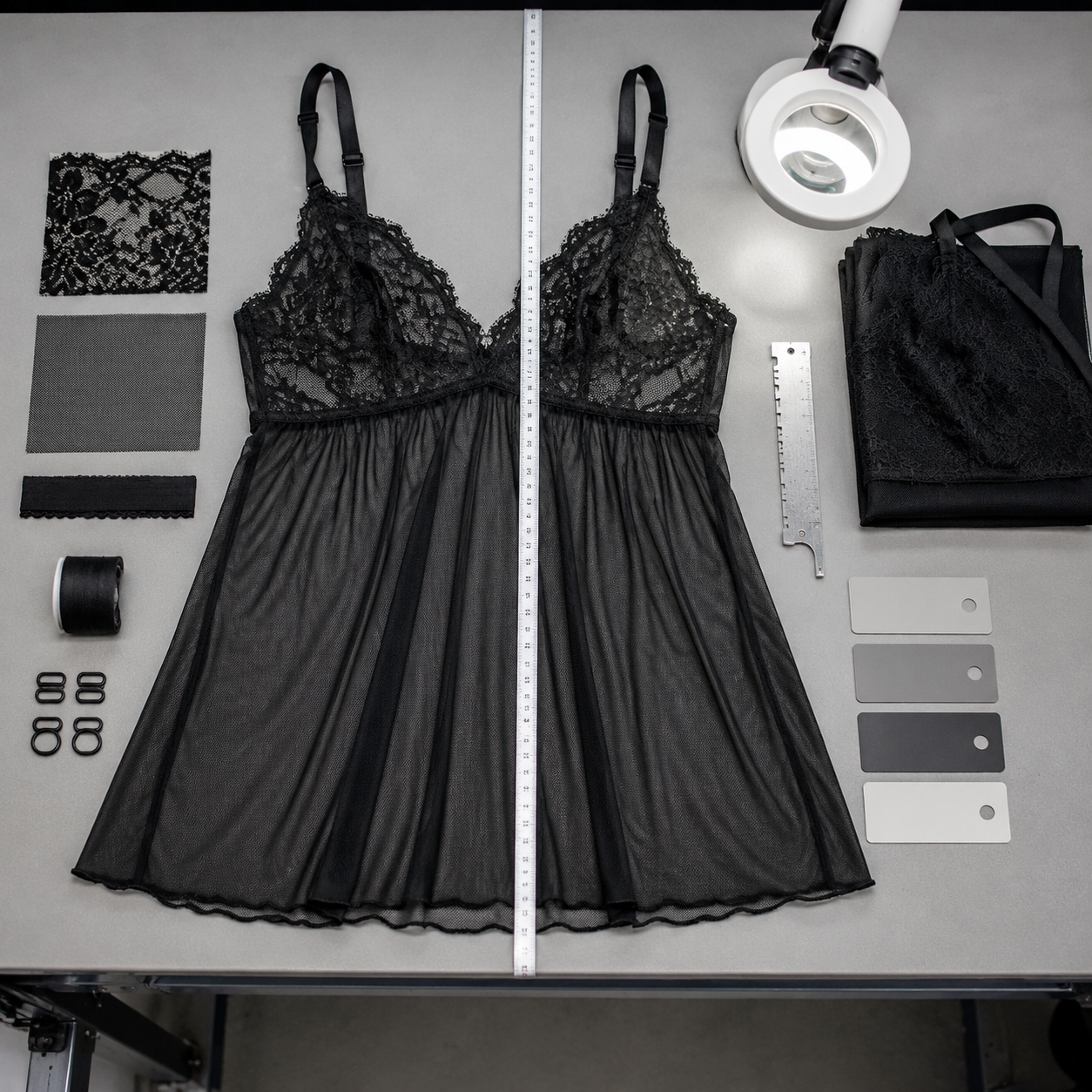
The inspection scope must reflect the actual design. For a babydoll with lace bust panels, sheer mesh, adjustable straps, sliders, a flowing skirt, or matching components, each controlled feature needs an observable instruction. Visual inspection, garment measurement, functional checks, document review, and laboratory work should remain separate because each produces different evidence.
European destination routing also belongs in the purchasing decision. An EU member-state order, an EEA destination outside the EU, a Great Britain shipment, and a Northern Ireland shipment should receive separate applicability reviews. That routing is a buyer-created risk control; it does not imply that one legal checklist applies throughout Europe.
Set the Quality Control Inspection Gate for Europe
The release schedule below is a proposed contractual control. It is not a legal requirement, a universal industry tolerance, or evidence of a supplier's current practice.
| Release decision | Evidence required in the RFQ and inspection record | Hold trigger |
|---|---|---|
| Product baseline | Approved-sample identifier, technical-pack revision, bill of materials, graded measurement chart, construction sheet, color references, and packing specification | Unidentified sample, conflicting documents, or an unapproved revision |
| Presented lot | Style, color, size assortment, quantity, material-lot references, production location, disclosed subcontracting, and packing status | Mixed, incomplete, substituted, or untraceable goods |
| Material control | Buyer-approved fabric and trim references, component records, material-lot identity, and a written substitution procedure | Unapproved lace, mesh, elastic, thread, hardware, decoration, lining, or packaging change |
| Product inspection | Defined measurement methods, workmanship criteria, visual zones, functional methods, defect rules, and evidence format | Missing method, failed result, or construction that differs from the controlled reference |
| Sampling and release | Lot definition, independent sample-selection control, inspection scope, defect counting, acceptance rule, and named release authority | Supplier-selected samples, incomplete lot presentation, exceeded limits, or unauthorized release |
| Destination and packing | Named European route, document checklist, label and traceability review, unit-pack reference, assortment, carton count, and current support for any certification claim | Generic Europe claim, unresolved destination requirement, packing discrepancy, or expired or out-of-scope document |
| Failed-inspection response | Stop-ship authority, containment, sorting, correction, rework, retesting, reinspection, cost allocation, and written disposition | Supplier self-release or an unverified statement that the goods were corrected |
A commercial manufacturer-evaluation article recommends defining the product category, target market, quality level, size range, customization, minimum-order expectations, and order model before evaluating a manufacturer (XS Lingerie). Those categories can structure the RFQ, but the cited article does not establish universal babydoll tolerances, defect limits, supplier performance, or release criteria.
Freeze the Babydoll Manufacturing Baseline
Quotation, production, and inspection should use the same controlled product package. Require the supplier to identify the files used for its quotation and to record each subsequently approved revision.
The controlled package should cover:
- The approved-sample identifier and approval status.
- Technical drawings and revision identifiers.
- A bill of materials for each fabric, lace, elastic, lining, thread, hardware, decoration, and packaging component.
- A graded measurement chart stating points of measure, units, tolerances, garment positioning, conditioning, and stretch handling.
- Seam construction, reinforcement, edge finishing, elastic insertion, strap attachment, slider orientation, closures, and hems where applicable.
- Buyer-approved references for color, shade, lace placement, motif alignment, symmetry, and visual zones where those characteristics are controlled.
- Product identity, assortment, packing, and lot-traceability instructions.
- The order of precedence among the approved sample, technical pack, purchase order, and approved revisions.
- A written approval route for changes to materials, components, processes, production locations, subcontractors, or packaging.
Approval should apply only to the identified sample and linked specification. The purchase terms should state which changes require disclosure and written buyer approval before affected production continues.
Do not use a finished-goods visual inspection as evidence for a characteristic it did not evaluate. Material composition, restricted substances, color performance, dimensional behavior after care, or component strength may require a defined document review or test linked to the relevant material, color, trim, lot, and destination.
Inspect at Defined Manufacturing Gates
A commercial inspection article organizes lingerie controls around pre-production, raw-material, assembly, visual, and sewing stages and discusses critical, major, and minor defect categories (InTouch Quality). It provides planning context, not mandatory gates or classifications for a particular purchase order.
- Incoming materials: Compare identified lace, mesh, elastic, lining, thread, hardware, decoration, and packaging with buyer-approved references. Record material-lot identity and isolate proposed substitutions pending disposition.
- Cutting and initial output: Check controlled panel direction, motif placement, paired-piece alignment, graded dimensions, and material handling before wider production proceeds.
- In-line assembly: Check specified seams, reinforcement, elastic application, strap attachment, slider orientation, bust-panel alignment, edge finishing, and supplied components while correction remains practical.
- Finished goods: Present completed and identifiable goods under the signed sampling plan. Record measurements, workmanship findings, functional results, defect locations, quantity status, and packing status.
- Packing: Verify product identity, size and color assortment, matching components, unit packaging, carton contents, carton condition, quantities, and lot traceability before release.
A manufacturer-published quality-control page discusses approved samples, defect distribution, rework, and reinspection as release-decision inputs (CHINGVA). This supports asking a proposed supplier how those controls will be documented. It does not prove that the supplier follows them or that its process satisfies the buyer's order.
Write Babydoll-Specific Defect Rules
Build the defect catalogue from the controlled technical pack and approved sample. The RFQ should define what the inspector observes, how the result is classified, and what evidence is retained.
| Controlled characteristic, when present | Inspection instruction to define | Evidence to retain |
|---|---|---|
| Lace and sheer panels | Reference orientation, motif placement, paired-panel symmetry, visual zones, and treatment of holes, snags, distortion, or visible damage | Overall and close-up images tied to the sampled unit and defect location |
| Garment silhouette | Center-front and center-back lengths, bust-panel dimensions, underbust seam position, skirt sweep, hem shape, garment positioning, and stretch handling as applicable | Measurement record tied to style, size, color, and sampled-unit identifier |
| Straps, sliders, and closures | Component identity, orientation, adjustment range, attachment method, operation check, and any buyer-selected strength method | Method, equipment, threshold, result, and sampled-unit reference |
| Seams and elastic | Seam construction, stitch security, reinforcement locations, elastic insertion, edge finishing, and permitted appearance | Close-up evidence classified against the controlled reference |
| Color and component matching | Approved color references, comparison conditions, material-lot handling, and matching rules for supplied components | Material-lot references and comparison result for each controlled component |
| Cleanliness and foreign matter | Prohibited contamination, stains, odor conditions, loose or embedded matter, isolation action, and escalation for a possible safety concern | Images, affected-unit identity, containment record, and buyer disposition |
| Product identity and packing | Required style, size, color, supplied pieces, buyer-provided label content, unit pack, carton assortment, and traceability | Count record, packing images, and carton-to-lot reconciliation |
Do not request an undefined pull, stretch, wash, or operation test. For each selected check, state the characteristic, specimen or finished-garment scope, conditioning, equipment, procedure, threshold, sample selection, report format, and decision owner.
Defect classes should come from the buyer's signed risk assessment. A buyer might classify a sharp foreign object presenting an identified safety risk as critical; an open seam, wrong controlled material, failed strap attachment, incorrect size identity, or out-of-tolerance key measurement as major; and a removable loose thread as minor only when it does not affect the agreed safety, identity, fit, function, appearance, or saleability criteria. These are buyer-created classification examples to confirm in the contract, not universal industry rules.
Quote Measurable Inspection Assumptions
A sample percentage alone does not define an acceptance plan. The RFQ should also identify the presented lot, eligibility for inspection, sample-selection control, checks assigned to sampled units, defect-counting method, and accept or reject rule.
Every figure below is a buyer-created example assumption or calculation to verify in the supplier quote. The shared context is a hypothetical babydoll style-color lot under an example RFQ dated 15 February 2025. That date is itself an example assumption, not a record of an actual order. None of the figures is an industry benchmark, observed supplier result, legal threshold, standards requirement, or recommended acceptance limit.
| Procurement variable | Example assumption or calculation | Scope, source, and supplier action |
|---|---|---|
| Finished length | Example assumption to verify in the supplier quote: a tolerance of +/- 1.0 cm for center-front finished-garment length | Scope: each quoted size and color in the hypothetical babydoll style under the example RFQ dated 15 February 2025. Source: buyer-created assumption. Supplier to confirm feasibility, conditioning, measurement method, commercial effect, and treatment of nonconforming units |
| Observed lot share | Example calculation to verify in the supplier quote: 80 garment units / 1,200 garment units x 100 = approximately 6.67% of the presented lot | Scope: the hypothetical style-color lot under the example RFQ dated 15 February 2025. Source: buyer arithmetic. Supplier to confirm the proposed sampling basis; the percentage does not replace random selection, defect limits, or accept and reject rules |
| Containment scenario | Example calculation to verify in the supplier quote: an assumed affected share of 2.0% x 1,200 garment units = 24 garment units | Scope: the hypothetical style-color lot under the example RFQ dated 15 February 2025. Source: buyer-created assumption and arithmetic. Supplier to define how the actual affected population would be identified and verified rather than extrapolated from a sample |
If the buyer selects an acceptance-sampling standard, the contract should identify its title, current revision, lot basis, inspection level, defect categories, and acceptance criteria. Using a sampling standard is a contractual choice. It is not factory certification, product certification, proof of legal compliance, or a guarantee that every uninspected unit conforms.
The quotation should price and schedule sample approval, in-line inspection, finished-goods inspection, laboratory work, sorting, rework, retesting, and reinspection separately. It should also state which party bears each cost when a failed result or supplier-caused delay creates additional work.
Route European Evidence by Destination
A commercial sourcing article flags REACH in the context of sourcing underwear for the EU (Union Source). Treat that citation only as a prompt for an EU-specific compliance review. It is not official legislation, legal advice, a complete market-access checklist, or evidence that a material, color, trim, production lot, or finished garment complies.
| Destination route | RFQ instruction | Decision boundary |
|---|---|---|
| EU member state | Name the destination member state and require the buyer's compliance owner to identify current requirements and evidence for the actual product, materials, labels, packaging, operators, records, and language presentation | Do not treat a general supplier declaration as proof for every EU member state, material, color, trim, or lot |
| EEA destination outside the EU | Name the destination state and commission a separate applicability review using current official or qualified compliance sources | Do not assume that a file prepared for an EU member state is sufficient without destination review |
| Great Britain | Record Great Britain as the destination and require the compliance owner to document the current evidence, labels, responsible parties, and records applicable to the order | Do not use an undifferentiated UK or Europe checklist |
| Northern Ireland | Record Northern Ireland separately from Great Britain and require the compliance owner to document the current route and evidence applicable to the order | Do not assume that the Great Britain file controls this route |
| Country and customer layer | Record destination-language presentation, packaging-responsibility arrangements, retailer protocols, and retention terms identified for the actual order | Keep legal requirements, retailer requirements, and voluntary buyer controls separately labeled |
For every declaration, report, or claimed certificate, request the issuing party, applicant or facility, product or material scope, test method, result, issue date, validity where applicable, and connection to the quoted product and production lot. Do not accept or publish a certification claim without a current document supporting the relevant scope.
A sealed reference sample, visual defect zones, garment tolerances, inspection timing, sampling rules, and mandatory reinspection are buyer or contract controls. They should not be described as REACH requirements or as proof of certification.
Use a Comparable Supplier RFQ Schedule
Require each proposed supplier to complete the same schedule so procurement can compare evidence, exceptions, timing, and total decision cost.
| RFQ field | Supplier response required | Buyer decision |
|---|---|---|
| Product and lot | Style reference, matching components, colors, sizes, quantities, material-lot structure, production location, subcontracting status, and packing state at inspection | Whether the proposed lot can be identified, selected, and traced |
| Controlled documents | File names, revision identifiers, approved-sample identifier, conflict hierarchy, and change-approval process | Whether quotation and inspection use the same product baseline |
| Inspection plan | Material checks, measurement methods, workmanship catalogue, functional methods, manufacturing gates, report format, sampling basis, and acceptance rule | Whether the proposed evidence supports a repeatable release decision |
| European destination file | Named route, required evidence, responsible parties, document scope, open gaps, and buyer approval owner | Whether each claim applies to the actual destination, product, material, and lot |
| Packing and traceability | Unit-pack reference, assortment, carton method, count control, lot coding, and retained records | Whether finished goods can be reconciled with the purchase order and inspection report |
| Failure response | Stop-ship authority, containment, root-cause response, sorting, rework, retesting, reinspection, replacement, delay, and cost terms | Whether a failed result has an enforceable remedy |
| Commercial effect | Inspection charges, testing charges, reinspection charges, lead-time assumptions, exclusions, and deviations | The total quoted decision cost and unresolved exceptions |
The supplier should confirm each requirement or record a specific exception with its price, timing, and product effect. Terms such as normal tolerance or factory AQL should not replace a stated method, sample plan, defect rule, and acceptance decision.
Hold, Correct, Reinspect, and Release
The purchase contract should name the people or functions authorized to stop shipment and authorize release. The inspection report should identify the presented lot, sampled units, selection method, measurements, defects by class, functional results, packing status, document status, images, and unresolved deviations.
Buyer-defined dispositions may include:
- Pass: Every release gate required by the signed inspection plan is satisfied.
- Buyer-authorized concession: The buyer records the deviation, affected population, destination review, commercial remedy, and authorization. A concession must not override a requirement identified as mandatory by the buyer's compliance owner.
- Fail with containment and correction: The supplier identifies and isolates the affected population, documents the cause, completes the buyer-approved sorting or rework method, and supplies objective correction records.
- Fail pending reinspection: The goods remain on hold until the required reinspection or retesting produces an acceptable result under the signed plan.
A supplier statement that goods were corrected should not replace reinspection when the contract requires objective verification. Responsibility for additional inspection, testing, storage, delay, rework, replacement, and disposal decisions should be agreed before production begins.
Before purchase-order award, confirm that the supplier has priced every inspection stage and exception, accepted the controlled product package, identified the European destination route, documented the failed-inspection remedy, and acknowledged that shipment requires written release from the buyer's named authority.
Sources, Methodology, and Limitations
| Supplied source | Context used in this article | Boundary applied |
|---|---|---|
| XS Lingerie | Up-front manufacturer requirement categories used to structure product and lot questions | Not used as evidence for universal tolerances, acceptance limits, or supplier capability |
| InTouch Quality | Staged lingerie inspection and defect-category planning context | Not used to assign mandatory gates or order-specific defect classifications |
| CHINGVA | Context for questions about approved samples, defect distribution, rework, and reinspection | Not used as proof of any proposed supplier's practices or performance |
| Union Source | Commercial sourcing context that flags REACH for EU underwear procurement | Not used as official legal guidance, a complete destination checklist, or compliance evidence |
| Vincent Xi author profile | Author name, role, and profile URL | Not used to claim factory, laboratory, inspection, certification, or customer experience |
Methodology: The supplied commercial sources were used only for the limited planning contexts identified above. Those concepts were translated into buyer-controlled RFQ questions, evidence fields, hold triggers, and release decisions. Product checks remain conditional on the controlled technical pack and approved sample. Every numerical entry is labeled as a buyer-created example assumption or calculation and must be verified in the dated supplier quotation.
Limitations and points to verify: No physical garment, production lot, technical pack, approved sample, laboratory report, factory audit, supplier quotation, inspection report, certificate, or destination-specific legal file was supplied. The cited commercial pages are not official legislation or complete standards. They do not establish factory performance, product conformity, certification, universal tolerances, sampling limits, or legal compliance. Verify current requirements for the named EU member state, EEA destination outside the EU, Great Britain, Northern Ireland, and any applicable country or retailer layer using qualified compliance resources. Confirm every material scope, measurement method, tolerance, test method, sampling rule, acceptance limit, price, lead time, corrective action, and release term in the supplier quotation and purchase contract.
Author basis: Vincent Xi is identified by the approved author profile as Editorial Author. The profile does not support a first-person claim about factory visits, laboratory tests, product inspections, certification reviews, customer outcomes, or manufacturing work, so no such experience is claimed here.
Discuss Your Requirements
Review our manufacturing capabilities, then share your specifications for a supplier-fit review.