Babydoll Lingerie OEM Digital Integration Readiness for Manufacturing Buyers in Malaysia
By Vincent Xi, Editorial Author | Author profile
B2B buyers in Malaysia who source custom babydoll lingerie should treat OEM digital integration readiness as a manufacturing go/no-go gate, not a later IT project. Before the first production purchase order, require a paid round-trip: the factory opens a buyer 3D scene and a named CAD-exchange file the cutting room can nest, returns an aligned tech pack and BOM, processes a staging EDI 850 Purchase Order, and returns test 810 Invoice and 856 Ship Notice data the inbound team can use. Do not approve on brochure copy. Hold or fail the partner if style-color-size runs must be re-keyed from spreadsheets, if lace layout exists only as a beauty render, or if carton content cannot be sent as structured 856 fields.
This is an evidence-bound procurement brief for babydoll lingerie OEM manufacturing. It does not describe unpublished tests, client names, certifications, factory visits, or first-person production experience. Vincent Xi is named here only as Editorial Author. Facts below are limited to practices named in the cited public pages on digital pattern and 3D-to-PLM flows and on lingerie OEM EDI. Any numeric timeline, sample count, or cycle-count figure that is not a count of named items on those pages is labeled as an example assumption to verify in the supplier quote.
Decision sequence. Specify the controls in the RFQ → compare returned artifacts → verify with one buyer 3D file plus one dummy 850 → approve only on a documented pass → release bulk quantity after a paid one-colorway babydoll pilot.
Methodology. Source contexts are: (1) a B2B custom-lingerie manufacturer insight page on digital pattern systems, 3D stretch simulation, automated cutting/sewing/inspection, and ERP data connection (Starwin Lingerie digital-design insight; URL path dated 2025-10-30); (2) a 3D fashion-design software page on PLM-linked tech packs, BOMs, avatars, and lace-layout validation (Style3D lingerie 3D software); and (3) an EDI compliance page listing transaction sets 850, 810 and 856 plus named ERP families and transport methods (Infocon Sol Lingerie EDI). Claims are restated only where those pages support them. Counts below are counts of named items on those pages, not measured factory performance.
Limitations and what to verify. The pages describe general industry approaches. They are not a current audit of any named factory, a certification document, or a Malaysia inbound, customs, climate, or 3PL field specification. File-format versions, avatar charts, EDI maps, API scopes, and access controls change. Run a paid digital round-trip (buyer-supplied 3D file plus a test 850) before bulk commitment. Named ERP families and automation language are not proof of a live map. Do not treat this brief as a Malaysia technical regulation or as a substitute for the buyer’s own warehouse data dictionary.
Concrete data points
- EDI document count (source-bound): 3 named transaction sets on the cited lingerie OEM EDI partner page—850 Purchase Order, 810 Invoice, 856 Ship Notice. Unit: count of named EDI documents. Scope: that page’s partner listing, not an industry census and not a live-factory certificate. As-of: as listed on the cited URL; the page does not publish a survey date—reconfirm live maps in the RFQ.
- ERP families named (source-bound): 4 families—SAP, Oracle, NetSuite, Dynamics. Unit: count of named product families. Scope: the same EDI partner page. As-of: as listed on that URL; not a compatibility certification for any factory.
- Transport methods named (source-bound): 3 methods—AS2, FTP, VAN. Unit: count of named transports. Scope: the same page. As-of: as listed; confirm which method the OEM will operate on the buyer’s test and production lanes from Malaysia.
- Example RFQ test scope (assumption to verify in the quote, not a measured average and not a source statistic): 1 babydoll style × 2 colorways × a full size run; 3D tech-pack round-trip window of 5 working days; sampling path of 1 virtual review + 1 physical proto versus 3 physical protos and 2 courier loops.
What Digital Integration Readiness Means for Babydoll Lingerie OEM Manufacturing
For this product family, digital integration readiness is the OEM’s ability to receive structured commercial data and 3D construction assets, keep them versioned through cutting and sewing, and send back invoice, ship-notice, and (where offered) quality or WIP data without repeated spreadsheet transcription.
A babydoll typically combines a fitted or empire bodice, a short flared skirt, adjustable straps, and decorative lace or mesh overlays. That construction creates more digital objects than a simple brief: graded 3D patterns, lace-placement maps, hardware BOM lines (rings, sliders, hooks), label and polybag lines, and colorway material cards. If the OEM cannot keep those objects in one data path from 3D scene to ERP, merchandising and planning teams in Malaysia will re-key sizes, trims, and requested ship dates.
Published manufacturer commentary describes B2B custom lingerie factories adopting digital pattern systems and 3D design that simulate fabric stretch on body shapes, with smart production automating cutting, sewing and inspection and connecting data to ERP systems to reduce errors and speed OEM response. Starwin Lingerie digital-design insight That is a restatement of the cited page, not an audit result for any bidder.
Ask whether the same style number, color, and size run that appear on the 3D tech pack also populate the 850, the cutting ticket, and the 856 carton content—without a human retyping the strap length or lace article. Price extra physical samples, mismatched lace layouts, delayed PO acknowledgments, and manual re-keying as decision risk. Those outcomes are not a published defect-rate study.
3D, PLM, and CAD Alignment for Tech Packs, BOMs, and Virtual Samples
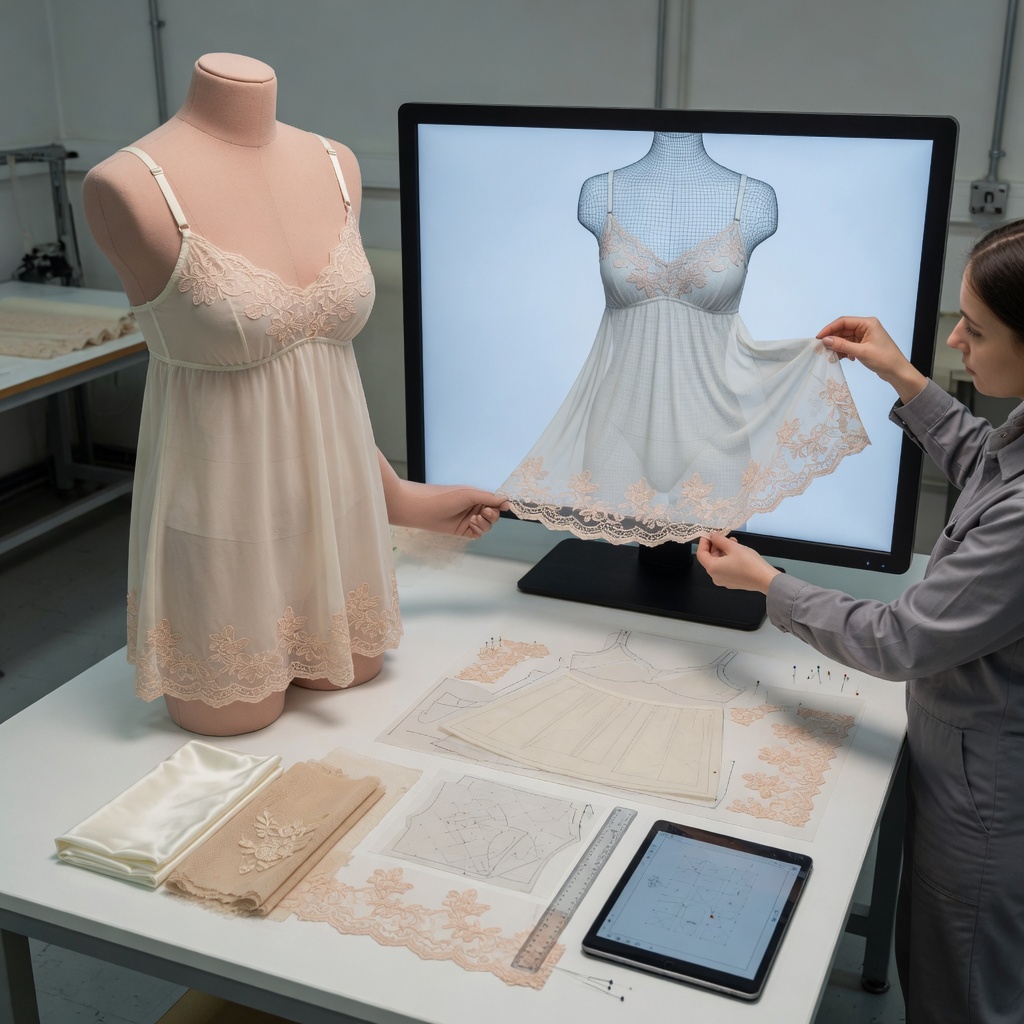
3D software used for lingerie can integrate with PLM so that tech packs and BOMs generate directly from digital scenes. Manufacturers then receive 3D patterns, avatars and assets to validate construction and lace layout, which can reduce physical samples when CAD capabilities and digital standards align with the brand. Style3D lingerie 3D software Sample reduction is stated on that page as a conditional outcome of alignment, not as a guaranteed count for babydoll programs.
For a babydoll, lace layout and skirt drape are the usual failure points. A virtual sample that looks acceptable on a default avatar can still fail if the factory’s stretch-mesh and rigid-lace physical cards do not match the brand’s digital fabric library; if strap and ring placement is not locked to the same measurement chart the buyer in Malaysia uses for retail size claims; or if hem flare and lining/no-lining construction are not visible in the 3D scene the factory actually cuts from.
Specify, in the RFQ, the 3D authoring or exchange format the brand will send, whether the OEM can open it natively or only via a viewer, and whether PLM auto-creates the size spec, construction notes, and trim BOM from that scene. Request that lace and embroidery placement in the digital twin be compared to the physical marker, not only to a beauty render. The cited pages do not name a mandatory CAD file extension; require the OEM to name the export the marker/nesting system consumes and to return one openable file.
Example assumption to verify in the quote (not a measured industry average): one 3D review cycle plus one physical proto per new babydoll block, and one additional 3D colorway review when only lace article or body color changes. Treat any quoted sample-count reduction as a quote line, not a guaranteed outcome.
Trade-off: fewer courier loops versus the engineering time to build and maintain digital fabric and trim libraries. If the digital card is wrong, the simulated drape of a short, lightweight skirt will not match the sewn garment the buyer inspects.
EDI 850, 810 and 856, API Layers, and ERP Connectivity
Lingerie OEM trading partners are described as needing to support EDI sets including 850 Purchase Order, 810 Invoice and 856 Ship Notice. Integration is described as available with ERP systems such as SAP, Oracle, NetSuite and Dynamics via AS2, FTP or VAN for automated order, invoice and shipping data exchange. Infocon Sol Lingerie EDI
Those three named transaction sets are the commercial backbone on that page. They are document names, not a certification that any OEM is live. The 850 should carry the buyer’s style, color, size breakdown, quantity, UOM, and requested dates. The 810 should return invoice data that matches the 850 without manual reconciliation. The 856 should return ship-notice / carton content so the inbound team or 3PL in Malaysia can plan receipt.
Ask for a mapping workbook that shows how the buyer’s SKU, color code, size run, UOM, and ship-to populate the 850, and how carton, packing-list, and (if the buyer’s warehouse process uses it) SSCC data return on the 856. The cited EDI page does not name SSCC, 997, 855 or 860; treat those as buyer-scope questions, not as listed partner requirements. Confirm whether a 997 functional acknowledgment and an 855 PO acknowledgment are in scope. Require separate test and production identifiers (for example ISA/GS IDs where used) and a named owner for VAN or AS2 certificate cost as a quote line.
API connectivity for WIP, inventory, or QC photo pull is a separate layer: specify authentication method, read-only versus bidirectional, and whether it is in addition to EDI or a substitute. The cited manufacturer insight page describes connecting production data to ERP; it does not name a public API product. Do not accept an API screenshot in place of a mapped 850/856 pair unless the buyer’s process has already retired EDI.
Trade-off: EDI setup and VAN or AS2 certificates cost time and money, especially on a first lane from the buyer in Malaysia to the OEM, but they reduce keying errors on multi-colorway babydoll orders that often carry many small trim lines. A factory that only accepts emailed Excel will push that labor and mismatch risk onto the buyer’s operations team. Do not treat a named ERP on a brochure as proof of a live map. Require a staging test using a dummy babydoll PO with at least two colors and a full size run (example test matrix to verify in the quote, not a source-measured average).
Digital Assets, DXF-Class Patterns, and Supply-Chain Visibility
Once 3D and commercial documents exist, the OEM still has to share assets the cutting room and the buyer’s technical team can both use. Request versioned 3D scenes and avatars used for the approved look, not only flattened JPEGs; pattern exchange in the format the factory’s marker/nesting system actually consumes (if the buyer uses DXF-class files, name the exact flavor in the RFQ; do not assume the cited pages mandate DXF); a named file-transfer method (SFTP or a controlled portal) with access control; a naming convention that includes style, color, size, and revision; and IP language covering who may download, how long files are retained, and whether the digital twin remains the buyer’s property after the program ends. Do not treat an unlabeled cloud folder as integration.
Source commentary on smart production notes automated cutting, sewing and inspection with data connecting to ERP. Starwin Lingerie digital-design insight That is a practice description, not a certification that any given line is automated. Ask how inspection measurements or photos are stored and whether they can be retrieved against the same style-color-PO key as the 856.
Visibility that only exists as chat-app images is not integration. Specify whether the buyer can see cutting complete, sewing line, and packed status as structured fields. If material reporting is required by the buyer’s own policy in Malaysia, ask whether digital material cards can feed a template; the cited pages do not establish that this is standard, so do not assume it.
Measurable Trade-offs in Digital Versus Physical Validation for Babydoll Styles
Digital workflows trade physical sample cost and calendar time against alignment risk. Price both paths as separate quote lines.
Each physical babydoll proto consumes pattern, lace, hardware, sewing, finishing, and international courier. Virtual validation of construction and lace layout is described as a way to reduce those physical samples when CAD and digital standards align. Style3D lingerie 3D software Alignment is the condition, not an automatic result.
Babydolls hang from straps and flare over the hip. Stretch simulation on an avatar helps only if the factory uses the same body measurements and fabric stretch/recovery values the buyer will later use in a fit session. A digital pass followed by a physical fail still costs a sample cycle. Auto-generated BOMs from 3D scenes reduce missed rings, sliders, and care labels; they do not replace a human check that the hardware finish matches the approved standard.
Connecting inspection and production data to ERP can reduce errors, per the manufacturer insight page. Starwin Lingerie digital-design insight The buyer still needs to define which measurements (bust, underbust, waist, hip, strap length, hem circumference, lace motif placement from CF) are stored and which defects auto-hold a carton. Units and sampling rates are quote assumptions to verify; they are not published averages on the cited pages.
Example calculation to verify in the quote (assumption only): if a traditional path uses three physical protos and two courier loops, and a digital path uses one 3D round plus one physical proto, ask the OEM to price both paths as separate line items with calendar days, not a single blended faster claim.
Malaysia Buyer Decision Table for OEM Digital Integration Readiness
Use this table to specify, compare, verify, and approve partners. Every row is a manufacturing control a buyer in Malaysia can put in an RFQ and then test. Score only artifacts. A missing file is a fail for that row. Windows and carton counts in the table are example assumptions to confirm in the quote, not source-measured cycle times.
| Capability | What to specify | How to verify | Trade-off | RFQ evidence to request |
|---|---|---|---|---|
| 3D-to-PLM tech pack | Tech pack and construction notes generated from the 3D scene, including strap and lace callouts | Buyer sends a sample scene; OEM returns tech pack + comments within an agreed window | Faster pack accuracy vs. time to match CAD/avatar standards | Round-trip 3D file and exported pack (example window: 5 working days—confirm in quote) |
| BOM from digital scene | Fabric, lace article, rings/sliders, labels, polybag lines auto-listed | Compare BOM Excel/CSV to physical proto trim card | Fewer missed trims vs. library-maintenance cost | Side-by-side BOM vs. sewn sample |
| Lace layout validation | Digital lace placement locked to marker, not only to beauty render | Overlay or photo of physical lace vs. 3D placement | Fewer lace recuts vs. extra 3D engineering | Marked photo or digital overlay |
| 3D/CAD transfer | Named SFTP or portal; versioned folder; no silent overwrite | Buyer uploads a test scene and receives an openable export | Control vs. extra IT setup | Test login plus one retrieved file |
| EDI 850 | Mapped 850 with style, color, size run, UOM, qty, ship-to used by the inbound process in Malaysia | Staging 850; optional 997/855 if the buyer’s process needs them | Lower order-entry error vs. mapping/VAN cost | Successful test 850 (and 855 if in scope) |
| EDI 810 | Invoice matches 850 lines without manual re-key | Test 810 against the same dummy PO | Faster AP match vs. map maintenance | Test 810 PDF/EDI pair |
| EDI 856 | Carton/content fields the buyer’s 3PL or warehouse needs, including packing hierarchy | Test 856 with two cartons / two SKUs (example matrix to verify in quote) | Better receipt planning vs. extra data discipline | Test 856 with carton hierarchy |
| Transport | AS2, FTP or VAN as actually used; test vs production IDs | Certificate exchange or SFTP account in staging | Security/reliability vs. setup effort | Named method from the three listed plus a test login |
| ERP alignment | Whether OEM middleware talks to SAP, Oracle, NetSuite or Dynamics on the buyer side | Architecture diagram + one live field mapping | Cleaner master data vs. middleware cost | Named ERP family and interface owner |
| CAD export | Pattern pieces the nesting system can cut (body, facing, lace appliqué) | OEM returns export the buyer’s technician opens | Faster marker vs. format mismatch risk | Openable file, not a screenshot |
| WIP / QC data | Structured status and key measurements against PO-style-color | Sample retrieval method on a test cut | Earlier exception handling vs. integration scope | Field list and one pulled record |
| Asset IP and access | Retention, download rights, revision lock | Written clause + permission demo | Control vs. factory reuse of blocks | Contract language plus folder ACL screenshot without logos |
Pass / conditional / fail rule. Pass: openable 3D or named CAD export, mapped 850, and test 856 carton fields, each matching the dummy babydoll PO. Conditional: artifacts exist but UOM, size codes, or lace-marker overlay still break. Fail: Excel-only orders, viewer-only 3D with no BOM export, or 856 replaced by an unlinked packing-list PDF. Fail-closed: if a row has no artifact, do not score it on interview answers.
Practical RFQ Checklist for Babydoll Lingerie OEM Digital Integration Readiness
Include these items so the OEM must answer with artifacts, not slogans. Each item supports specify / compare / verify / approve / order for Malaysian B2B buyers of babydoll lingerie manufacturing.
- Attach the buyer’s measurement chart and state whether the OEM must use the buyer’s avatar or may substitute a factory default (list the default measurements if so).
- Name the 3D formats the OEM can open and whether a paid viewer license is required on the buyer side.
- Require a PLM or equivalent export of tech pack + BOM generated from a buyer-supplied or jointly built 3D babydoll scene, including lace placement and strap hardware.
- State the pattern-exchange format the nesting system consumes and require one openable file for a simple babydoll block (bodice, skirt, strap, lace appliqué).
- Name the 3D/CAD transfer method (SFTP or portal), folder ACL, virus-scan rule, and retention period.
- List EDI 850, 810 and 856 as mandatory test sets; add 855/860/997 only if the buyer’s process needs them. Treat 850/810/856 as named document sets on the cited partner page, not as a claimed certification.
- Name the buyer’s ERP family if it is SAP, Oracle, NetSuite or Dynamics, and ask whether the OEM already has a map or will build one.
- Specify transport: AS2, FTP or VAN; request staging credentials, test versus production identifiers, and a certificate exchange date.
- Require a mapping workbook for SKU, color code, size code, UOM, requested date/time zone, and ship-to on the 850, and carton hierarchy on the 856.
- Provide a dummy PO: one babydoll style, two colors, full size run, two ship-to scenarios if used; require a mapped 850 in staging.
- Require an 856 test that includes carton count and SKU contents the warehouse or 3PL in Malaysia will actually scan or key.
- Ask how cutting, sewing, and inspection status is stored and whether it can be pulled by PO and style without screenshots.
- Define QC fields to store: at minimum strap length, underbust or empire seam, waist, hip, hem circumference, and lace motif distance from centre front—confirm units (cm) and sampling rate as quote assumptions to verify.
- Require version control: style-color-revision in file names; no silent overwrite when lace article changes.
- Include IP, retention, and access-control clauses for 3D assets, avatars, and CAD exports.
- Ask who bears VAN, AS2 certificate, and map-build cost as separate quote lines.
- Ask for two priced sampling paths as separate quote lines: digital-first (3D then one physical) versus traditional physical-only; treat day counts as assumptions to verify, not as published averages.
- Require a named integration owner and a test window before the first bulk PO is released.
- State that brochure claims of automation or ERP connection are insufficient; only a successful file and EDI round-trip counts as pass.
After the RFQ returns, score suppliers only on artifacts: openable 3D/CAD export, mapped EDI, and a written data dictionary. Then run the paid pilot on one babydoll colorway before releasing the full size and color matrix.
Discuss Your Requirements
Review our manufacturing capabilities, then share your specifications for a supplier-fit review.