Babydoll Lingerie OEM Compliance Requirements for Australian Buyers
By Vincent Xi, Editorial Author
For an Australia-bound babydoll lingerie OEM order, make compliance a documented release decision rather than a general supplier promise. Before comparing quotes, require each supplier to acknowledge the same product revision, respond to a buyer-verified requirements register, map evidence to the selected components and colourways, price unresolved evidence work, and accept written material-change, bulk-release and shipment-release gates.
The supplied sources do not establish the current Australian legal obligations for a specific babydoll SKU. A commercial underwear-sourcing page advises buyers to audit the target retail market and refers generally to AS/NZS fibre-labeling rules, but it provides no exact standard identifier, edition, clause, regulator citation or confirmation of current legal status (source). Use that reference only to open an Australian labelling applicability review. Confirm current obligations through authoritative Australian sources or qualified advice before classifying them as legal requirements in the RFQ.
A decision-ready RFQ should produce a controlled product definition, a classified requirements register, a component-level bill of materials, an evidence index, itemised compliance costs and written release conditions. Unless a current authoritative source says otherwise, treat these as buyer contractual controls rather than legal requirements.
Set Babydoll Lingerie OEM Compliance Requirements for Australia
Classify each requirement before requesting supplier evidence:
Verified obligation: supported by a current authoritative source whose scope and effective status have been checked for the product and Australian sales channel.Sales-channel requirement: imposed by the intended retailer, marketplace or distribution channel and recorded separately from legislation.Buyer contractual control: a specification, inspection, record or release condition chosen by the buyer.Supplier proposal: a material, method, document or tolerance offered for buyer review.Unresolved: a screening lead or evidence gap that cannot yet support approval.
The requirements register should capture:
requirement ID, classification, exact requirement, issuing authority or source, source URL or document reference, publication or revision date, retrieval date, effective-status check, Australian applicability decision, decision owner, sales channel, style, component, colourway, lot or batch scope, required evidence, acceptance criterion, supplier response, exception, cost, lead-time effect and approval status
Do not convert a commercial page into proof of Australian law. If an applicability review confirms that a standard is relevant, record its exact title, identifier, edition, applicable clause, test method and acceptance criterion. Keep buyer-set tolerances, inspections, retention periods and document controls classified as contractual controls unless an authoritative source establishes otherwise. Avoid broad statements such as AS/NZS compliant, and do not imply certification without a current document whose holder, site, product scope and validity match the order.
Source Boundaries for the RFQ
| Supplied source context | Supported use | Boundary to preserve |
|---|---|---|
The underwear-sourcing page recommends auditing the target retail market and mentions AS/NZS fibre-labeling rules (source) | Open an unresolved Australian labelling review and assign a buyer-side verification owner | The page does not identify an exact standard, legal provision, test method, regulator decision or certification |
| The manufacturer-selection page recommends defining product category, target market, quality level, size range, customisation, minimum-order expectations, price position and OEM or ODM model before contacting suppliers (source) | Align competing quotes to the same product and commercial basis | The page does not establish Australian law, validate a supplier or prove compliance for a quoted style |
| The same manufacturer-selection page discusses risks including unstable fit, weak finishing, delayed sampling, inconsistent bulk output and poor communication (source) | Convert those risk themes into measurement records, workmanship criteria, dated milestones, revision logs and named approval owners | The source does not show that a specific supplier has these problems or provide acceptance thresholds |
| The lace-sourcing page uses terms including Chantilly, Guipure, eyelash and Raschel and discusses construction, drape, finishing and production context (source) | Clarify the intended lace category before converting it into measurable material fields | A trade term is not a standard, test result, compliance document or proof that bulk material matches the approved sample |
No publication or revision dates were included with these source citations. Record the retrieval date and any displayed publication or revision date when building the live requirements register, then check whether the information remains current.
Map Compliance Requirements to the Babydoll Product Definition
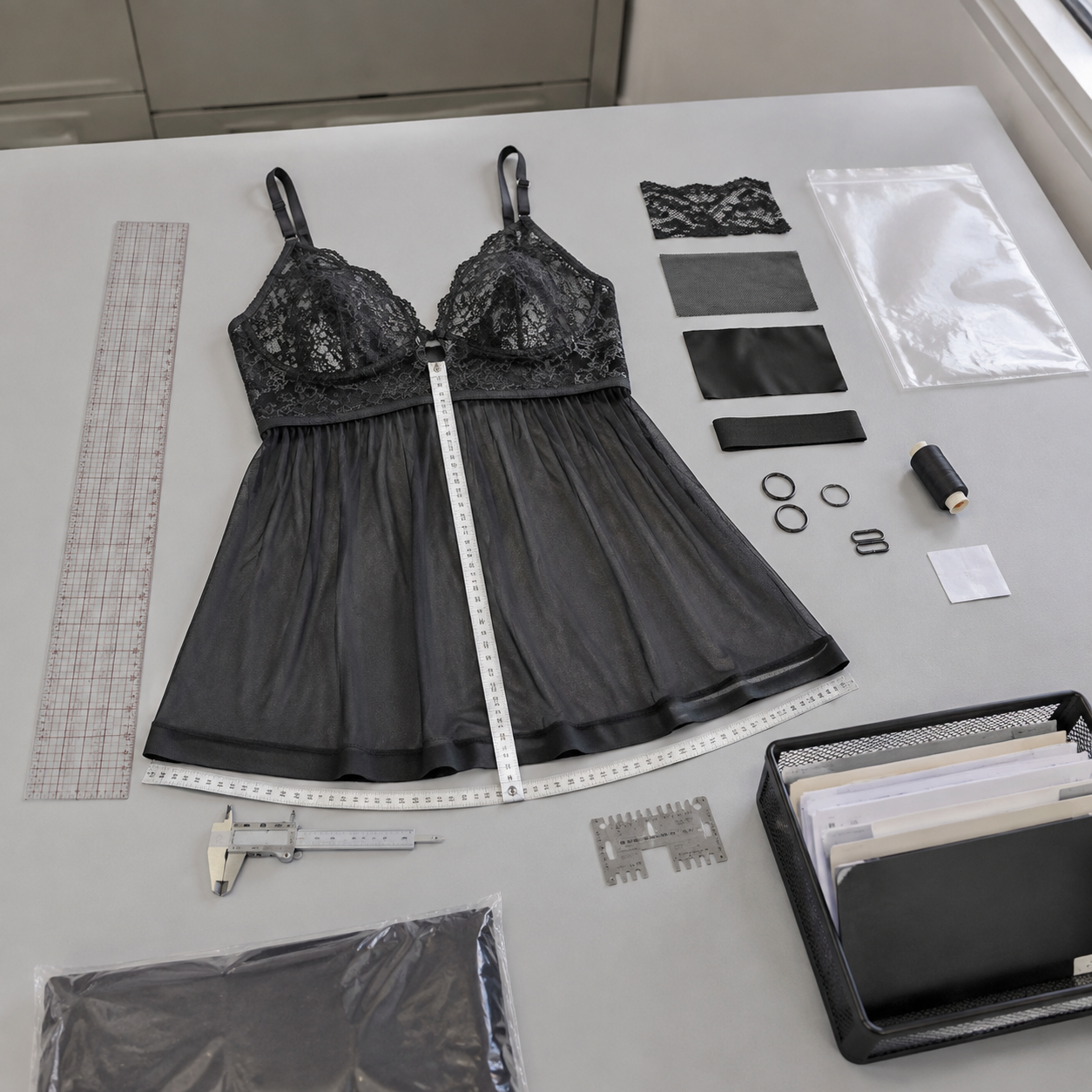
Quote the selected babydoll design rather than a generic lingerie category. Use only the component rows that match the actual style, and assign every included material, trim, label and packaging item a stable buyer reference, supplier reference and bill-of-materials revision.
| Conditional component | RFQ identity fields | Supplier evidence and traceability return |
|---|---|---|
| Lace bust panel, shell or insert | Submitted fibre declaration, construction term, usable width, mass per unit area where controlled, motif or repeat dimensions, stretch direction, recovery method, edge treatment, finish, colour reference, placement and approved swatch revision | Material specification and applicable evidence mapped to the supplier material code, colourway, manufacturing source and stated evidence scope |
| Mesh skirt or insert | Submitted fibre declaration, construction, usable width, mass per unit area where controlled, stretch and recovery method, transparency comparison method, finish, colour reference, placement and approved swatch revision | Material specification and evidence clearly identified as raw-material or finished-product evidence |
| Bust or cup lining | Material description, submitted fibre declaration, construction, colour, finish, coverage area, stretch direction, attachment method and approved reference | Evidence linked to the lining component rather than only to the outer fabric |
| Shoulder straps and elastic | Material, relaxed width, thickness where controlled, colour, adjustment range, extension method, recovery method, attachment point, stitch construction and supplier reference | Component specification, agreed test conditions and confirmation that quoted, sampled and bulk components use the same reference |
| Rings, sliders or closures | Material declaration, internal dimensions, section thickness, finish, colour, placement, orientation and supplier reference | Hardware specification and any register-required evidence mapped to the actual material and finish |
| Thread, seams and decorative trim | Material, supplier reference, colour, seam type, stitch-density method, seam placement, trim dimensions, attachment method and approved appearance reference | Component declaration, construction record and applicable evidence mapped to the actual thread or trim |
| Labels and consumer packaging | Buyer-verified content, material, finished dimensions, artwork revision, placement, attachment or packing method, and intended claim | Artwork proof, material details, claim substantiation where required and finished-sample evidence before bulk release |
For every evidence record, capture the requirement ID, style, component, supplier material reference, colourway, production site and lot or batch where relevant. Retain the complete document and record its test method, result, issue date, holder, issuer, validity information and stated limitations. Keep raw-material evidence labelled as raw-material evidence unless a verified basis supports applying it to the finished garment.
The supplied lace source supports terminology and material-selection context, not a legal or performance threshold (source). Convert the selected trade term into measurable construction and appearance fields, then require the supplier's actual specification and a controlled swatch.
Any proposed change to lace, mesh, lining, elastic, hardware, thread, labels, packaging, colour, finish, material source, manufacturing site or subcontracted process should trigger a revised bill of materials, a new applicability check and replacement or reconfirmed evidence before approval.
Build a Quote-Comparable Manufacturing Return
Issue the same controlled response schedule to every supplier. The manufacturer-selection source supports defining the product and commercial basis before contacting manufacturers and turning identified sourcing risks into practical controls (source). It does not provide measurable acceptance values, so those must come from verified requirements, the buyer's specification or clearly labelled supplier proposals.
| RFQ section | Required supplier return | Hold condition |
|---|---|---|
| Product and quote basis | Quote tied to the destination, style IDs, tech-pack revision, size range, colourways, construction, OEM scope, order assumptions and minimum-order expectations | Do not compare quotes built on different product revisions or control scopes |
| Product identity | Proposed component-level bill of materials, supplier references, colour references, manufacturing site and disclosed subcontracted processes | Hold if the quote or sample cannot be reconciled to the proposed bill of materials |
| Compliance evidence | Clause-by-clause response plus complete documents mapped to requirement, holder, site, product, component, material, colourway and validity scope | Reject badges, cropped pages, unsupported document numbers and documents for a different site or product scope |
| Labels and claims | Artwork revision, label material, dimensions, placement, attachment method, finished-sample proof and claim-specific evidence where required | Hold artwork while wording, applicability, placement or substantiation remains unresolved |
| Commercial closure | Separate quote lines for development, evidence work, tests, retests, inspections, artwork changes and replacement documents | Treat the quote as incomplete if required controls or evidence are excluded from the commercial return |
| Change control | Written process for proposed material, colour, finish, source, site, label or process substitutions | Do not approve an affected release stage until the change and replacement evidence are accepted in writing |
| Release file | Current bill of materials, approved evidence index, sample or inspection records, artwork proof, packing evidence and closed exceptions | Hold bulk production or shipment when the corresponding release file is incomplete or mismatched |
The clause-by-clause response should include:
RFQ clause, requirement ID, classification, buyer source, applicability status, style, component, colourway, lot or batch scope, supplier response, proposed evidence, issuer, holder, manufacturing site, test method, result, issue date, validity, limitation, gap, corrective action, owner, cost, lead-time effect, exception and approval status
Assign Australian applicability decisions to a buyer-appointed reviewer. The supplier can identify evidence, assumptions and gaps, but its response should not be treated as the buyer's legal determination.
Example RFQ Data Points to Verify in the Supplier Quote
Every value below is a buyer-created example calculation or assumption. None is presented as an Australian legal limit, industry benchmark, supplier capability, measured production result or company practice. Each value must be accepted or replaced in the supplier quote before it becomes contractual.
| Buyer control | Illustrative value, unit and scope | Date or as-of context | Source and verification required |
|---|---|---|---|
| Evidence-map coverage | 4 quoted style IDs x 3 quoted colourway IDs = 12 style-colour records per supplier for the named babydoll RFQ | Applies as of the buyer's dated RFQ issue for the recorded product revision | Buyer-created example calculation; supplier must verify the record count and identify any evidence legitimately shared across records in its quote |
| Garment measurement control | +/- 5 mm at each named measurement point for centre-front length and hem-sweep measurements in every quoted size of the named style revision | Applies as of the dated sample-review record for that revision | Buyer-created example assumption; supplier must accept it or propose a measurable replacement in its quote before sample approval |
| Inspection visibility | 32 finished garments per defined shipment lot for the named purchase order | Applies as of the recorded inspection date for each shipment lot | Buyer-created example assumption; supplier must verify the sample size, selection method and lot definition in its quote; the buyer must define a separate acceptance rule |
| Reference retention | 1 sealed finished garment per approved style-colour record for 6 calendar months after the final shipment date for the named purchase order | Retention begins as of the final shipment date recorded for that purchase order | Buyer-created example assumption; supplier must verify custody, storage conditions, access and disposal responsibility in its quote |
These examples make commercial differences visible. They do not replace an applicability review, agreed test method, defect classification, acceptance rule or evidence mapped to the ordered product.
Apply Manufacturing Hold Points
| Hold point | Required record | No-go condition |
|---|---|---|
| Quote approval | Classified requirements register, aligned product scope, itemised evidence costs and disclosed gaps | Scope, responsibility, exclusions or evidence costs remain unclear |
| Material approval | Proposed bill of materials, controlled swatches and evidence mapped to selected components | Material identity, source or evidence scope cannot be reconciled |
| Artwork approval | Buyer-verified content, substantiation where required, current artwork revision, material, placement and attachment details | Applicability, wording, claim support or placement remains unresolved |
| Sample approval | Sample made from intended materials, measurement report, workmanship record, labels and recorded deviations | The sample differs from the controlled bill of materials or a deviation lacks written approval |
| Bulk release | Frozen bill of materials, approved evidence index and closed change requests | A material, colour, finish, supplier, site, label or process change remains unapproved |
| Shipment release | Final production references, required evidence, inspection result, packing proof and exception closure | The release file is incomplete, out of date or mismatched to production scope |
An inspection sample size does not establish acceptance on its own. Define the shipment lot, selection method, defect categories, acceptance and rejection rules, exception authority, reinspection process and release records in the RFQ.
Australia Babydoll Lingerie OEM Compliance Requirements Checklist
Buyer Issue Pack
- [ ] State Australia as the destination and identify the intended use and sales channel.
- [ ] Name the buyer-side owner of the Australian applicability review.
- [ ] Record the dated RFQ issue, style identifiers and tech-pack revision.
- [ ] Issue construction details, size range, measurement points, grading rules and buyer-defined tolerances.
- [ ] Include every selected material, trim, hardware item, label and packaging item in the controlled bill of materials.
- [ ] Attach the classified requirements register with source, status, applicability, date context, evidence type and approval owner.
- [ ] Cite a standard only after checking its exact identifier, edition, scope, clause, method and current applicability.
- [ ] Keep sales-channel rules and buyer controls separate from verified legal obligations.
- [ ] Define sample stages, workmanship criteria, measurement methods, defect categories and release rules.
- [ ] Require itemised costs for samples, evidence, tests, retests, inspections, artwork changes and unresolved gaps.
- [ ] State which material, supplier, colour, site, finish, label and process changes require written approval.
- [ ] Define the contents and buyer-side owner of the shipment-release file.
Supplier Return Pack
- [ ] Acknowledge every RFQ clause and disclose assumptions, exclusions, exceptions and unresolved items.
- [ ] Identify the quoting entity, manufacturing site and subcontracted processes.
- [ ] Return a proposed bill of materials tied to the quoted style and revision.
- [ ] Map complete evidence to its requirement, holder, issuer, site, product, material, colourway, lot or batch scope and validity.
- [ ] Distinguish raw-material evidence from finished-garment evidence.
- [ ] Return label and packaging artwork, material, dimensions, placement and attachment details.
- [ ] State evidence gaps, proposed closure actions, owners, costs and timing effects.
- [ ] Confirm the change-control process before bulk production.
- [ ] Confirm the records supplied at material, artwork, sample, bulk and shipment hold points.
Evidence Method, Limitations and Author Basis
Methodology: Each supplied source was reviewed according to the type of claim it could support. The manufacturer-selection source was used for pre-quote product-definition fields and sourcing-risk context. The underwear-sourcing source was used only for target-market screening advice and its unverified reference to Australian fibre-labelling considerations. The lace-sourcing source was used for construction terminology and material-selection context. Those points were translated into buyer-owned RFQ fields, evidence records and release controls. The illustrative values are buyer-created examples to verify in a supplier quote, not source-derived results.
Limitations and what to verify: The cited sourcing pages are commercial materials. The supplied evidence does not include Australian regulator guidance, current legislation, published standard text, legal advice, accredited laboratory reports, current supplier certificates or SKU-specific production records. It also does not establish Australia-specific freight or climate controls, so none are prescribed here. Before approving an order, verify the product classification, current Australian obligations, applicable sales-channel requirements, exact standard identifiers and editions, test methods, laboratory scope, label content, product and packaging claims, and every document's holder, issuer, site, product, material, colourway and validity. Record the verification source and date in the requirements register.
Author basis: The approved author profile identifies Vincent Xi as Editorial Author. It does not provide a basis for first-hand manufacturing, factory-visit, testing, certification-audit or customer-outcome claims, so none are made.
Discuss Your Requirements
Review our manufacturing capabilities, then share your specifications for a supplier-fit review.